
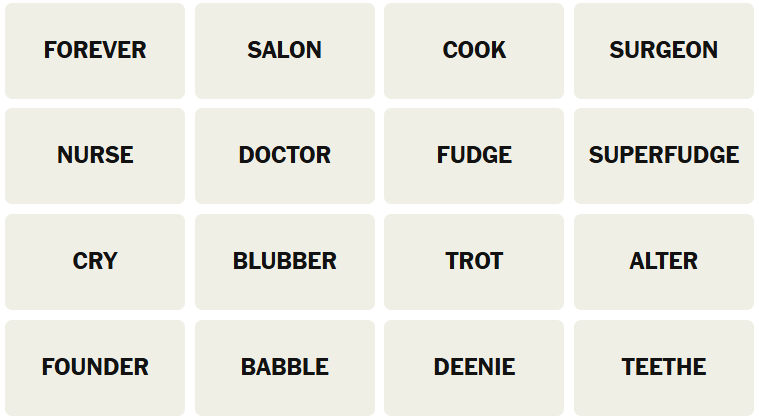
NYT Connections puzzle #1073 for May 19, 2026, looked straightforward at first, but several words were designed to push players into misleading pairings before the real categories became visible. The board mixed literal meanings, book titles, and word transformations in a way that punished quick assumptions.
The hardest part for many solvers was separating the deceptive-action verbs from the Judy Blume titles while also noticing that the purple category did not contain actual fish names. Words like “cook,” “Forever,” and “founder” created especially strong false paths because they naturally fit multiple interpretations.
NYT Connections May 19 Hints
Yellow hint: Think about actions connected to infants and early childhood.
Sharper clue: These are all things babies commonly do while growing.
Trap to avoid: Avoid building a sound-based category around “cry” and “babble.” The connection is broader than communication.
Green hint: This category is about changing something dishonestly.
Sharper clue: Think about manipulated numbers, altered information, or tampered records.
Trap to avoid: “Cook” can easily pull players toward food-related thinking, but the meaning here is deceptive rather than culinary.
Blue hint: One famous author connects all four words.
Sharper clue: These are titles tied to coming-of-age fiction and middle-grade classics.
Trap to avoid: “Forever” looks too generic to be a title, while “Superfudge” may incorrectly feel connected to “fudge” from the green group.
Purple hint: The sea theme is hidden behind altered spellings.
Sharper clue: Add one missing letter to each answer to uncover a fish.
Trap to avoid: Do not look for direct fish names on the board. The category depends entirely on letter restoration.
Main misleading paths from today’s board: Many players likely paired “fudge” and “Superfudge” early because the wording is visually obvious, but the meanings belong to entirely different categories. “Founder” can also look like a business-related word alongside “doctor” or “alter,” while “Forever” appears too ordinary to immediately register as a Judy Blume title. The purple category became much easier only after realizing every word was one letter short of a fish.
Today’s NYT Connections Answers
Today’s Connections puzzle rewarded patience more than speed. Several words had perfectly believable surface meanings, but the board only became manageable once players stopped grouping by appearance and started testing hidden relationships like titles, alternate meanings, and missing-letter transformations.
For official gameplay and post-game analysis, players can visit the New York Times Connections page.

Make Swikblog your go-to source on Google for reliable updates, smart insights, and daily trends.