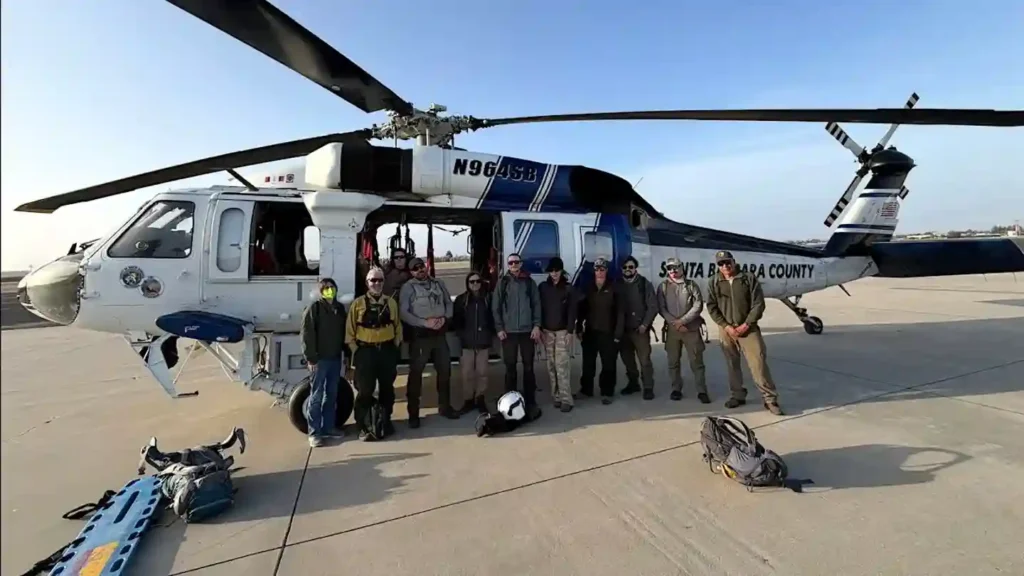

A wildfire burning across Santa Rosa Island has turned a remote stretch of Channel Islands National Park into an active emergency zone, forcing 11 National Park Service employees to be flown out by helicopter as flames moved close enough to threaten access to staff housing.
The rescue took place Sunday after fire officials determined that employee housing on the island could be cut off by the advancing vegetation fire. Santa Barbara County Fire Department’s Helicopter 964 carried out the evacuation and transported all 11 workers to Oxnard Airport. No injuries were reported.
The fire had grown to more than 10,000 acres by Sunday afternoon and remained 0% contained, according to fire officials cited in incident updates. The blaze was reported on the south side of Santa Rosa Island, between Ford Point and South Point, an area where dry vegetation and strong winds helped flames spread quickly across the remote landscape.
Santa Rosa Island sits about 26 miles off the Santa Barbara coast and is the second-largest of the Channel Islands. That distance from the mainland makes any emergency response more complicated. Fire crews cannot rely on the same road access, staging areas or water supply systems available during mainland wildfires. Personnel and equipment must be moved by aircraft or boat, slowing operations and increasing the challenge for crews on the ground.
The National Park Service has described the fire as human-caused, though the exact circumstances remain under investigation. Officials have not released a final determination on how it began. For now, investigators are treating the cause as an active matter while firefighters focus on containment and protection of park resources.
At least two structures have been destroyed, and the island has been closed to visitors while firefighting work continues. Park officials are expected to keep public access restricted until crews can assess fire behavior, damaged areas, visitor safety and the condition of island facilities.
The emergency is not only about burned acreage. Santa Rosa Island is home to rare plants and wildlife that make the fire especially concerning for conservation teams. Officials warned that six plant species found only on the island are threatened by the blaze. The island also provides habitat for island foxes, spotted skunks, elephant seals and other species tied to the Channel Islands’ fragile ecosystem.
Wildfires on isolated islands can leave long-lasting damage because plants and animals often have limited space to recover or relocate. A large burn scar can increase erosion, damage nesting and feeding areas, and change the balance of native vegetation. Even after flames are contained, the ecological recovery may take months or years to measure.
Smoke from the Santa Rosa Island Fire also drifted toward parts of Southern California’s coastline. The National Weather Service in San Diego warned that near-surface smoke could affect the region through at least Tuesday if the fire continued burning. Residents who notice smoke or haze should monitor local air quality through AirNow.gov, especially people with asthma, heart conditions or other respiratory risks.
Read More
For official incident information, readers can check updates from Channel Islands National Park and state fire agencies as conditions change. Fire behavior can shift quickly on island terrain, particularly when winds strengthen or visibility limits air operations.
The Santa Rosa Island Fire adds to broader concern over fast-moving California wildfires fueled by dry vegetation and wind. Swikblog recently reported on another Southern California fire emergency in its coverage of the Moreno Valley brush fire, where weather conditions also played a major role in firefighting challenges.
While the successful helicopter evacuation prevented injuries among park staff, the wider impact of the fire is still unfolding. Fire crews remain focused on stopping the spread, protecting remaining structures and limiting damage to one of California’s most unique national park landscapes.

Make Swikblog your go-to source on Google for reliable updates, smart insights, and daily trends.