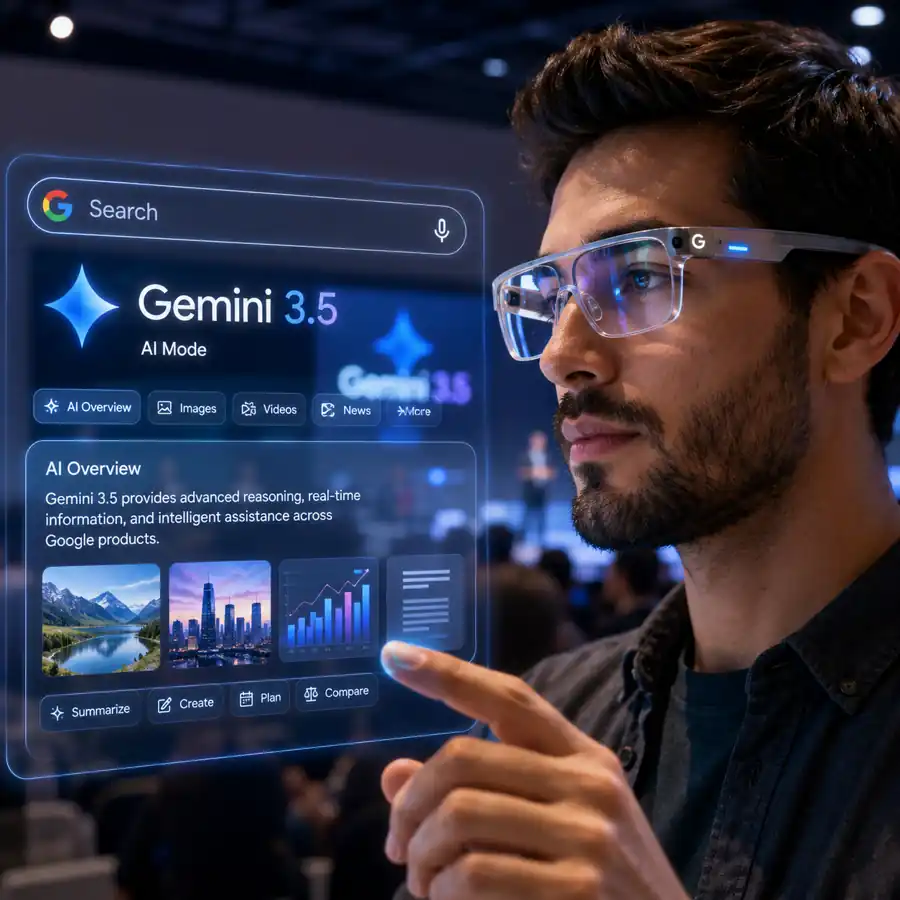

Google Search is heading into one of the biggest transformations in its nearly 30-year history, and the company’s Gemini 3.5 launch makes clear that AI is now at the center of Google’s future. At the Google I/O 2026 developer conference in Mountain View, California, executives unveiled a major overhaul of Search, new autonomous AI agents, upgraded coding tools and a fresh push into smart glasses.
The biggest change is how Google wants people to interact with Search. Instead of short keyword-based queries and long lists of blue links, Search is becoming more conversational, visual and action-focused. Users can now ask longer questions in natural language, upload photos or documents, and receive AI-generated summaries that can also create spreadsheets, organize travel plans, generate calendar invites or complete tasks across Google products.
Gemini 3.5 powers Google’s AI-first Search experience
The new features are powered by Gemini 3.5 Flash, Google’s latest AI model focused on coding, reasoning and multi-step workflows. According to Google DeepMind, the model is designed to handle long-horizon tasks, complex automation and agent-based workflows faster than previous Gemini versions.
Google says Gemini 3.5 Flash is now the default model inside the Gemini app and AI Mode in Search globally. During the event, executives described the update as the next stage of Search, where AI no longer simply answers questions but actively helps users complete tasks.
The company also revealed that AI Mode usage has doubled every quarter over the past year, while Google Search queries recently reached an all-time high. Users can still switch back to traditional web links through a separate “Web” tab, but Google is clearly encouraging more interaction with AI-generated results.
One of the most notable announcements was Gemini Spark, a new AI agent that can help users shop, research topics, organize appointments, manage recurring tasks and plan trips. With permission, Spark can connect to Gmail, Google Calendar, Maps and other Google services to personalize results and automate actions.
Google also introduced “information agents” for premium subscribers. These autonomous agents can perform deeper online research, summarize findings and suggest plans of action. Another feature called generative user interface can create custom dashboards, visuals and interactive layouts based on user requests.
Read More
Google returns to smart glasses after Google Glass failure
Alongside its AI Search expansion, Google confirmed it is returning to the smart glasses market more than a decade after shutting down Google Glass. The company is partnering with Samsung, Warby Parker and Gentle Monster to develop new AI-powered eyewear equipped with cameras, speakers and Gemini voice controls.
The glasses will allow users to take photos, record videos and interact with Gemini through voice commands. Google is also reportedly developing another version with an in-lens display under a project internally known as Project Aura. The move places Google back into direct competition with Meta’s Ray-Ban smart glasses business.
The broader AI race is moving quickly as companies compete to dominate search, chatbots and automation tools. Swikblog recently reported on another major development in the AI industry here: OpenAI Launches ChatGPT Shopping Search Feature.
For users, the changes could make Search more useful and efficient. For publishers and website owners, however, the shift may create fresh challenges as Google increasingly answers questions directly inside its own platform instead of sending traffic to external websites. Either way, Google I/O 2026 made one thing clear: the company now sees AI agents, not traditional search links, as the future of the internet experience.

Make Swikblog your go-to source on Google for reliable updates, smart insights, and daily trends.