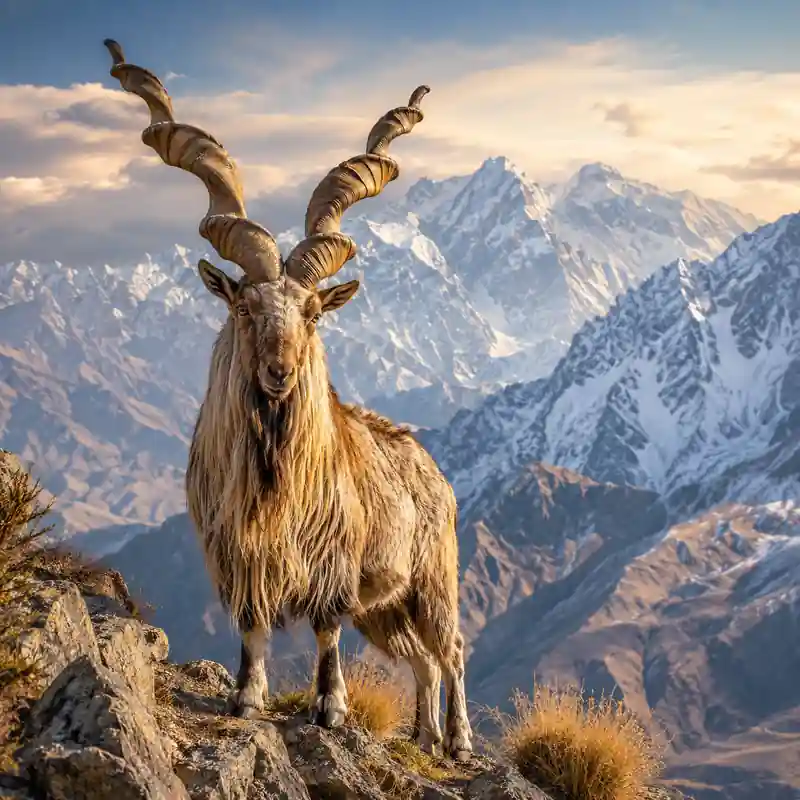

International Day of the Markhor 2026 will be observed worldwide on Sunday, May 24, as the United Nations continues its push to protect endangered wildlife and fragile mountain ecosystems. The annual observance shines a spotlight on the markhor, a rare wild goat species native to the mountainous regions of Central and South Asia and widely recognised for its striking corkscrew-shaped horns.
The markhor, scientifically called Capra falconeri, lives across Afghanistan, India, Pakistan, Tajikistan, Turkmenistan and Uzbekistan. It is also the national animal of Pakistan. Male markhors can weigh more than 100 kilograms and grow spiral horns measuring nearly five feet long, making them one of the most visually distinctive wild goat species in the world.
The United Nations General Assembly officially proclaimed May 24 as the International Day of the Markhor in May 2024 through resolution A/RES/78/278. Pakistan and eight other countries sponsored the resolution, and the first official observance was held the same year.
Why the markhor remains under threat
Despite improvements in conservation efforts, the markhor still faces serious threats. According to the United Nations, habitat destruction, illegal hunting, poaching and climate change continue to threaten the species across its natural range.
The markhor is currently listed as “near threatened” on the International Union for Conservation of Nature (IUCN) Red List of Threatened Species. It has also been protected under Appendix I of the Convention on International Trade in Endangered Species of Wild Fauna and Flora (CITES) since 1992, restricting international commercial trade of the species.
Wildlife experts estimate that only around 5,700 mature markhors remain globally. While that number represents progress compared to earlier decades, conservationists warn that climate change and ecosystem imbalance are creating new risks. In parts of northern Pakistan, changing weather conditions and the disappearance of predators such as snow leopards have reportedly disrupted the natural ecological balance.
Read More
Conservation efforts are showing results
One of the biggest success stories has come from Pakistan’s Chitral Gol National Park, where markhor numbers recovered from only a few hundred animals to nearly 3,000 in recent years. Community-based conservation programmes, anti-poaching patrols and sustainable tourism initiatives have played an important role in stabilising local populations.
The International Day of the Markhor 2026 will focus on fostering conservation, protecting biodiversity and encouraging international cooperation to safeguard endangered wildlife. The observance also highlights how protecting wildlife can support local economies through eco-tourism and sustainable development.
Readers interested in other major global observances can also explore Swikblog’s guide to important international days in May 2026.
The growing global attention around the markhor reflects a wider message from conservation groups and the United Nations: protecting endangered species is no longer only about wildlife. It is also about preserving ecosystems, supporting communities and maintaining biodiversity for future generations.

Make Swikblog your go-to source on Google for reliable updates, smart insights, and daily trends.