
Scientists have produced the largest magnetic map of the universe ever created, offering an unprecedented look at one of the least understood forces in cosmic evolution. The breakthrough comes from an international collaboration led by Australia’s national science agency, CSIRO, and the Square Kilometre Array Observatory (SKAO), using observations from nearly four million galaxies.
Known as SPICE-RACS, the new map is approximately five times larger than all previous magnetic surveys combined. Rather than showing stars, planets or galaxies in visible light, it traces invisible magnetic fields spread across vast regions of space, providing researchers with a powerful new tool to investigate how the universe evolved over billions of years.
A new view of the hidden universe
Magnetic fields are found throughout the cosmos. They influence the formation of stars, affect the movement of charged particles and may play an important role in shaping galaxies. Despite their importance, astronomers still have major questions about where these fields came from and when they first appeared.
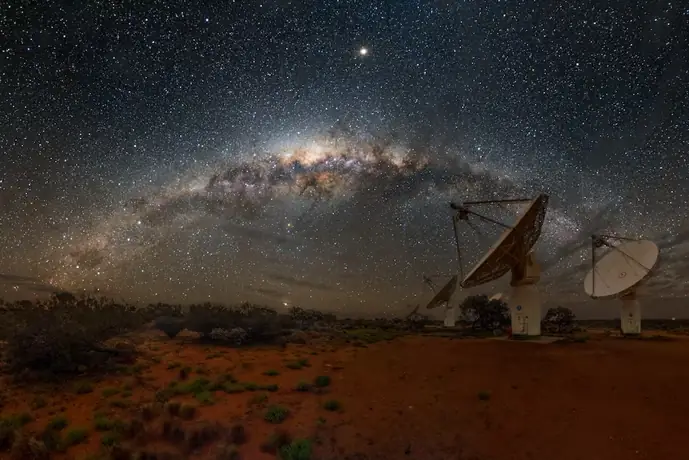
The SPICE-RACS project was designed to address those questions. Researchers used the Australian Square Kilometre Array Pathfinder (ASKAP), a radio telescope located at Inyarrimanha Ilgari Bundara, the CSIRO Murchison Radio-astronomy Observatory on Wajarri Yamaji Country in Western Australia.
Unlike optical observatories that collect visible light, ASKAP detects radio waves emitted by distant objects across the universe. As those radio waves travel through magnetic fields, their polarization changes slightly. By measuring these changes, astronomers can identify magnetic fields and estimate their strength across enormous cosmic distances.
After collecting measurements from nearly four million galaxies, scientists reprocessed the data to build what is now the most extensive magnetic map ever assembled. More information about the telescope behind the discovery is available through CSIRO’s official ASKAP overview.
Why researchers are excited about SPICE-RACS
The significance of the project extends far beyond setting a record. For years, astronomers have been working with a much smaller magnetic-field dataset that offered limited coverage of the southern sky. SPICE-RACS dramatically expands that view, allowing scientists to study cosmic magnetism on a scale that was previously impossible.
One of the biggest opportunities involves studying the cosmic web, the enormous network of galaxies, gas and dark matter that forms the large-scale structure of the universe. Researchers believe magnetic fields are woven throughout this network, but direct observations have been difficult. The new map could help reveal how these hidden forces connect some of the largest structures in existence.
The dataset has already been made available through CSIRO’s data access systems, enabling research teams around the world to conduct independent studies and explore new questions about galaxy formation, cosmic evolution and intergalactic space.
As astronomers continue pushing the boundaries of observation, major sky events such as the March 2026 Blood Moon total lunar eclipse help maintain public interest in the discoveries that are reshaping our understanding of the universe.
Read More
The work also serves as a foundation for the next generation of radio astronomy. The Square Kilometre Array Observatory is currently building SKA-Low in Western Australia and another SKA telescope in South Africa. These powerful instruments are expected to begin early scientific operations later this decade and could provide even more detailed views of magnetic fields across the cosmos.
While many questions remain unanswered, SPICE-RACS represents a major advance in humanity’s effort to understand the invisible forces that have influenced the universe since its earliest history. With the largest magnetic map ever produced now available to researchers, astronomers are closer than ever to uncovering how cosmic magnetism helped shape the universe we see today.

Make Swikblog your go-to source on Google for reliable updates, smart insights, and daily trends.