
FIFA is changing one of the most familiar sights before a World Cup match, replacing the traditional pre-kick-off line-up with a broader ceremony designed to put the entire matchday squad into the spotlight.
Under the new format for the FIFA World Cup 2026, players will no longer be presented only through the usual two parallel lines of starting XIs before kick-off. Instead, every player selected in the matchday squad, including substitutes, will gather around the centre circle for the line-up presentation and national anthems.
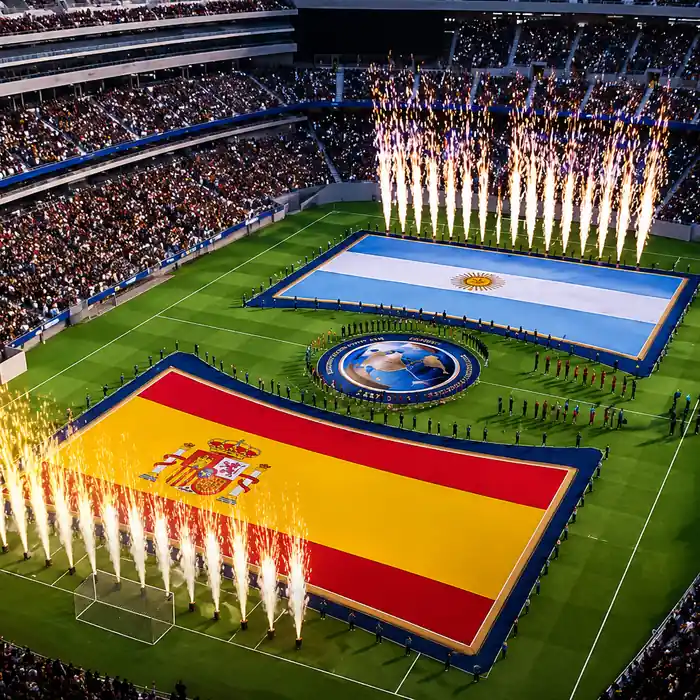
The change is part of a new fan-focused pre-match ceremony that FIFA says will debut at the 2026 tournament in Canada, Mexico and the United States. The format is designed to make the minutes before kick-off feel more immersive inside the stadium, with giant flag banners, player entry arches, handheld country flags and a more dramatic centre-circle presentation.
FIFA outlined the new format in an official media release, describing it as a 360-degree ceremony created to give supporters in every part of the stadium a more complete view of the build-up.
Full squads will stand together for the anthems
The most visible change is the involvement of substitutes. In previous World Cup matches, the starting players typically lined up for the national anthems while substitutes remained away from the main presentation. FIFA’s new approach gives every player named in the matchday squad a role in the ceremony, even if they are not starting the match.
Players will enter the pitch through a dedicated arch near their tunnel and move toward the centre circle. There, both teams will gather around a central banner as the line-ups are presented and the national anthems are played.
FIFA President Gianni Infantino said the change is meant to create a stronger moment of unity, pride and emotion, with all players and referees facing one another in the centre circle during the anthems.
That means the ceremony is not a change to the Laws of the Game. It does not alter kick-off rules, substitutions, VAR, playing time or team tactics. It is a change to the match presentation and pre-match protocol, aimed at making the World Cup atmosphere feel bigger and more inclusive for players and fans.
The visual side of the ceremony will also be more theatrical than the traditional walkout. FIFA says extra-large national flag banners will be displayed across the pitch, while handheld country flags and FIFA branding will form part of the stadium presentation. Later in the tournament, selected matches may also include coloured smoke or pyrotechnic elements.
After the anthems, the ceremony will return to the familiar match routine. Players will proceed with handshakes, starting XI team photos and the captains’ coin toss before kick-off.
World Cup 2026 adds spectacle to its expanded format
The timing of the change is significant because the 2026 World Cup will already be the largest edition of the tournament. The competition will feature 48 teams for the first time, with 104 matches played across Canada, Mexico and the United States.
The tournament is scheduled to begin on Thursday, 11 June 2026, when Mexico face South Africa at Mexico City Stadium. The final is set for Sunday, 19 July 2026, in New York New Jersey.
For FIFA, the new ceremony fits into the wider scale of the expanded tournament. More countries, more players and more matches mean the World Cup will involve a larger global audience than any previous edition. By bringing substitutes into the anthem moment, FIFA is also widening the symbolic spotlight beyond the starting XI.
For players, the change could matter emotionally. A substitute goalkeeper, a young squad player or a veteran who starts on the bench will still stand with the team during one of the most powerful moments of a World Cup match. That can be especially meaningful in a tournament where some players may not get many minutes on the pitch but still represent their country on football’s biggest stage.
For supporters in the stadium, the ceremony is being built as a fuller visual experience. Giant flags across each half of the field, teams gathered around the centre circle and a more deliberate stadium presentation are all intended to make the opening minutes feel closer to a major global event than a standard matchday routine.
The change may also create a more television-friendly opening sequence. With every member of the matchday squad visible, national flags spread across the pitch and the teams positioned centrally, broadcasters will have a clearer visual moment before each fixture begins.
The traditional pre-match line-up has long been part of international football’s visual identity, so the change will be noticeable from the first match. Some fans may prefer the simplicity of the old format, while others may welcome a more emotional and cinematic build-up for a tournament of this scale.
What is clear is that FIFA wants World Cup 2026 to feel different from the opening whistle. The football itself will still begin the same way, but the moments before kick-off are being reshaped around full squads, national identity and a bigger stadium spectacle.

Make Swikblog your go-to source on Google for reliable updates, smart insights, and daily trends.