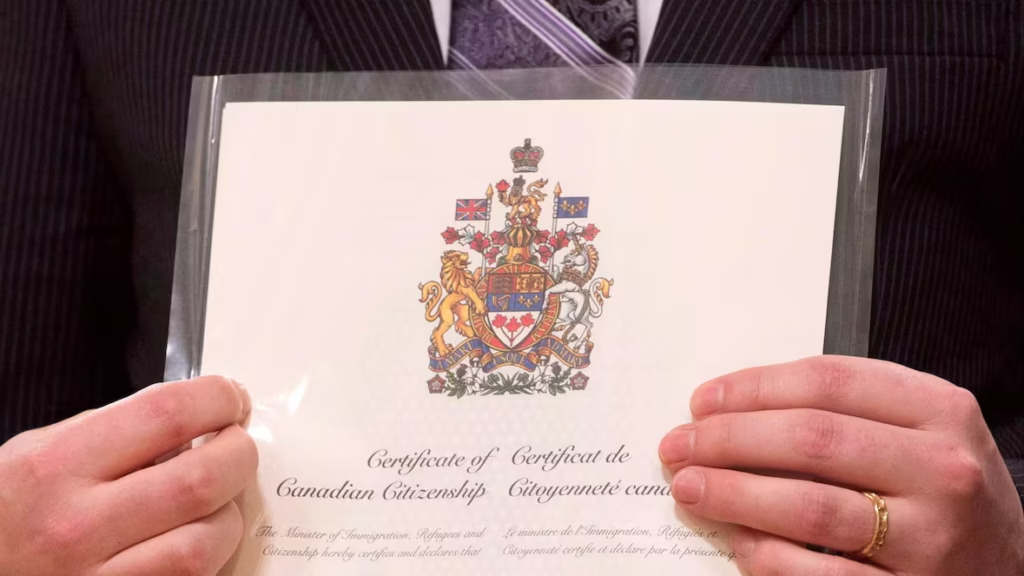

Canada’s expanded citizenship-by-descent program is facing a new controversy after some people who had already received Canadian citizenship certificates were told to send them back while the federal government rechecks their files.
The notices were sent by Immigration, Refugees and Citizenship Canada, or IRCC, to people approved under the “Lost Canadians” law. The reform was designed to restore citizenship access for descendants of Canadians who were excluded under older rules. But for some newly recognized citizens, approval has now been replaced by uncertainty.
The letter, signed by citizenship registrar Peggy Sun, says officials have information suggesting some certificate holders may not be entitled to keep a Canadian citizenship certificate. Recipients were asked to surrender their certificates while IRCC reviews the evidence behind their claims.
The move does not automatically mean citizenship has been revoked. However, it places affected people in a difficult position: their proof of citizenship has been suspended even though the government had already approved their applications.
Why Canada Is Reviewing Some Citizenship Certificates
The review appears to focus on whether applicants submitted documents from original source authorities. In citizenship-by-descent cases, IRCC generally expects official records that prove each family link between the applicant and the Canadian ancestor.
Those records can include birth certificates, marriage certificates, death records, name-change documents, civil registry records, vital statistics records or official archival records. The key issue is whether the document comes from the authority that created or preserves the original record.
Some affected applicants may have used genealogy website records, family history printouts, uncertified copies or documents that did not clearly come from an original authority. Where original records were unavailable, IRCC says applicants should have provided a written explanation and evidence showing what steps were taken to obtain them.
That distinction is important for readers trying to understand the dispute. A person may have Canadian ancestry and may even qualify under the law, but the government can still question whether the proof submitted is strong enough to support a citizenship certificate.
Thousands Were Approved After The Law Changed
The latest review follows the implementation of Bill C-3, which expanded citizenship access for people known as “Lost Canadians.” Before the change, Canada’s first-generation limit generally restricted citizenship by descent for people born outside the country.
That rule had left some families unable to claim citizenship even when they had clear Canadian roots. After legal challenges, Ottawa moved to expand eligibility and allow more descendants abroad to seek proof of citizenship.
Since the change took effect on December 15, about 4,075 people from around the world are estimated to have received proof-of-citizenship certificates under the expanded framework. Roughly half of those recipients were born in the United States. The growing demand mirrors the surge in Canadian citizenship by descent applications seen after Ottawa expanded eligibility rules.
Families Are Now Facing Real-Life Disruption
For affected certificate holders, the issue is not only legal. It is practical and personal.
A Canadian citizenship certificate can be used to apply for a passport, obtain a Social Insurance Number, prepare for employment, enrol in school, access services or plan a move to Canada. When that certificate is suddenly suspended, those plans can become uncertain overnight.
One reported case involved Valerie Campbell of Bucksport, Maine, who received her certificate after tracing family roots to Quebec and Ontario. After receiving approval, she began preparing to sell her home and move to New Brunswick or Nova Scotia. The suspension notice forced her to pause those plans and begin gathering more evidence.
Others may be in similar situations. Some may have already applied for Canadian passports. Some may have started relocation plans. Others may be inside Canada and relying on proof of citizenship for work, study or government services.
Why Lawyers Say The Move Is Unusual
Immigration lawyers say IRCC can review citizenship certificate files when officials believe there may be a problem. But several lawyers have described the current situation as unusual because the certificates were already issued.
Normally, document concerns are raised during the application process before approval. Here, the government appears to be reopening some cases after applicants received a positive decision and were given official proof.
That timing could become important if the issue reaches court. Affected people may argue they relied on the certificate in good faith and made financial or personal decisions based on a government-issued document.
Lawyers have also pointed out that mass certificate suspensions are not commonly seen in citizenship proof cases. Similar large-scale reviews are more familiar in immigration files involving permanent residence or suspected document problems, but issued citizenship certificates carry a different level of significance.
Backlogs Add Pressure To The Review
The situation comes as IRCC faces growing pressure on citizenship certificate processing. Wait times have reportedly increased sharply since the expanded law came into effect, rising from about five months in May 2025 to around 15 months in 2026.
The number of pending citizenship certificate applications has also grown, with about 82,000 people waiting for decisions. That backlog could make reviews more stressful for those whose certificates have now been suspended, because there is no clear public timeline for when their cases will be resolved.
For new applicants, the message is direct: documentation standards matter. Anyone applying for proof of Canadian citizenship by descent should try to obtain certified records directly from official issuing authorities and avoid relying only on genealogy databases or informal family records.
Official guidance on proof of Canadian citizenship is available through Immigration, Refugees and Citizenship Canada.
What Affected Applicants Should Know
The suspension letters do not necessarily mean recipients are not Canadian. They mean IRCC wants more confidence that the original application proved citizenship entitlement with acceptable evidence.
Applicants who receive a notice should review the exact reason given, keep copies of every document, request certified records from source authorities where possible and prepare explanations for any missing records. If a birth, marriage or death record cannot be found, a formal “no record” letter from the responsible authority may help support the file.
Read More
The review could end with certificates being returned if eligibility is confirmed. It could also lead to longer questioning or cancellation of proof if IRCC concludes the evidence does not establish the claim.
The broader issue is now bigger than paperwork. Canada expanded citizenship rights to fix an old legal problem, but the latest suspensions show how difficult it can be to verify family history across generations. For thousands of “Lost Canadians” and their descendants, the promise of restored citizenship now depends on whether their documents can withstand a second look.

Make Swikblog your go-to source on Google for reliable updates, smart insights, and daily trends.