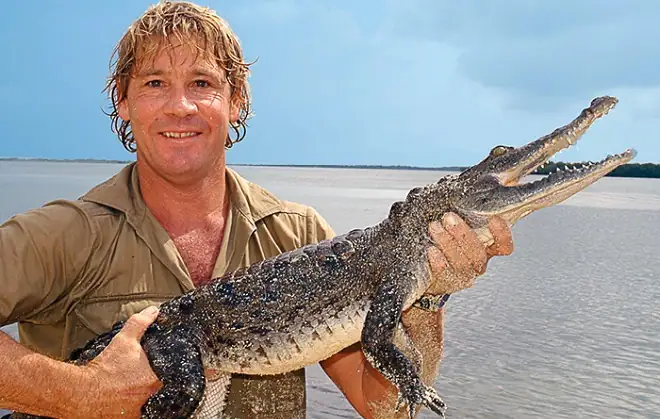

Twenty years after Steve Irwin’s death, his family and fans are remembering the Australian wildlife icon while the mission he built continues through Terri, Bindi and Robert Irwin.
Steve, known worldwide as the “Crocodile Hunter,” died on September 4, 2006, after a stingray barb pierced his heart while he was filming at Batt Reef off Port Douglas in Far North Queensland. He was 44. On September 4, 2026, the anniversary has renewed attention on both the tragedy and the conservation work that continued after him.
Bindi and Robert Irwin Remember Their Father
Bindi Irwin marked the anniversary with an emotional tribute reflecting on her father’s influence on her family and wildlife conservation. She was only eight when Steve died and later spoke at his September 20, 2006 memorial at Australia Zoo’s Crocoseum.
That commitment has continued into another generation. Bindi’s daughter Grace Warrior knows Steve through family stories and documentaries, while the wider family still supports the conservation message highlighted through Steve Irwin Day and his Wildlife Warrior legacy.
Robert Irwin, who was two when his father died, also shared a childhood photograph in remembrance. Now 22, he has built a public career around wildlife, photography and television, including his Dancing With the Stars Season 34 victory, while continuing to work with animals at Australia Zoo.
What Happened to Steve Irwin?
At about 11am on September 4, 2006, Steve was snorkelling in shallow water at Batt Reef while filming when a stingray struck him. The animal’s tail barb pierced his heart, and despite efforts by the crew to save him, the injury was fatal.
An estimated 300 million viewers later watched his memorial service from Australia Zoo. According to ABC News, friends and former colleagues still describe him as a deeply committed wildlife advocate whose television fame never replaced his fieldwork.
Steve Irwin’s Work Went Beyond Television
Steve’s larger-than-life television personality sometimes overshadowed his involvement in serious wildlife research. He worked with crocodile researchers in northern Queensland and helped support projects examining how estuarine crocodiles move through their habitat.
That work included early satellite-tracking studies designed to understand crocodile movement and relocation behaviour. He also helped establish Wildlife Warriors in 2002, turning public enthusiasm for animals into practical conservation support.
Australia Zoo Still Carries the Mission Forward
Australia Zoo now attracts about 700,000 visitors a year, while Terri, Bindi and Robert remain closely involved in its wildlife programs. The Steve Irwin Wildlife Reserve protects roughly 180,000 hectares of habitat across Queensland.
The family also continues annual fieldwork in Far North Queensland studying saltwater crocodiles. That ongoing research is one of the clearest links between Steve’s original conservation work and the efforts being carried forward today.
Why Steve Irwin Still Matters 20 Years Later
Steve’s influence was never limited to memorable television moments. He helped make crocodiles, snakes and other feared species understandable to a global audience and encouraged people to see wildlife protection as something personal rather than distant.
Two decades after his death, that impact is still visible in the work of his family, the Australia Zoo conservation programs and the researchers and wildlife advocates inspired by his approach. For fans remembering him in 2026, that continuing work gives the anniversary meaning beyond nostalgia.

Make Swikblog your go-to source on Google for reliable updates, smart insights, and daily trends.