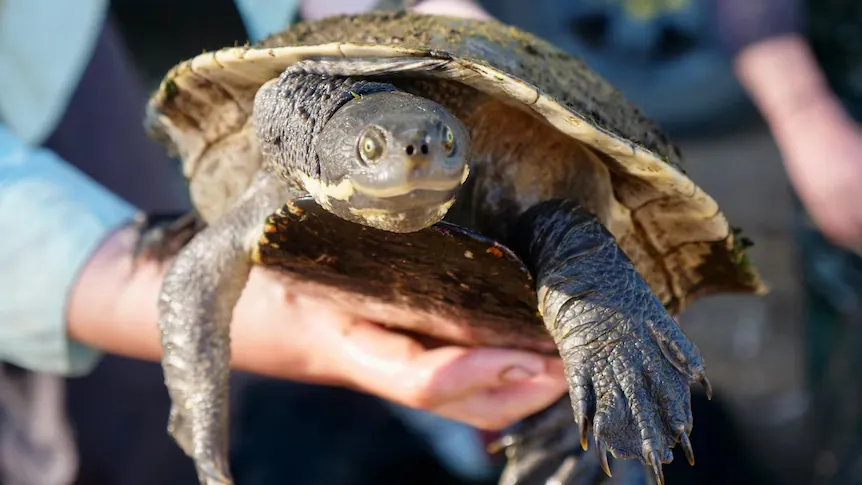

The discovery at Imperial Lakes Nature Park in far west New South Wales has turned a local conservation emergency into an unexpected wildlife success story. Earlier this year, the park’s eastern lake was under severe pressure after hot, dry weather pushed water levels dangerously low. Wildlife carers and Landcare volunteers feared the lake could fail, threatening fish, birds and freshwater turtles that depended on it.
Instead, a combination of emergency community action and heavy late-summer rain has helped transform the site. Researchers from La Trobe University have now recorded more than 500 freshwater turtles across the park’s two artificial lakes, a result that surprised even those who travelled to Broken Hill specifically to study turtle populations.
The team, made up of university researchers and students, visited the nature park in April after being invited by Landcare Broken Hill. Their work forms part of a broader study into freshwater turtles in the Murray-Darling Basin and nearby inland systems, where scientists are trying to understand how turtles survive, move and breed in regions where water can be unpredictable.
For one week, the researchers set traps in the lakes during the evening and checked them in the early morning from kayaks. Each turtle was identified, measured, weighed and released back into the water. By the end of the survey, the number had climbed far beyond early expectations.
The species recorded included eastern long-necked turtles, broad-shelled turtles and eastern short-necked turtles, also known as Murray River turtles. The strong presence of short-necked turtles was especially intriguing because this species is not usually known for travelling effectively across dry land.
That detail has raised a bigger question for scientists: how did so many short-necked turtles end up in an isolated outback lake system near Broken Hill?
Researchers believe several explanations are possible. Some turtles may have reached the area during major flood events. Others may have been moved by people in the past. Another possibility is that turtle populations have existed in the wider region for far longer than previously understood, surviving through natural wet and dry cycles over generations.
The finding matters because freshwater turtles are under pressure in many parts of Australia. Changes to river flows, drought, habitat disturbance, fox predation and declining wetland health have all affected turtle populations. The Australian Government’s environment department lists native species and ecosystems facing growing threats through its threatened species information, highlighting the importance of long-term habitat protection and monitoring.
Imperial Lakes Nature Park may now become an important field site for understanding how artificial water bodies support wildlife in dry inland landscapes. While artificial lakes are not a replacement for healthy rivers and wetlands, they can sometimes provide refuge when natural systems are under stress.
This is particularly relevant in far west NSW, where extended dry periods can quickly put pressure on wildlife. In January, Landcare Broken Hill issued an urgent call for help as the eastern lake approached a critical point. The lake had survived major droughts in the past, including the federation and millennium droughts, but the latest dry spell pushed it close to a historic low.
A national crowdfunding effort raised more than $100,000 to buy emergency water. That money helped keep the lake going long enough for the weather to change. At the end of February and into March, record-breaking rain fell across parts of far west NSW, with some areas receiving more than 200 millimetres. The rain soaked dry country, filled the lakes and gave wildlife a sudden reprieve.
Read More
Before the rain arrived, dead turtles had already been seen near the shrinking lake, showing how serious the situation had become. Landcare Broken Hill president Simon Molesworth said the remaining turtles may have been packed into the last pockets of water as the lake continued to fall.
Now, the same lake system is full again, and the discovery of more than 500 turtles has given researchers a rare opportunity to study a thriving population in an arid environment.
La Trobe University’s research team is also looking beyond Broken Hill. Their work includes turtle populations in the Darling and Lachlan river systems, the Menindee Lakes system, dams, ponds, irrigation channels and other artificial habitats. The goal is to learn whether these places help turtles move across the landscape or simply act as temporary refuges during wet periods.
The next stage of research will be important. A single survey can show that turtles are present in large numbers, but it cannot confirm whether the population is stable over time. Researchers will need to return, monitor breeding, track survival rates and gather more data to understand whether the population can remain healthy through future dry spells.
For local conservationists, the discovery is still a reason for cautious optimism. It shows that fast action, community fundraising and timely rain can help protect vulnerable habitats before they cross a point of no return.
It also highlights a wider lesson for Australia’s inland ecosystems. Wildlife in dry regions often survives on narrow margins. A lake, dam or wetland that appears small on a map can be essential for hundreds of animals during extreme weather.
As climate pressure increases across parts of Australia, stories like Imperial Lakes may become more important. They show not only how fragile freshwater habitats can be, but also how quickly life can return when water is protected.

Make Swikblog your go-to source on Google for reliable updates, smart insights, and daily trends.