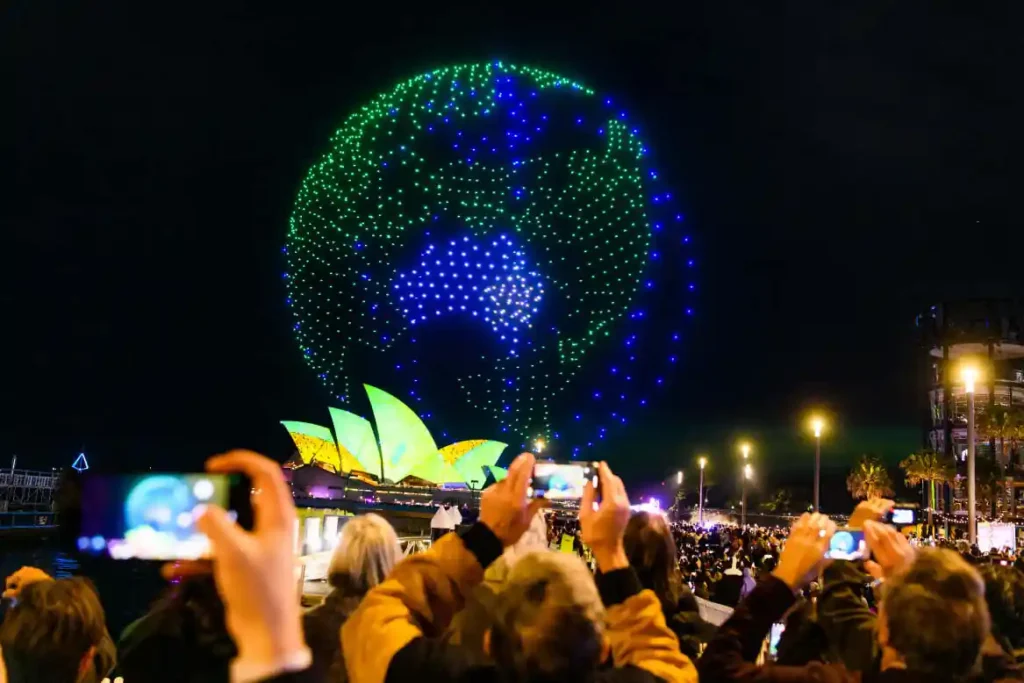

Vivid Sydney’s drone show has become the centre of a safety review after 89 drones dropped into Darling Harbour during Monday night’s “Star-Bound” performance, forcing organisers to cancel several upcoming displays at Cockle Bay.
The incident happened during the 7.30pm session, when the display had only just begun. Viewers saw the formation break down before drones started falling into the water on the southern side of Cockle Bay. The later 9.30pm show was cancelled the same night, and organisers later scrapped the Tuesday and Wednesday night drone sessions while engineers and safety officials examined the failure.
Sky Magic, the UK-based company operating the display, said the drones stayed within the approved safety boundary and did not land among spectators. The company linked the failure to an unexpected change in the radio frequency environment after takeoff. In simple terms, the drones appear to have encountered a communications problem that was not detected during rehearsals or earlier site checks.
Some drones attempted emergency landing procedures, while others shut down after meeting geofence limits. A geofence is a digital boundary designed to stop drones from flying outside an approved zone. In this case, that safety system helped keep the devices away from the public, but it also meant some aircraft fell into the harbour rather than continuing beyond the show area.
No injuries have been reported, but the episode has raised serious questions because Vivid had promoted this year’s drone program as its biggest yet. The “Star-Bound” show was designed to use up to 1000 drones for an eight to 12-minute display, with 22 performances planned across 11 nights during the festival.
The Civil Aviation Safety Authority has been made aware of the incident and is working with organisers as the review continues. CASA’s official guidance says drone operators must fly in a way that protects people, property and other aircraft, with rules applying to all drone operations in Australia. Readers can check the official safety guidance on the CASA drone safety rules page.
The weather may also become part of the review. Sydney faced poor conditions on Monday night, and drone experts have pointed out that humidity, cloud, rain, Wi-Fi congestion and signal reflections from nearby buildings can all make large drone formations harder to manage. A single drone losing signal is one problem; hundreds of drones needing to communicate at the same time over a busy urban harbour is a far more complex operation.
Read More
The setback is especially sensitive for Vivid Sydney because drone shows have already had a disrupted history at the festival. The 2025 drone shows were cancelled after police and transport authorities raised crowd safety concerns following congestion around Circular Quay in 2024. This year’s Darling Harbour program was meant to bring the spectacle back in a more controlled setting.
The wider Vivid Sydney festival is still running, with light installations, projections, music events and other attractions continuing across the city until June 13. Swikblog has also covered the broader festival program here: Vivid Sydney 2026 light installations, harbour projections and free events.
For now, the drone show remains grounded while organisers decide whether it can return safely. The incident does not mean drone entertainment is finished, but it does show how quickly a headline attraction can become a safety test when technology, weather and crowded city conditions meet over water.

Make Swikblog your go-to source on Google for reliable updates, smart insights, and daily trends.