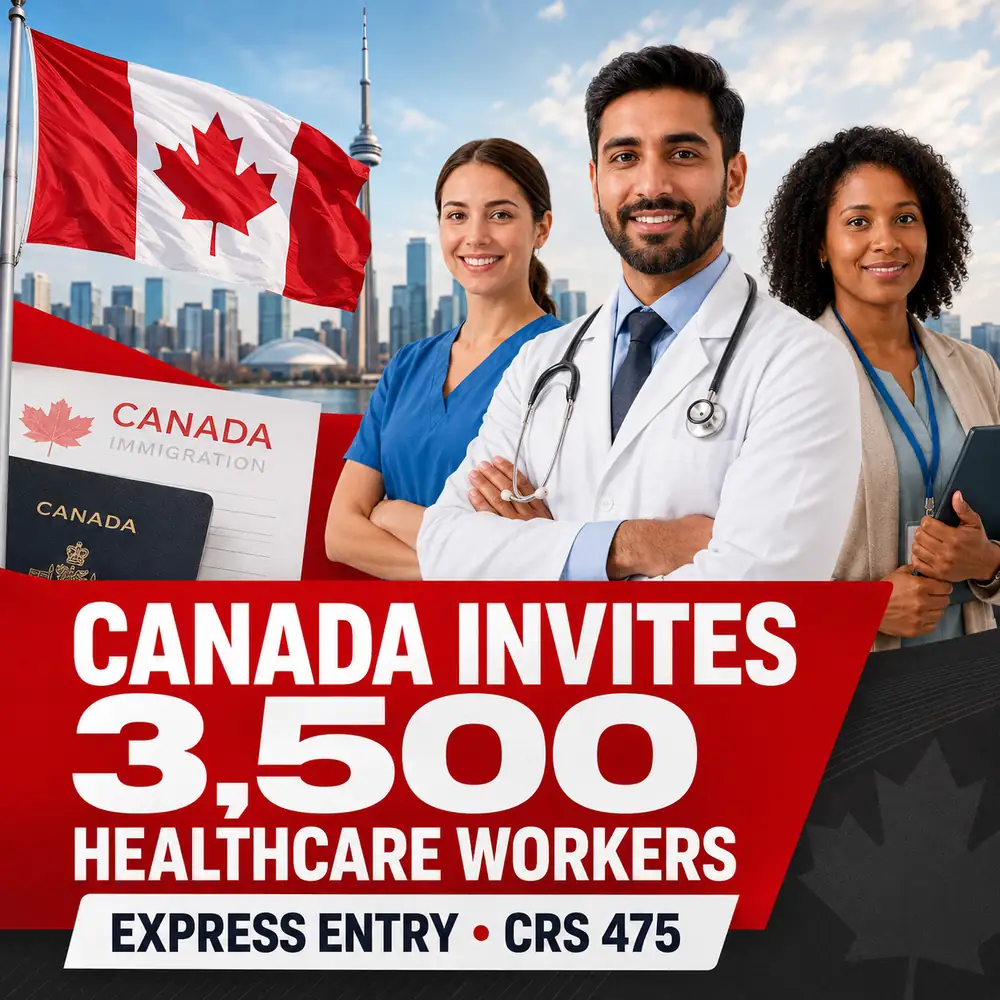

OTTAWA — Canada has invited 3,500 healthcare and social services professionals to apply for permanent residence in its latest category-based Express Entry draw.
Immigration, Refugees and Citizenship Canada issued the invitations on September 4, 2026, targeting candidates with qualifying professional experience in healthcare and social services occupations.
The Comprehensive Ranking System cutoff was set at 475 points. Candidates also needed to have submitted their Express Entry profiles before 12:26 a.m. UTC on May 26, 2026 to qualify under the tie-breaking rule.
An invitation to apply does not automatically grant permanent residence. Successful candidates must submit a complete application and supporting documents before IRCC makes a final decision on their eligibility and admissibility.
Latest Express Entry draw at a glance
- Draw date: September 4, 2026
- Category: Healthcare and social services occupations
- Invitations issued: 3,500
- CRS cutoff: 475
- Tie-breaking date: May 26, 2026, at 12:26 a.m. UTC
Who was eligible for the healthcare draw?
According to IRCC’s category-based selection rules, candidates must first qualify for one of the federal immigration programs managed through Express Entry.
Healthcare and social services candidates must also have accumulated at least 12 months of full-time work experience—or an equivalent amount of part-time experience—within the previous three years.
The qualifying experience does not need to be continuous, but it must have been gained in a single occupation included in IRCC’s healthcare and social services category. The experience may have been acquired either in Canada or abroad.
Eligible occupations include registered nurses, nurse practitioners, licensed practical nurses, physicians, dentists, pharmacists, physiotherapists, psychologists, paramedics, medical laboratory technologists, dental hygienists, social workers and community service workers.
Other eligible professions include veterinarians, optometrists, occupational therapists, medical sonographers, pharmacy technicians, respiratory therapists, massage therapists and nurse aides.
Applicants should check the official occupation list and their National Occupational Classification code carefully. A similar job title alone does not establish eligibility if the candidate’s employment duties do not correspond with the applicable NOC description.
The September selection is part of Canada’s continued use of occupation and language-based immigration rounds. In February, IRCC issued a record 8,500 Express Entry invitations in a French-language draw with a CRS cutoff of 400.
What invited candidates must do next
Candidates who received an invitation have 60 days to submit their electronic application for permanent residence, according to the Canadian government’s Express Entry application guidance.
The application may require identity documents, language-test results, educational records, employment evidence, police certificates, medical examinations and proof of funds where applicable.
IRCC will compare the information and documents in the application with the details originally entered in the candidate’s Express Entry profile. Incorrect or unsupported information may result in the application being refused and, in serious cases, a finding of misrepresentation.
The September 4 draw followed several Express Entry selections in quick succession. Canada invited 229 physicians with Canadian work experience on September 3, while 2,000 Canadian Experience Class candidates received invitations on September 1.
The latest healthcare draw was the third selection for the broader healthcare and social services category in 2026. Earlier rounds reportedly issued 4,000 invitations on February 20 and another 4,000 on June 25.
The September draw retained the same 475-point cutoff recorded in June, although it was eight points higher than the 467-point threshold used in February.
IRCC uses category-based draws to address specific economic and labour-market priorities. Healthcare and social services remain among the government’s current Express Entry categories, alongside French-language proficiency, STEM, trades, education and transport occupations.
Canada is also prioritizing selected temporary residents already living and working in the country. A separate federal initiative is expected to accelerate permanent residence decisions for eligible applicants, although the Canada TR-to-PR plan is not a new open application pathway.
The government’s official Express Entry rounds page explains that candidates are ranked by their CRS scores after IRCC identifies those who satisfy the requirements of a particular round.
The CRS score includes factors such as age, education, official-language ability and skilled work experience. Additional points may be available for factors including a provincial nomination.
The healthcare draw arrives during a year of broader policy adjustments affecting foreign workers, international students and permanent residence applicants. Candidates can review Swikblog’s overview of the Canadian immigration, student and worker rule changes introduced in 2026 for additional context.
Healthcare professionals who did not receive an invitation can remain in the Express Entry pool while their profiles are valid. Candidates may also improve their ranking through stronger language results, additional qualifying work experience, further education or a provincial nomination.
Applicants should ensure that their profiles remain accurate and that language tests and other time-sensitive documents do not expire while they wait for another invitation round.
This report provides general information and should not be considered legal or immigration advice. Candidates should confirm their eligibility and application requirements through official Canadian government resources.

Make Swikblog your go-to source on Google for reliable updates, smart insights, and daily trends.