
YOSEMITE NATIONAL PARK, California — Two people were killed when a helicopter supporting the response to the Dome Fire crashed in Mariposa County on Sunday afternoon, federal officials have confirmed.
The aircraft went down at approximately 2:55 p.m. local time on September 20 while participating in firefighting operations inside Yosemite National Park. Both people aboard died in the crash.
According to the Federal Aviation Administration, the aircraft was a Eurocopter AS32. The National Transportation Safety Board will lead the investigation, while the FAA will provide assistance.
Investigators have not announced what caused the helicopter to go down. There has also been no official confirmation of a mechanical failure, distress call or weather-related problem.
Helicopter was conducting Dome Fire water drops
The helicopter was reportedly conducting water-bucket drops when it crashed. The aircraft was operated by Precision, an Oregon-based aviation company that provides fire support, heavy-lift operations and other specialist aviation services.
Precision confirmed that two members of its team had died.
“We are devastated by this loss and are struggling to find the words,” the company said in a statement, while requesting privacy and compassion for the victims’ families and its employees.
The company’s official fleet page lists the AS332L1/H215 among the helicopters used for its manned operations. However, federal authorities have so far described the aircraft involved in Sunday’s crash only as a Eurocopter AS32.
The victims’ names, ages and hometowns had not been released as of Monday, pending notification of their relatives. Some early reports described both occupants as pilots, while another identified them as a flight crew member and a passenger. Authorities have not yet publicly resolved that discrepancy.
The aircraft was reportedly supporting an operation involving Price Valley Helitack, a US Forest Service aviation unit based near New Meadows, Idaho. Local reporting said no Price Valley firefighters were aboard the helicopter when it crashed.
The tragedy follows several recent aviation emergencies across the United States, including an F-16 crash near Traverse City in Michigan in which the pilot successfully ejected.
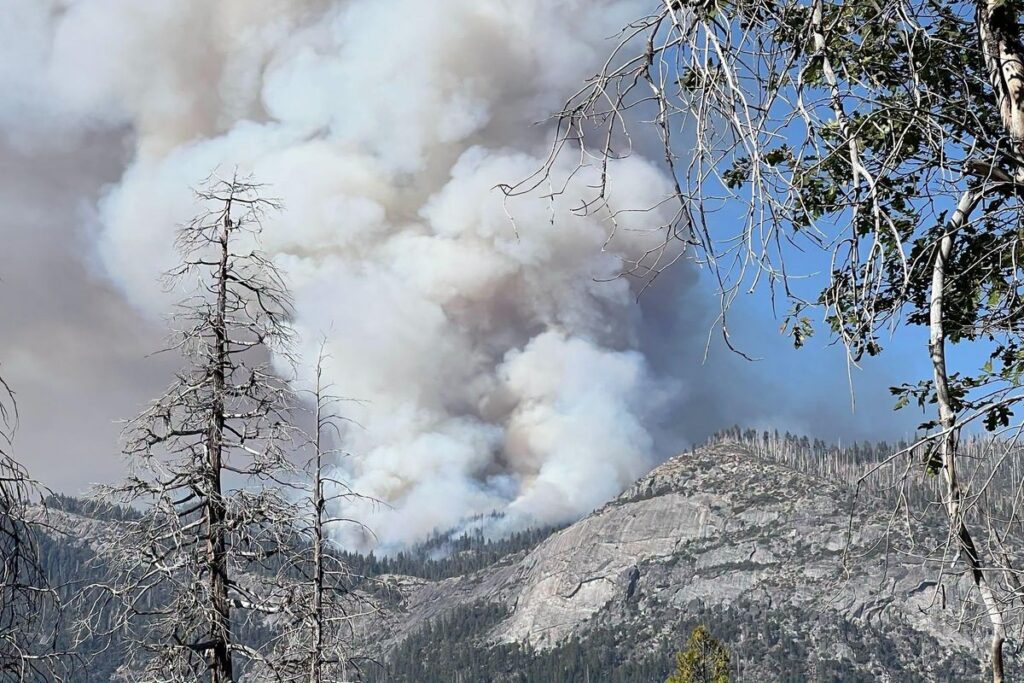
Dome Fire reaches 3,222 acres
The crash occurred as firefighters continued confronting difficult conditions across the Dome Fire, which was first reported on September 15 approximately a quarter-mile north of Chilnualna Falls.
By Monday morning, the fire had burned approximately 3,222 acres and remained 15% contained, with 581 personnel assigned to the response, according to the latest incident information update.
The fire remains within Yosemite’s wilderness and is spreading mainly north and northeast through red-fir forest. Heavy fallen timber, dry fuels and dead standing trees are complicating containment work and reducing the speed at which ground crews can construct fire lines.
Because bulldozers and conventional fire engines cannot reach much of the steep terrain, helicopters have played a central role in dropping water, transporting supplies and flying hotshot crews into remote locations. Nine helicopters were reportedly supporting the operation before Sunday’s accident.
Officials have not said whether the crash caused other aircraft to be grounded or forced changes to the wider firefighting strategy.
Yosemite National Park remains open and is operating normally. However, the Chilnualna Falls Trail, routes from the falls toward Buena Vista and Crescent lakes, and a wider section of the fire zone remain closed.
The National Park Service warned that falling trees, burning logs, hidden hot ash, smoke and poor visibility present dangers inside the restricted area. No evacuation orders or warnings were in place, and officials said developed areas and infrastructure faced no immediate threat.
The cause of both the helicopter crash and the Dome Fire remains under investigation. The NTSB is expected to release preliminary factual information after investigators examine the wreckage, flight records, weather conditions and the aircraft’s operations before impact.

Make Swikblog your go-to source on Google for reliable updates, smart insights, and daily trends.