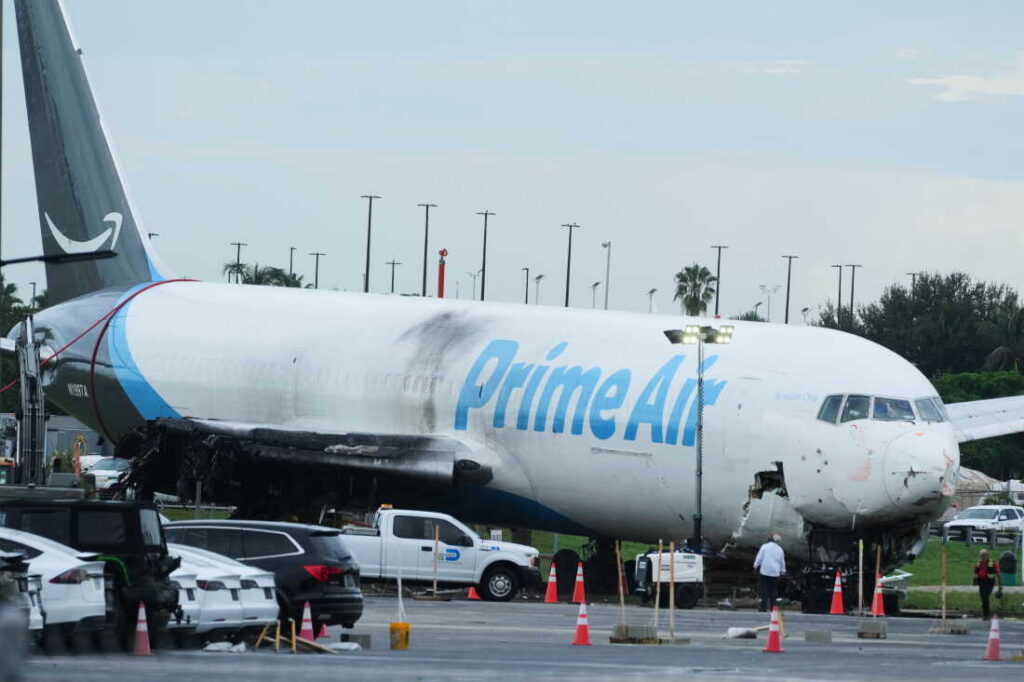

MIAMI — Amazon has paused operations with cargo carrier 21 Air following the deadly Sept. 6 crash of Flight 7598 at Miami International Airport, adding a major commercial consequence to an accident investigation that is increasingly focused on the Boeing 767’s final seconds on the runway.
The decision comes after federal investigators disclosed preliminary recorder data showing the aircraft approached and landed at high speed, followed by an attempted go-around after touchdown. The crash killed five people on the ground and injured five others.
Amazon spokesperson Kelly Nantel said the company had spent the week supporting investigators and reviewing circumstances surrounding the accident before deciding to pause operations with 21 Air.
“After the tragic incident last weekend, we’ve spent time supporting the investigation and reviewing some of the surrounding circumstances, and we’ve decided to pause our operations with 21 Air, the operator of Flight 7598.”
Amazon has not publicly identified a specific safety finding that triggered the decision, and the National Transportation Safety Board has not determined the probable cause of the crash.
The landing data now under scrutiny
Flight 7598 was arriving in Miami from San Juan, Puerto Rico, when the Boeing 767-33A overran Runway 30.
According to the NTSB’s Sept. 9 investigative update, cockpit recordings captured repeated comments about excessive speed during the approach. The aircraft’s nose gear and right main landing gear touched down at a recorded groundspeed of about 158 knots.
The sequence that followed is likely to receive particular attention during the investigation.
Investigators said a go-around was called after touchdown — an attempt to abandon the landing and return to the air. The aircraft subsequently remained on the ground and continued beyond the end of the runway.
The NTSB also said its recorded data showed no indication that the speed brakes or thrust reversers were deployed before the recording ended. Brakes were applied and the throttles eventually remained at idle.
That does not establish why those systems were not recorded as deployed. Investigators will need to determine whether the sequence resulted from crew actions, aircraft configuration, mechanical factors or some combination of circumstances.
The plane ultimately travelled roughly 1,300 feet beyond the runway, crossing into an area where it struck vehicles. Five people inside a van carrying workers from an aircraft-cleaning company were killed.
The crash was previously covered in our Miami Amazon cargo plane crash report, while subsequent developments involving the recorders and investigation can be followed in our Flight 7598 investigation update.
Amazon’s decision puts 21 Air itself in focus
21 Air had transported Amazon packages since 2024. The carrier said following Amazon’s announcement that it remained focused on the victims and their families while cooperating with the NTSB and its partners.
The company added that it remained confident in its safety policies, procedures and training.
The suspension does not mean Amazon Air operations have stopped. Amazon uses multiple direct air-carrier partners, including Air Transport International, ABX Air, Sun Country Airlines, Hawaiian Airlines, Cargojet, ASL Airlines and Quickjet.
The decision nevertheless shifts part of the story beyond the mechanics of a single runway overrun. Investigators are examining the aircraft, crew actions, weather, maintenance history and 21 Air’s operations. The NTSB cautions that recorder information released so far is preliminary and could change as its investigation develops.
The aircraft involved was a 32-year-old Boeing 767 that had originally flown as a passenger jet before being converted for cargo operations in 2015.
For now, one of the key unanswered questions is why a landing already drawing repeated speed warnings continued to touchdown — and what happened during the seconds between touchdown, the attempted go-around and the aircraft leaving the runway.

Make Swikblog your go-to source on Google for reliable updates, smart insights, and daily trends.