
An American Airlines flight arriving from New York was met by a large emergency response at Chicago O’Hare International Airport after two tires were damaged during landing, but the aircraft landed safely and no injuries were reported.
American Airlines Flight 386 arrived from New York’s LaGuardia Airport at about 2 p.m. Monday, August 17, according to the Federal Aviation Administration and local reporting. About 180 people were reported on board. Fire trucks and police vehicles surrounded the aircraft after it stopped on the airfield, while passengers later left by stairs and were taken to the terminal by bus.
The incident drew attention because the emergency response looked dramatic, but the available facts point to a controlled landing rather than a crash. Chicago firefighters reported no smoke or flames, no apparent damage to the engines or wings and no debris on the runway. American Airlines removed the aircraft from service for inspection.
What happened to American Airlines Flight 386 at O’Hare?
Flight 386 was completing its trip from LaGuardia when two tires were damaged during landing at O’Hare. The FAA said it would investigate the incident. American Airlines thanked its team members for their professionalism and apologized to customers for the experience.
Emergency vehicles remained around the aircraft while passengers were moved safely away from the plane. The response itself is an important part of airport safety: a tire problem can affect how an aircraft taxis or is moved after landing, so rescue crews may be positioned nearby even when there is no fire or injury.
For travelers, the key point is that the problem appeared limited to the aircraft rather than the wider airport. Delays around the time of the incident were reported at less than 15 minutes, and Chicago aviation officials said there were no significant delays attributed to the event.
O’Hare has faced much larger operational disruptions from other causes. Earlier in 2026, fog and thunderstorms triggered ground stops and major delays at O’Hare and Midway, showing the difference between an isolated aircraft problem and an airport-wide traffic restriction.
A second tire incident happened hours later
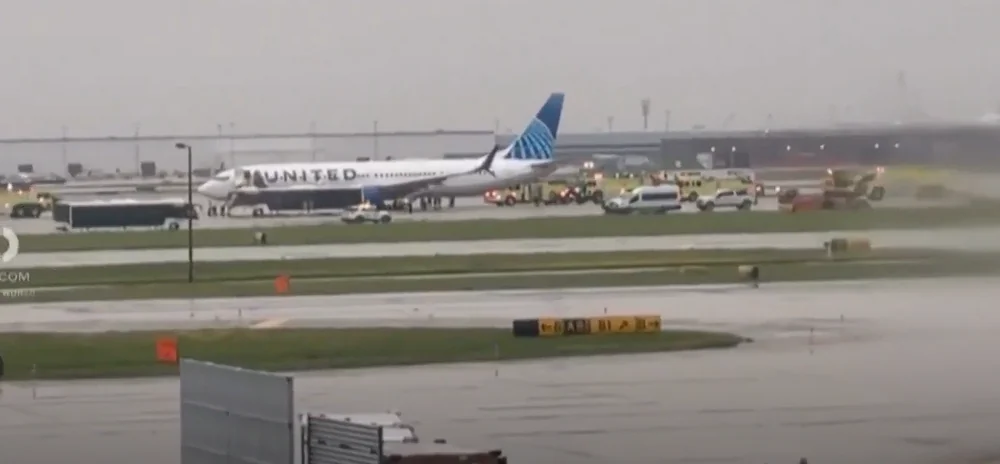
The American Airlines landing received extra scrutiny because a second tire incident happened at O’Hare later the same day. United Airlines Flight 739, arriving from Omaha, Nebraska, suffered tire damage as it exited the runway, according to air traffic control information reported by NBC Chicago.
There were 127 passengers on the United flight, and no immediate injuries were reported. Passengers were taken off on the tarmac and transported to the terminal by bus. Air traffic control said the two incidents occurred in different parts of the airport.
That timing may look unusual, but it does not establish a common cause. Tire damage can occur for different mechanical, operational or environmental reasons. Until investigators identify specific evidence, the two events should be treated as separate incidents rather than proof of a broader airport problem.
A recent British Airways technical fault that temporarily closed Gatwick’s runway offers a useful comparison: a single aircraft problem can sometimes disrupt an airport far more widely when it blocks a runway or prevents normal traffic flow. At O’Hare, Flight 386 did not appear to create that kind of system-wide interruption.
Why aircraft tire damage gets an immediate response
Commercial aircraft tires operate under heavy loads and high forces during takeoff and landing. When a tire is damaged, crews and airport responders must consider whether the aircraft can taxi normally, whether debris is present and whether passengers should leave the aircraft before it is moved.
In this case, the reported absence of smoke, flames, runway debris and injuries is important context. It explains why a large number of emergency vehicles could be present even though the outcome remained controlled.
The FAA’s aircraft accident and incident investigation guidance outlines how aviation events can be documented and reviewed. For Flight 386, the agency’s investigation is the proper source for determining why the tires were damaged and whether any additional action is needed.
What passengers should know after the O’Hare emergency
There is no indication from the information released so far that passengers on other O’Hare flights face a specific risk because of Flight 386. Travelers should check their own airline’s flight status rather than assume the emergency response affected the entire airport.
The confirmed picture remains straightforward: American Airlines Flight 386 landed safely after two tires were damaged, about 180 people were reported on board, passengers were moved to the terminal by bus, the aircraft was taken out of service for inspection and no injuries were reported. The FAA investigation will determine whether further findings need to be added.

Make Swikblog your go-to source on Google for reliable updates, smart insights, and daily trends.