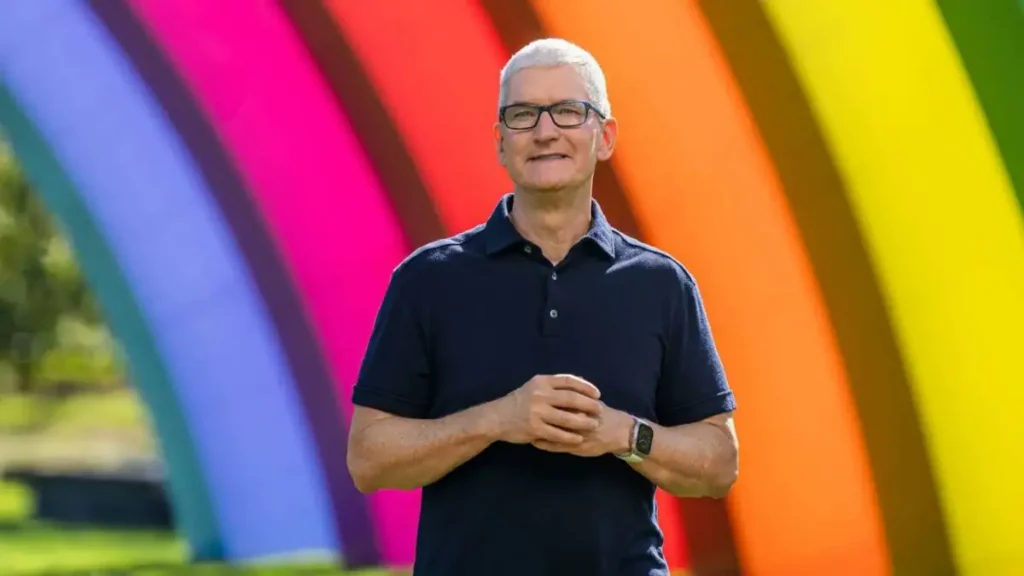

Apple (NASDAQ: AAPL) shares fell about 1.25% on Monday as Tim Cook completed his final day as chief executive, closing a 15-year run that transformed Apple into a company valued at more than $4 trillion. John Ternus takes over on September 1, putting Apple’s leadership in the hands of a longtime hardware executive as investors focus on AI, new devices and the company’s ability to keep growing at enormous scale.
AAPL was trading around $315.68 during Monday’s session, down roughly $4 from its previous close. The timing makes the decline notable, but Apple’s CEO succession was announced months ago. The stock move should therefore not automatically be interpreted as a negative reaction to Ternus taking control.
APPLE CEO HANDOVER: KEY NUMBERS
AAPL: Around $315.68
Monday move: About -1.25%
Incoming CEO: John Ternus
CEO change: September 1, 2026
Cook’s tenure: 15 years
Apple market value: More than $4 trillion
Active devices: More than 2.5 billion
The bigger story isn’t Monday’s 1.25% drop
For investors, the more important number is the scale of the company Ternus inherits.
Cook became CEO in August 2011 after establishing himself as Apple’s operations and supply-chain specialist. Apple was worth roughly $350 billion around the beginning of his tenure. Fifteen years later, its market capitalization has climbed above $4 trillion.
Apple’s annual revenue increased from about $108 billion in fiscal 2011 to more than $416 billion in fiscal 2025. AAPL shares have gained more than 2,000% during Cook’s tenure, depending on the precise comparison dates.
Apple’s revenue nearly quadrupled under Cook
The revenue comparison shows how dramatically Apple’s financial scale changed during Cook’s leadership.
Apple annual revenue: 2011 vs 2025
Fiscal-year revenue figures. Bars are scaled against Apple’s 2025 revenue.
The company also became broader. Apple Watch and AirPods developed into major businesses, while Services expanded to more than $100 billion in annual revenue. Apple now has more than 2.5 billion active devices worldwide.
Another defining Cook-era move was Apple’s transition away from Intel processors in Macs toward its own silicon, giving the company greater control over performance, efficiency and integration between hardware and software.
Cook is stepping down, but he isn’t leaving Apple
The transition does not represent a complete departure for Cook. He will become Apple’s executive chairman and remain involved with selected areas of the company, including engagement with policymakers around the world.
John Ternus will join Apple’s board when he becomes CEO, while Arthur Levinson will become lead independent director.
Apple laid out the September 1 succession and Cook’s continuing role in its official leadership announcement.
Keeping Cook involved could provide continuity as Apple navigates political relationships, regulation and global supply-chain risks.
Who is John Ternus?
Ternus is an Apple insider rather than an outside executive brought in to reset the business. He joined Apple in 2001 and eventually became senior vice president of Hardware Engineering.
His organization has overseen engineering for products including the iPhone, iPad, Mac and AirPods. Ternus was also closely involved in Apple’s transition from Intel processors to Apple-designed silicon.
His hardware background makes Apple’s product roadmap one of the most important early indicators investors will watch.
AI may be Ternus’s toughest early test
The most urgent strategic issue is artificial intelligence.
Apple has faced pressure over the pace of its AI development and delays involving a more personalized Siri while rivals including Google and Microsoft have pushed aggressively into generative AI.
Concerns about Apple’s AI rollout delays and Wall Street’s reassessment of AAPL have already shown why successful execution on Apple Intelligence matters to investor sentiment.
The AI boom is simultaneously reshaping valuations elsewhere in technology. Nvidia’s earnings and NVDA stock outlook provide a useful comparison for how strongly investors are rewarding companies positioned at the center of AI spending.
PayPal Stock Drops as Stripe and Advent Abandon Takeover Bid
ExxonMobil (XOM) Stock in Focus After £267,000 Fine Over Five Gas Leaks
The next product cycle arrives quickly
Ternus will not get a long settling-in period. Apple’s fall product cycle arrives shortly after the CEO handover, putting immediate attention on new iPhones, Apple Watches and the company’s wider hardware strategy.
A potential foldable iPhone is among the most closely watched future products. Smart glasses and other AI-focused hardware could also become important as Apple searches for another large computing platform beyond its mature smartphone business.
Vision Pro showed Apple’s willingness to enter a new category, but it has yet to develop into a mass-market business comparable with the iPhone, Mac or Apple Watch.
China and regulation remain major investor risks
China presents a particularly difficult balancing act. The country remains important to Apple as both a manufacturing base and consumer market, even as the company works to diversify portions of its supply chain.
Europe creates a different challenge. Regulatory pressure has forced changes to parts of Apple’s App Store and platform model. That matters because Services has become one of Apple’s most important sources of recurring revenue.
What AAPL investors will measure now
Monday’s roughly 1.25% decline is unlikely to provide a meaningful verdict on the new CEO. Investors have known about the succession since April and will have far more useful evidence once Ternus starts reporting results under his leadership.
The numbers to watch will include iPhone demand, Services growth, margins and AI adoption. Investors will also be looking for progress on Siri, supply-chain diversification and evidence that new hardware can become commercially significant.
Cook’s challenge in 2011 was proving Apple could prosper after Steve Jobs. Ternus inherits almost the opposite problem: proving that a company already generating more than $400 billion in annual revenue and valued above $4 trillion can still find new businesses large enough to materially change its growth trajectory.

Make Swikblog your go-to source on Google for reliable updates, smart insights, and daily trends.