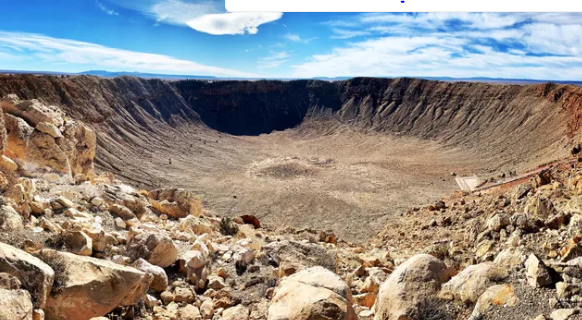

Arizona’s famous Meteor Crater is back in the spotlight as scientists report new discoveries from the 50,000-year-old impact site. Often called the best-preserved meteor impact crater on Earth, this massive geological structure continues to provide fresh insights into how cosmic collisions shape our planet. What makes this even more remarkable is that despite decades of research, the crater is still revealing new scientific data every year.
Located near Winslow, Arizona, Meteor Crater measures around 700 feet (213 meters) deep, more than 4,000 feet (1,219 meters) across, and roughly 2.4 miles (3.9 kilometers) in circumference. These massive dimensions are a direct result of a high-speed meteorite impact that struck Earth thousands of years ago, releasing energy far greater than most natural events humans can imagine.
Why Scientists Call It a “Natural Laboratory”
According to Dan Durda, a research scientist at the Southwest Research Institute (SwRI), Meteor Crater is considered the “best-preserved and exposed impact crater on Earth.” This makes it an ideal natural laboratory for studying impact events. Unlike many other craters that have been eroded or buried over time, Meteor Crater still maintains its structure, allowing scientists to study its features in detail.
Durda emphasized that the crater continues to provide new insights every year, reinforcing the importance of ongoing research. Scientists use the site to test theories, validate computer simulations, and better understand the physics behind high-speed cosmic collisions.
New Research Funding and Global Studies Rise
One of the biggest developments is the growing support for crater research worldwide. New competitive grants are now being offered to fund fieldwork at known and suspected impact sites. These programs are supporting laboratory analysis, geological surveys, and advanced computer modeling.
The Barringer Crater Company (BCC), which manages the Meteor Crater site, has introduced funding initiatives aimed especially at students and early-career researchers. The goal is to encourage new talent to explore impact science and deepen understanding of how these craters form and evolve.
Applications for the Barringer Family Fund are administered by The Meteoritical Society, with deadlines typically set around April 1, highlighting the increasing urgency and interest in this field.
Hidden Craters and Earth’s Lost Impact History
Christian Koeberl from the University of Vienna, who chairs the BCC scientific advisory committee, pointed out a major challenge in impact science: many craters on Earth are extremely difficult to identify. This is because geological and atmospheric processes such as erosion, tectonic activity, and sediment deposition gradually erase evidence of impacts.
Despite these challenges, scientists have confirmed around 200 impact craters on Earth so far. However, experts believe many more remain undiscovered beneath layers of rock or have been heavily eroded over time.
This makes well-preserved sites like Meteor Crater incredibly valuable, as they provide clear and accessible evidence of impact processes that can be applied to studying hidden or ancient craters across the globe.
Shock Metamorphism: The Key Scientific Evidence
One of the most important aspects of crater research is identifying “shock metamorphic effects” in rocks and minerals. These are unique changes caused by the extreme pressure and temperature generated during a high-velocity impact.
Unlike normal geological processes, shock metamorphism only occurs under intense conditions associated with meteor strikes. Scientists use these features to confirm whether a structure was formed by an impact event rather than volcanic or tectonic activity.
Detailed investigations at Meteor Crater involve studying these shock signatures and searching for traces of meteoritic material embedded within rocks. This combination of evidence helps researchers reconstruct the exact nature of the impact event.
More Powerful Than Nuclear Explosions
Impact events like the one that formed Meteor Crater are described as short-duration but extremely high-energy geological events. The conditions created during such impacts can exceed those produced by nuclear explosions, generating immense pressure waves and heat in a matter of seconds.
This level of energy drastically alters the surrounding environment, reshaping landscapes and leaving behind distinctive geological signatures that scientists can study even tens of thousands of years later.
For a deeper understanding of impact science and ongoing discoveries, you can explore updates on Space.com, which regularly covers breakthroughs in planetary research and meteor studies.
Impacts That Changed Life on Earth
The importance of impact research goes far beyond individual craters. Scientists know that meteor impacts have played a major role in Earth’s geological and biological evolution. One of the most well-known examples is the asteroid impact that occurred about 66 million years ago, marking the transition from the Cretaceous to the Paleogene period.
This event led to the extinction of the dinosaurs, demonstrating how powerful and transformative these cosmic collisions can be. According to researchers, species caught in such events “literally had no chance,” highlighting the destructive potential of large-scale impacts.
Even smaller impacts, like the one that created Meteor Crater, provide crucial data that helps scientists understand how these events unfold and how they influence the planet over time.
Why Meteor Crater Still Matters in 2026
The continued research at Meteor Crater shows that even ancient geological structures can produce new discoveries when studied with modern tools. Advances in imaging technology, laboratory analysis, and computer simulations are allowing scientists to extract more information than ever before.
Researchers now see impact crater studies as an interdisciplinary field that combines geology, physics, chemistry, and planetary science. This integrated approach is helping scientists build a more complete picture of how impacts have shaped Earth and other planetary bodies.
Institutions like the Lunar and Planetary Institute continue to support research and education in this area, further highlighting the growing importance of impact science.
The Bottom Line
Arizona’s Meteor Crater is not just a relic of the past — it is an active scientific resource that continues to deliver new insights into Earth’s history and the powerful forces that shape it. With increasing research funding, global scientific interest, and modern analytical tools, this 50,000-year-old crater remains at the forefront of impact science.
As scientists continue to study this remarkable site, one thing is clear: the secrets of Meteor Crater are far from fully uncovered, and its role in advancing our understanding of the planet is only growing stronger.

Make Swikblog your go-to source on Google for reliable updates, smart insights, and daily trends.