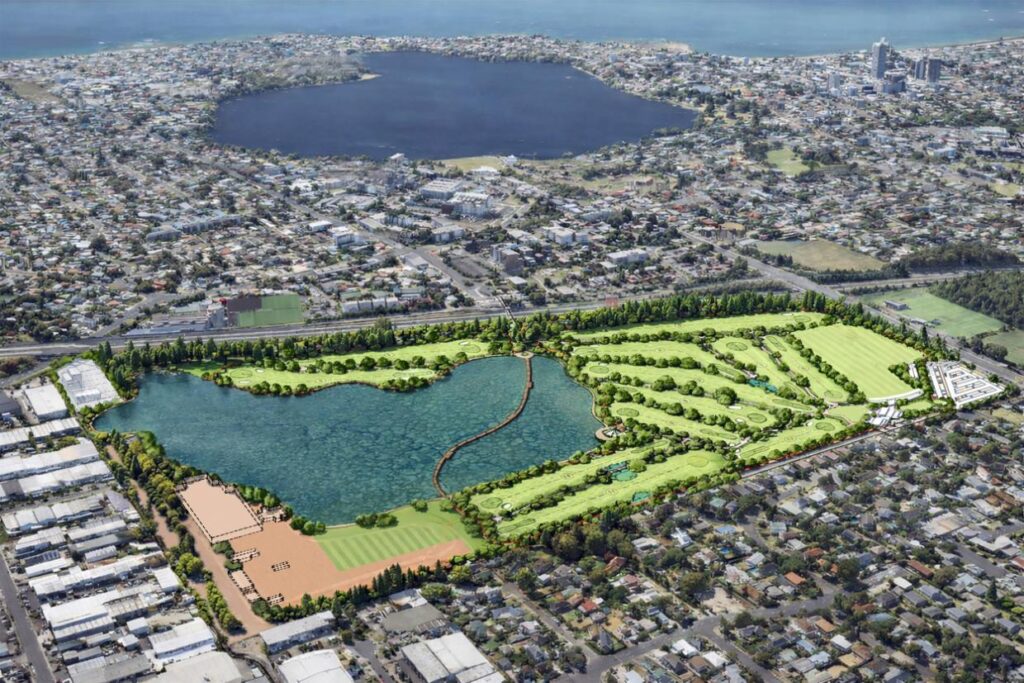

Auckland’s North Shore is heading toward a crucial decision that could redefine the future of public golf in the city. Takapuna Golf Course has launched a last-ditch proposal to retain golf at AF Thomas Park, unveiling a bold 12-hole concept just days before the Kaipātiki Local Board is set to decide whether the sport survives at the site.
The timing is critical. Auckland Council is advancing plans to redevelop roughly one-third of the park into a permanent wetland designed to mitigate flooding in one of the region’s most vulnerable areas. With climate resilience now a top priority, the council’s proposal would transform part of the land into flood storage while reshaping how the remaining space is used.
Final Push Before Decision Day
The local board is expected to make its decision next Wednesday after months of community consultation. With that deadline looming, Takapuna Golf Course presented its revised plan last week — a purpose-designed 12-hole urban course that would allow golf to continue while accommodating the council’s flood mitigation requirements.
The proposal replaces the original ambition to retain the full 18-hole course. That earlier plan included multiple small stormwater ponds across the park but was ultimately deemed unfeasible by Auckland Council, which asked the club to come back with an alternative.
The new concept goes beyond just preserving golf. It includes retaining the existing driving range and café bar, while also introducing new public walkways and opening up more green space for the wider community. The plan even proposes relocating Eventfinda Stadium within the park footprint.
100,000 Rounds a Year at Stake
At the heart of the debate is a facility that plays a major role in local recreation. Takapuna Golf Course hosts more than 100,000 rounds of golf annually, making it one of the busiest public courses in the region.
Head Greenskeeper Steve Dowd emphasized that the course is not an elite venue but a community hub. It caters to a wide cross-section of Aucklanders — from tradies playing on Fridays to beginners learning the game, school-aged players, and older residents enjoying social rounds.
According to Dowd, the 12-hole model is designed to ensure “affordable, accessible golf continues to thrive” on the North Shore. The idea is to preserve the course’s identity as a public, inclusive space rather than allow it to be replaced entirely by other recreational or infrastructure projects.
Community Speaks: 70% Want Golf Retained
Public sentiment appears to strongly favour keeping golf at AF Thomas Park. More than 5300 submissions were received during consultation, with 70% supporting golf being retained in some form. Only 21% backed alternative recreational uses over golf.
Those figures could carry significant weight as the Kaipātiki Local Board weighs competing priorities. In a city where public land must serve multiple needs — from sport and leisure to flood protection — strong community backing often becomes a decisive factor.
The consultation process itself reflects a broader trend in urban planning, where councils are increasingly required to balance environmental resilience with public access and recreation. More details on Auckland’s long-term planning approach can be explored via Auckland Council’s official site.
Wetland Plan vs Golf Future
The council’s proposal focuses on creating a recreational wetland that doubles as flood storage. AF Thomas Park sits in a flood-prone zone, and recent extreme weather events have intensified the urgency to redesign such spaces for resilience.
This creates a direct trade-off. Retaining golf in its current form is no longer considered viable under the council’s framework. The question now is whether a reduced-footprint golf facility — like the proposed 12-hole course — can coexist with the wetland project.
Takapuna Golf Course believes its plan offers that balance. Dowd described it as a “potential win for everyone,” combining flood mitigation with continued community access to affordable sport and open green space.
Competing $20 Million Proposal Raises Stakes
The decision is further complicated by alternative proposals for the park. One of the most notable comes from The Golf Warehouse, which has put forward a $20 million redevelopment concept.
That plan includes a 9-hole golf course, a driving range, mini golf, a new clubhouse, pickleball courts, a pump track, and a redesigned Eventfinda Stadium built on a raised platform to address flood risks.
This competing vision highlights the broader question facing decision-makers: should AF Thomas Park remain primarily a traditional public golf space, evolve into a mixed-use recreational hub, or shift further toward infrastructure-focused flood management?
Timeline: What Happens After the Decision
Even after next week’s decision, the process is far from over. Auckland Council is expected to present a detailed design and business case for the redevelopment in 2026, with construction currently scheduled to begin in 2027.
That means the upcoming vote will likely determine the direction of the park, but not finalize every detail. The long-term outcome will depend on how the chosen concept is implemented and funded over the coming years.
For golf advocates, the stakes are immediate. Losing the course would mean the disappearance of one of Auckland’s most accessible golf venues. Retaining it, even in a reduced form, could set a precedent for how urban golf adapts to modern land-use pressures.
A Defining Moment for Urban Golf
The situation at AF Thomas Park reflects a wider global trend where urban golf courses face increasing pressure from competing land demands. Flood mitigation, housing, and multi-use recreation are all reshaping how cities think about large green spaces.
Takapuna’s 12-hole proposal may represent a new model — one that prioritizes flexibility, accessibility, and coexistence with environmental infrastructure. Whether that model is adopted will become clear in the coming days.
For now, the future of golf at AF Thomas Park hangs in the balance, with a community-backed proposal, a council-driven wetland plan, and a multimillion-dollar alternative all competing for the same piece of land. Updates on the sport’s development in New Zealand can also be tracked through Golf New Zealand.
Skywatchers tracking rare celestial events may also want to read this report on the Northern Lights forecast across 20 US states in 2026.

Make Swikblog your go-to source on Google for reliable updates, smart insights, and daily trends.