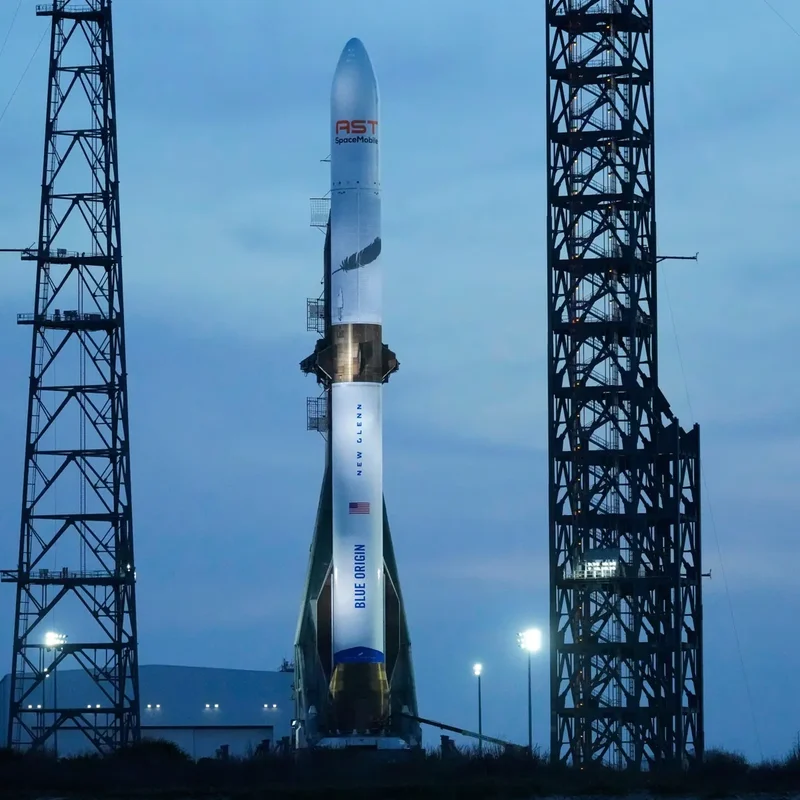

Blue Origin delivered one of its most important commercial space moments yet on April 19 as its heavy-lift New Glenn rocket lifted off from Cape Canaveral and carried AST SpaceMobile’s BlueBird 7 satellite toward low-Earth orbit. The launch was notable not simply because the mission reached space, but because it showed the company is beginning to turn technical ambition into repeatable execution. New Glenn flew with a previously used first-stage booster, and that same stage returned to Earth and landed on a barge in the Atlantic Ocean, giving Blue Origin another proof point in the race to build a reusable launch system that can compete in a market long shaped by SpaceX.
The rocket rose from Florida at about 7:25 a.m. local time after a brief hold late in the countdown. About 10 minutes after liftoff, the first-stage booster came back down and touched down on Blue Origin’s drone ship, extending the company’s success in recovery operations. The payload, AST SpaceMobile’s BlueBird 7, was expected to separate from the upper stage roughly 75 minutes after launch. That mission profile made the event important for two different reasons at once: Blue Origin advanced its long-term launch strategy, while AST SpaceMobile moved ahead with plans to build a direct-to-device satellite network designed to connect ordinary smartphones from space.
Why New Glenn’s latest flight mattered
Blue Origin has spent years developing New Glenn as the rocket that could carry the company far beyond suborbital tourism and into the center of the commercial launch business. But heavy rockets are not judged by promises. They are judged by performance, cadence and customer confidence. That is why this third New Glenn mission carried more weight than a typical launch headline. It combined a commercial payload, a reflown booster and a successful landing, three elements that together show Blue Origin is moving closer to the operating model needed to serve satellite customers on a larger scale.
Reusability is at the center of that model. Launch companies can lower costs and improve scheduling only if they can bring back expensive hardware, inspect it, refurbish it and fly it again. SpaceX made this concept mainstream, and every serious rival has been forced to prove it can do the same. Blue Origin’s latest mission does not erase the distance between the two companies, but it does show that New Glenn is beginning to produce the kind of evidence the market wants to see. For customers, that means a stronger case that Blue Origin may become a more dependable option for future launches. For the company, it means progress toward a launch business built on more than one-off milestones.
Chief Executive Officer Dave Limp has made clear that Blue Origin wants a far busier year. Ahead of the mission, he said the company would like to carry out eight to 12 New Glenn flights in 2026. That goal is ambitious, particularly because Blue Origin had earlier expected six to eight flights in the previous year and ended up completing only two. The gap between plans and execution has been one of the biggest criticisms hanging over the program. This mission does not settle that issue, but it does give Blue Origin a stronger foundation from which to argue that higher cadence is achievable.
AST SpaceMobile’s launch carries its own significance
The BlueBird 7 satellite made this more than a rocket story. AST SpaceMobile is trying to build a network that can beam broadband connectivity directly to standard, unmodified mobile phones. That idea has captured attention because it goes after one of the biggest frustrations in telecom: places where terrestrial coverage still falls short. Instead of requiring a dedicated satellite handset, the company’s system is designed to work with everyday smartphones. BlueBird 7 is part of the next generation of that plan, and it reflects how fast the direct-to-device segment is moving from concept toward real commercial deployment.
AST SpaceMobile has said its newer BlueBird satellites include a phased-array antenna spanning roughly 2,400 square feet, a scale intended to support the power and sensitivity needed for direct links to consumer devices. The company started 2026 with only seven satellites in orbit, but it has laid out plans to launch as many as 60 this year. That gives this mission added importance. It is not a symbolic demonstration. It is part of an attempt to expand a constellation quickly enough to support eventual service at commercial scale.
The competition around that opportunity is intensifying. SpaceX continues to use Starlink to dominate the broader satellite internet market, and Amazon is also pushing deeper into space-based connectivity. The pressure increased further after Amazon agreed on April 14 to acquire Globalstar and laid out a plan to enter the emerging direct-to-device arena. Against that backdrop, AST SpaceMobile is trying to prove there is room for another major network built around direct cellular links, and Blue Origin’s role as launch provider places it directly inside one of the most closely watched infrastructure races in orbit.
Blue Origin is building for more than one business line
New Glenn is also important because Blue Origin sees launch as the starting point for a broader space business. The company has discussed plans that go well beyond putting satellites into orbit, including an orbital data center concept and a satellite network meant to serve government users and data-heavy operations. That strategy mirrors a wider industry shift. Space is no longer only about transportation. It is increasingly about owning pieces of the infrastructure stack, from launch and communications to computing and national security applications.
At the same time, Blue Origin is dividing attention between near-term commercial work and longer-term lunar development. The company said earlier this year that it would pause New Shepard tourism flights to focus more closely on technologies tied to moon missions. Like SpaceX, Blue Origin holds NASA contracts related to lunar landing systems as the agency works toward a crewed moon mission targeted for 2028. Limp has said the company’s Mark 1 lunar lander has a strong chance of reaching the moon later this year, a reminder that Blue Origin is trying to compete not only in launch and satellite services but also in deep-space exploration.
That broader ambition matters when judging the significance of the NG-3 mission. A heavy rocket program becomes more valuable when it supports multiple future businesses. New Glenn is not just a launch vehicle in that sense. It is a gateway asset. If Blue Origin can fly it more often, recover it reliably and attract more commercial customers, the rocket strengthens nearly every part of the company’s long-term strategy.
There is still a long way to go before Blue Origin can claim parity with the industry’s most established launch operator. The next test is consistency. It must show that booster landings are not isolated wins, that reused stages can keep flying without long gaps, and that customer missions can move on a steady schedule. But this launch did something important: it replaced some of the conversation about delay with a clearer example of delivery.
Readers looking for the official company briefing can review Blue Origin’s mission update. For more reporting and analysis on launch providers, satellite internet and the commercial space economy, explore our latest space and markets coverage.
You may like: Robot Beats Humans in Half Marathon China Lightning Race Stuns Spectators

Make Swikblog your go-to source on Google for reliable updates, smart insights, and daily trends.