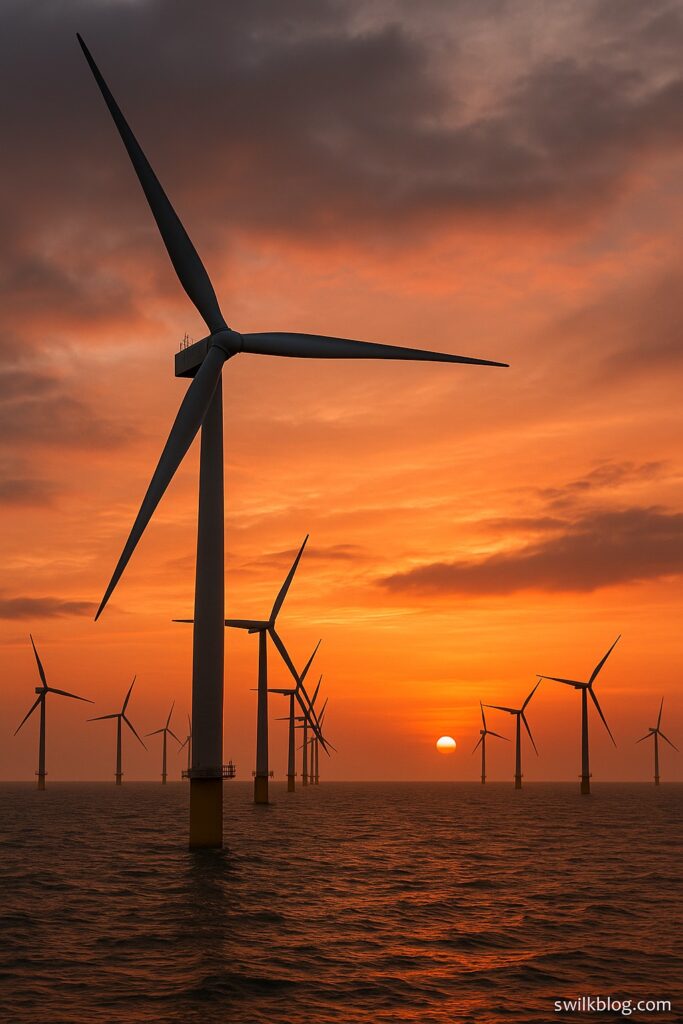

For a few blustery hours over the North Sea, Britain became a glimpse of a cleaner energy future — with almost half of its electricity demand powered by wind.
By Swikblog News Desk | Published: December 9, 2025 | London, United Kingdom
Britain has set a new wind power generation record, underscoring how quickly the country’s energy system is shifting towards renewables. According to the National Energy System Operator (NESO), wind turbines reached a peak output of almost 24 gigawatts (around 23,800 MW) during a windy spell in early December, supplying close to half of Britain’s electricity demand in that moment.
The new record eclipses a previous peak set just weeks earlier and highlights how rapidly UK offshore and onshore wind capacity has grown in recent years as the country moves away from coal and cuts back on gas. For climate campaigners, it is another data point showing that a high-renewables grid is not a distant dream but something already taking shape on stormy evenings across the UK.
How Britain’s Wind Record Was Set
NESO, which manages Britain’s electricity system, reported that the record was hit during the early evening peak, when household and business demand is typically high. At that point, wind turbines were generating enough zero-carbon electricity to power more than 20 million homes, dramatically reducing the need for gas-fired power plants and cutting emissions across the grid.
Britain has become one of the world’s leaders in offshore wind development, with giant turbines anchored off the coasts of England and Scotland feeding electricity directly into the high-voltage network. Onshore wind farms in Scotland, Wales and northern England added further output on the record-breaking day, helped by strong low-pressure weather systems sweeping the North Atlantic.
Energy analysts say the record reflects not just strong winds but years of investment and policy support. The UK’s legally binding net-zero emissions target has pushed successive governments to expand renewables and reduce the country’s reliance on fossil fuels.
Why This Wind Power Milestone Matters
At first glance, a new “megawatt record” can sound like a technical footnote. But for Britain’s energy transition, this kind of moment is a stress test of what a high-renewables grid looks like in real life.
When wind meets such a large share of demand, it automatically pushes higher-carbon generation off the system. Gas plants ramp down, coal (where it still appears) barely runs, and system emissions plunge. For consumers, abundant wind can also help ease pressure on wholesale power prices, especially when combined with strong interconnections and growing battery storage.
Crucially, these milestones are becoming more frequent. Each time a new record is set and handled smoothly, it boosts confidence that the grid can cope with an even larger share of variable renewables in the future — provided that storage, flexible demand and smarter networks continue to scale up.
Challenges: Storage, Flexibility and “Too Much of a Good Thing”
Britain’s wind boom, however, comes with challenges. On very windy days, output can surge beyond what the grid can easily absorb, leading to so-called “curtailment,” where turbines are paid to switch off. At other times, calm weather can leave the system heavily reliant on gas, nuclear and imports.
Experts argue that the next phase of the transition must focus on grid flexibility: more large-scale batteries, better interconnectors with neighbouring markets, dynamic pricing to shift demand, and upgraded transmission lines that bring offshore wind power to cities without congestion.
Without those upgrades, the UK risks wasting cheap clean electricity or facing price spikes when the wind drops. That is why the record is being seen not as an endpoint but as a signpost — proof that the country’s wind fleet can deliver huge volumes of power, and a reminder that policy needs to keep pace.
What This Means for Households and the Climate
For households, the immediate impact is subtle: lights stay on, chargers hum, kettles boil — but behind the scenes, more of that power is coming from wind farms rather than gas pipelines. Over time, as Britain adds more offshore wind projects and strengthens its grid, the expectation is that cleaner electricity will help stabilise bills and shield consumers from fossil fuel price shocks.
For the climate, the symbolism matters. Hitting new records for renewable energy generation is a tangible sign that decarbonisation is moving from policy slogans into everyday infrastructure. Each gigawatt of wind displaces tonnes of carbon dioxide that would otherwise have come from burning gas or coal.
And for countries watching Britain’s energy transition, this latest record offers a simple message: large economies can run a big share of their grids on renewables — but they need to invest early, think long term and build public support for the changes that come with it.
You may also like
Enjoy our football coverage too: read our latest feature on the North London Derby and why it dominated trends.
This article is based on official system operator data and public reporting on Britain’s wind power generation record. For more information on the UK’s climate and energy policy, readers can refer to NESO and UK government climate resources linked above.

Make Swikblog your go-to source on Google for reliable updates, smart insights, and daily trends.