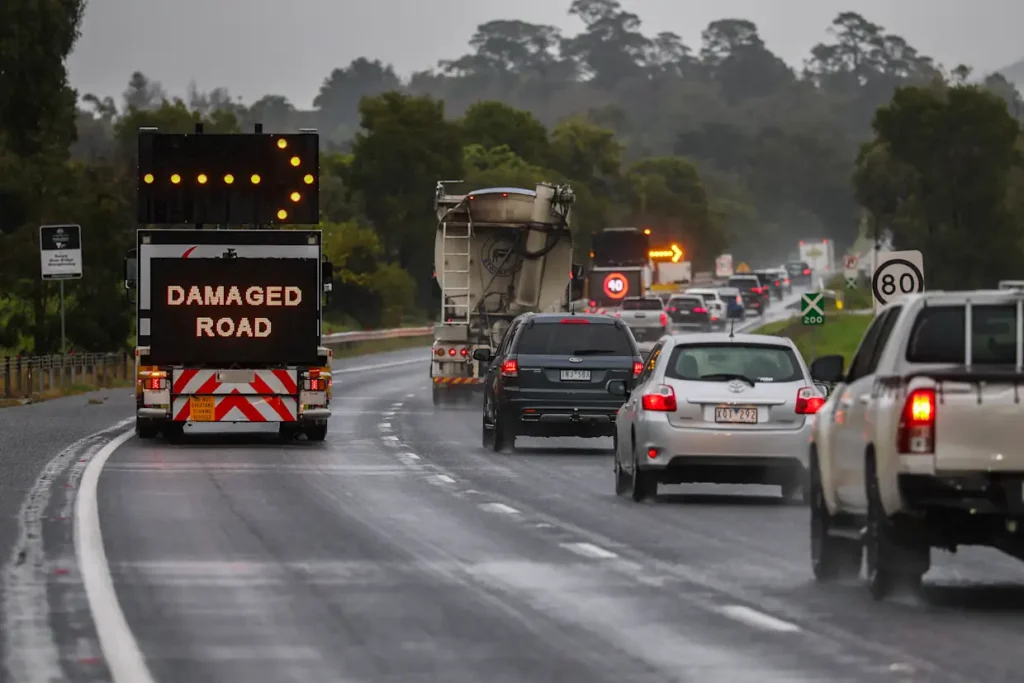

A routine Monday commute turned into a costly roadside ordeal near Bunyip when vehicles began striking deep potholes hidden beneath rainwater on the Melbourne-bound Princes Freeway.
Tyres burst without warning, wheel rims were bent and cars pulled onto the shoulder one after another near Hope Street. What initially looked to passing motorists like a serious collision was instead a growing line of vehicles damaged by the same section of road.
The number affected changed as the morning progressed. Initial reports identified at least 23 cars, while later estimates ranged from 30 to 38. There were also claims that another 15 vehicles hit a separate pothole farther along the route, although that figure has not been independently confirmed.
Nobody was reported injured, but some motorists waited as long as three hours for towing assistance. Others changed tyres beside the freeway while rain continued and traffic passed nearby.
A wet commute becomes a 15-kilometre roadside queue
The first traffic warnings were issued shortly after 7am. One witness reported seeing damaged cars pulled over for approximately 15 kilometres after the potholes, showing how quickly a single road defect can disrupt a major commuter and freight route.
Drivers described a sudden, heavy impact followed by tyre-pressure warnings on their dashboards. In some cases, tyres were shredded immediately. Other vehicles sustained rim damage that made it unsafe to continue driving.
Overnight rainfall played a central role. About 15 millimetres was recorded near Warragul, and water collecting inside the broken road surface made the holes difficult to distinguish from shallow puddles.
A water-filled pothole is particularly dangerous at freeway speed because its depth and edges remain hidden until the wheel enters it. The force can damage a tyre, rim, alignment, steering or suspension. Even when a car remains controllable, the driver may be forced to stop in an exposed roadside position.
Trying to avoid the hazard at the last moment can create another danger. Sudden braking or swerving on a wet road may cause a driver to lose control or move into the path of another vehicle.
Most of the damaged vehicles had reportedly been repaired or removed by around 10am. Road crews patched the principal pothole by approximately 11.30am.
An unverified account suggested crews had been repairing other potholes about two kilometres away but had not attended to the larger defect before cars began striking it.
The rain caused problems beyond Bunyip. Victoria’s State Emergency Service received 182 requests for assistance overnight, mainly involving fallen trees and floodwater. Flood warnings were issued for the Broken River at Benalla and areas around Marong, Shelbourne, Eddington, Newstead, Lockwood and Lockwood South.
Previous storms across Melbourne brought flash flooding and road disruption, highlighting how quickly heavy rain can affect transport infrastructure and commuter safety.
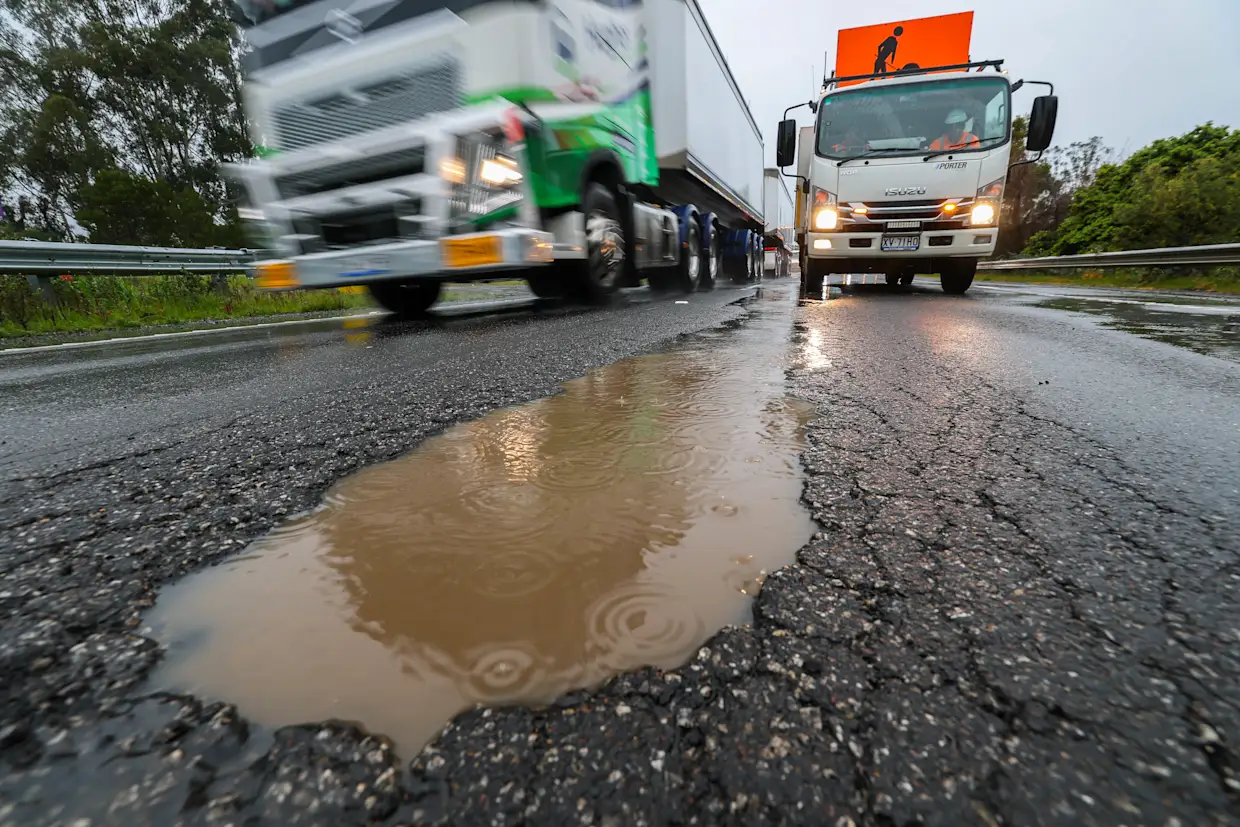
The Bunyip incident also follows repeated pothole problems on Victorian roads. More than 20 cars were damaged near Nar Nar Goon on the same freeway in November 2025. Motorists near Warrnambool later reported repair bills worth hundreds of dollars after striking potholes on the Princes Highway in June 2026.
Disruption on a major road can spread well beyond the site of the original incident. An earlier M80 truck rollover affecting Princes Freeway connections similarly produced wider delays across Melbourne’s road network.
Read More
Repair bills, evidence and compensation
Drivers who hit a pothole should first move as far from live traffic as safely possible, activate their hazard lights and avoid standing close to a moving lane. Walking back towards the defect to take photographs is not worth the risk if there is no safe roadside access.
When conditions allow, motorists should record the location, time and direction of travel. Photographs of the tyre, rim, road surface and nearby signs can help establish where the incident happened. Dashcam footage, witness details, towing receipts and repair invoices should also be retained.
A tyre may not be the only damaged component. A hard impact can bend the inner edge of a rim or affect alignment and suspension without leaving obvious external signs. A mechanical inspection can identify damage before it causes uneven tyre wear or handling problems.
Motorists may contact their insurer and can also seek compensation from the road authority. The Victorian Department of Transport and Planning explains its official procedure for road-related damage claims. Eligibility depends on the circumstances, evidence and requirements of the Road Management Act, so payment is not automatic.
Past results show the difficulty of securing compensation. The department received 1,532 claims involving pavement and surface defects during the 2022–23 financial year, but only one was assessed as payable.
The condition of Victoria’s roads is now a significant issue ahead of the November 2026 state election. The government has announced $1.04 billion in road funding, with 70 per cent allocated to regional Victoria. The Coalition has pledged $5 billion for road repairs and rebuilding if it wins office.
The main Bunyip pothole has been patched, but the episode leaves a practical warning for motorists: standing water can conceal serious road damage. Reducing speed smoothly, leaving more space and checking current traffic conditions can provide valuable reaction time during the next period of heavy rain.

Make Swikblog your go-to source on Google for reliable updates, smart insights, and daily trends.