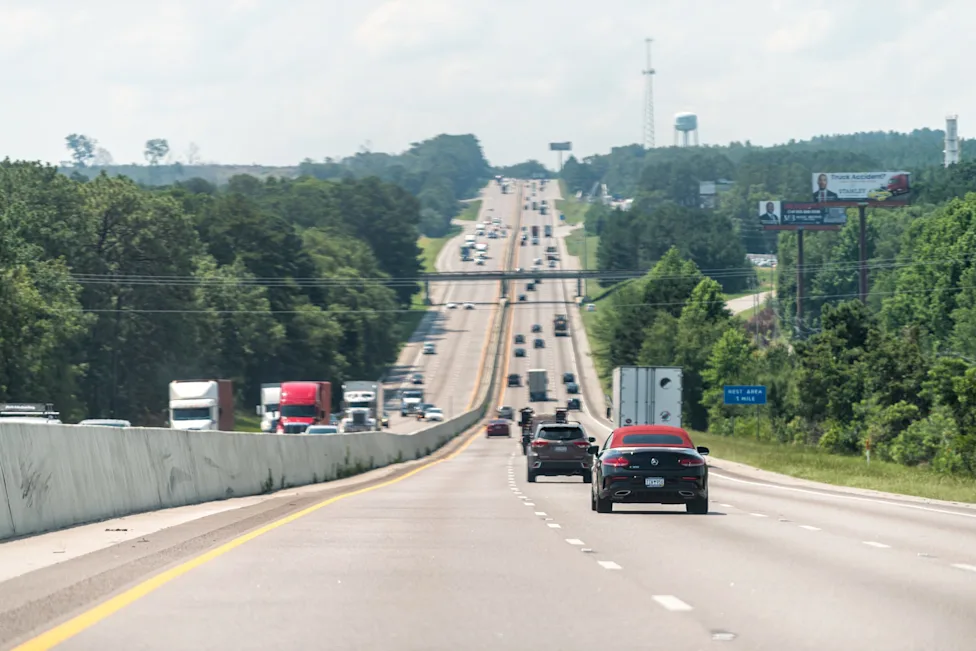

California is testing a new way to tackle traffic congestion on one of Southern California’s busiest commuter corridors, and it does not involve building more lanes.
The state has launched a $33 million Smart Freeway pilot on northbound Interstate 15 between Temecula and Murrieta, using connected traffic technology to manage how vehicles enter the freeway. Transportation officials believe the project could improve traffic flow and reduce travel times, even though some drivers may have to wait longer before merging.
The initiative comes as transportation agencies search for alternatives to costly highway expansion projects. With traffic volumes continuing to grow and construction budgets under pressure, smart traffic-management systems are increasingly being viewed as a practical way to improve existing roads without years of major construction.
California Is Using Technology Instead of More Pavement
The pilot covers an eight-mile stretch of Interstate 15 from the San Diego-Riverside County line in Temecula to the I-15/I-215 interchange in Murrieta. Rather than widening the freeway, officials are relying on sensors, coordinated ramp meters and digital speed signs to manage traffic more efficiently.
Transportation planners have long argued that adding lanes can offer temporary relief before congestion returns. The Smart Freeway project is designed to improve the performance of the existing corridor by controlling how traffic enters the roadway during busy periods.
The approach reflects a broader shift toward technology-driven transportation systems. Governments are investing in digital tools to improve mobility and efficiency, similar to the planned Western Australia digital driver’s licence rollout, which aims to modernize how motorists access essential driving credentials.
How the Smart Freeway System Works
The project focuses on three key on-ramps: Temecula Parkway, Rancho California Road and Winchester Road. Unlike traditional ramp meters that operate independently, these locations are coordinated as part of a single traffic-management network.
Roadside sensors continuously monitor traffic speeds and congestion levels. The system then adjusts ramp-meter timing in real time, controlling how many vehicles enter the freeway and when they are released.
Digital signs along the corridor also display recommended speeds to help maintain smoother traffic flow. Officials say reducing sudden braking and aggressive merging can help prevent traffic waves that quickly create miles of congestion.
The technology relies on traffic-management algorithms and live roadway data. However, transportation officials have emphasized that the system is not powered by artificial intelligence. Instead, it uses pre-programmed traffic-engineering strategies designed to respond to changing traffic conditions.
Why Drivers Could Face Four-Minute Ramp Delays
The most talked-about part of the project is the potential wait time at freeway entrances. Depending on traffic conditions, some drivers could experience delays of up to four minutes before being allowed onto Interstate 15.
For many commuters, that may sound like an inconvenience rather than a solution. Yet traffic engineers argue that carefully controlling freeway access can reduce larger delays later in the journey.
When too many vehicles merge into already crowded lanes, traffic flow can quickly break down. A controlled delay at the ramp is intended to prevent those disruptions and create a more consistent driving experience once motorists are on the freeway.
Officials say the objective is not simply to get drivers onto the highway faster, but to reduce total trip time across the entire corridor.
Can the Project Actually Save Time?
Supporters of the Smart Freeway pilot point to results from similar projects in other regions. Comparable systems have been used in Denver, where travel times reportedly improved by roughly 20 percent.
International examples have shown even larger gains in some cases. In parts of Australia, smart freeway technology has been associated with travel-time reductions ranging from 35 percent to 65 percent, depending on roadway conditions and traffic volumes.
Whether California achieves similar results remains uncertain. Local traffic patterns, driver behavior, ramp demand and commuter volume can all influence the effectiveness of coordinated traffic-management systems.
The pilot is scheduled to operate for two years, allowing transportation agencies to collect data on traffic speeds, congestion levels, travel times and driver experience.
What the Results Could Mean for California
If the Interstate 15 project delivers measurable improvements, it could become a model for future congestion-reduction efforts across California. Transportation agencies are under increasing pressure to improve mobility while controlling infrastructure costs.
Read More
Smart traffic-management systems offer a potentially lower-cost alternative to major construction projects, especially in urban areas where expanding highways can be difficult, expensive and disruptive.
For now, commuters along Interstate 15 will play a central role in determining whether the experiment succeeds. The project’s ultimate value will not be measured only by how long drivers wait at a ramp meter, but by whether they spend less time sitting in traffic overall.
If the system works as intended, California’s Smart Freeway pilot could show that the fastest way onto a freeway is not always the fastest way home.
Source: Smart Freeway Pilot Project details

Make Swikblog your go-to source on Google for reliable updates, smart insights, and daily trends.