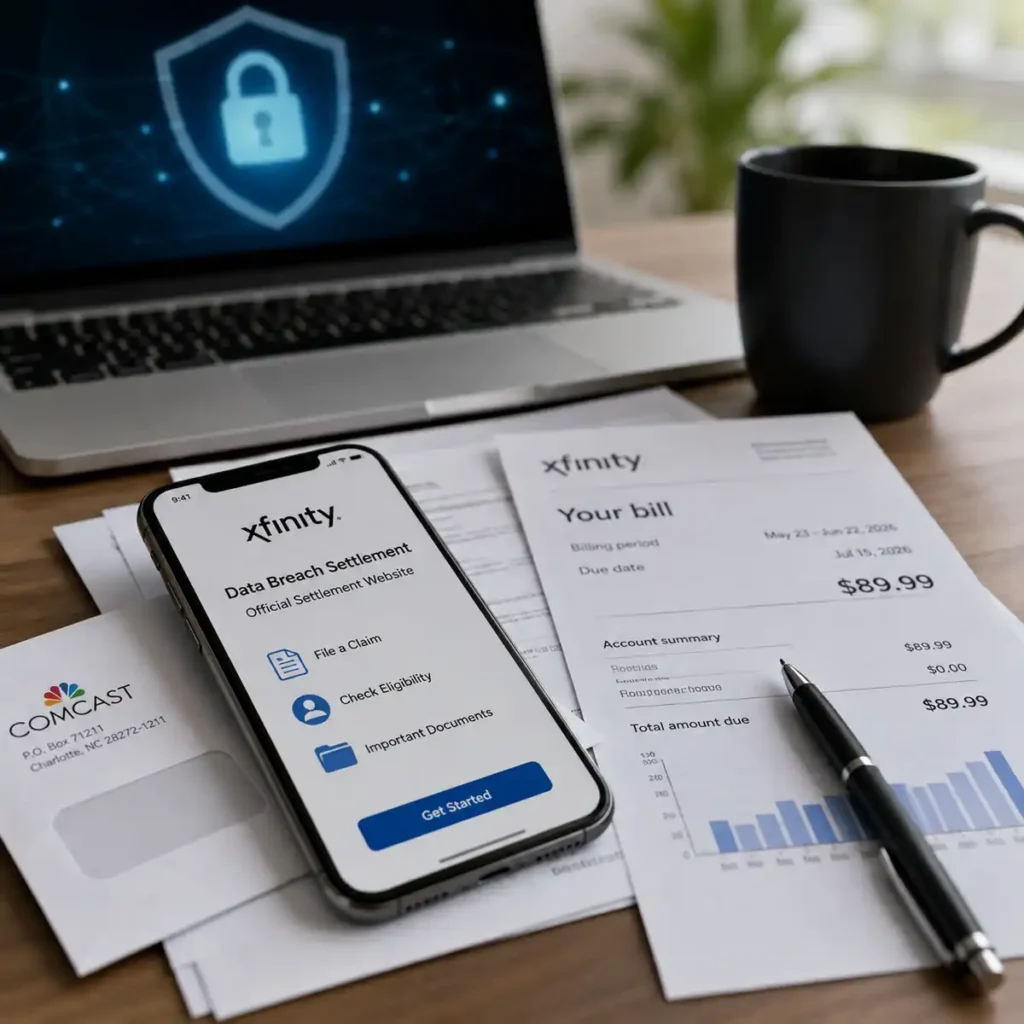

Comcast has agreed to establish a $117.5 million settlement fund to resolve a class-action lawsuit tied to the 2023 Xfinity data breach, giving eligible current and former customers a chance to seek cash or reimbursement for qualifying losses.
The key date is September 14, 2026. Eligible class members can request an alternative cash payment estimated at $50 or seek reimbursement for documented out-of-pocket losses and lost time, subject to a combined maximum of $10,000.
Those figures need some context: not every Comcast customer qualifies, the $50 amount can change, and the $10,000 figure is a maximum rather than an automatic payment.
Who is eligible for the Comcast settlement?
The settlement generally covers people living in the United States and its territories who were sent an individual notification about the October 2023 data breach. Comcast publicly disclosed the incident in December 2023, with affected customers receiving notices around December 18.
That means simply being an Xfinity customer is not enough. People who received the breach notice are the group that should check their settlement eligibility and locate their Settlement Class Member ID.
What happened in the Xfinity data breach?
The case stems from an October 2023 cybersecurity incident involving a vulnerability in Citrix software used by Xfinity. Unauthorized access occurred between October 16 and October 19, 2023.
Information involved included usernames and hashed passwords. For some customers, the affected data also included names, contact information, dates of birth, the last four digits of Social Security numbers and secret questions and answers.
The lawsuit accused Comcast of failing to adequately protect personal information and maintaining insufficient data security. Comcast denies wrongdoing and liability, and the settlement does not amount to a court finding that the company violated the law.
The case adds to broader concerns surrounding large consumer cybersecurity incidents. A separate Carnival data breach affecting nearly 6 million customers recently highlighted how stolen personal information can create risks long after attackers first gain access.
How much money could customers receive?
Eligible class members have two main monetary options.
Alternative Cash Payment: Customers can request a payment estimated at $50. The amount is subject to proportional adjustment, meaning the final payment can change depending on the number of approved claims and money available in the net settlement fund.
Documented losses and lost time: Customers can instead seek reimbursement for qualifying expenses and lost time connected with the breach, subject to an aggregate maximum of $10,000.
Eligible expenses can include certain unreimbursed costs connected with identity theft, fraud, credit monitoring, credit reports, credit freezes or other measures taken in response to the breach. Supporting records such as receipts, invoices, bank statements or credit-card statements may be required.
Customers familiar with other consumer settlements may recognize this structure. The Krispy Kreme data breach settlement similarly distinguished between a standard cash benefit and larger reimbursement tied to documented losses.
Lost time could also qualify
The settlement allows compensation for up to five hours of qualifying lost time at $30 per hour, for a maximum lost-time component of $150. This can cover eligible time spent responding to fraud or taking permitted measures related to the breach.
The lost-time amount counts toward the broader $10,000 maximum rather than being an automatic additional payment.
Customers also get identity-protection benefits
Cash is not the only benefit. Settlement class members are entitled to three years of CyEx Financial Shield Complete, which includes credit monitoring, dark-web monitoring, financial-account monitoring, security-freeze assistance and other identity-protection services.
The package also includes $1 million in identity-theft insurance. Class members were provided enrollment codes for these services.
Why the $117.5 million will not all become customer checks
The settlement fund also pays permitted notice and administration costs, court-approved attorneys’ fees and expenses, service awards and costs associated with identity-defense services.
The remaining net fund is used for approved customer claims. That is why the $50 alternative payment can be adjusted depending on the number and value of claims.
Disney Settlement 2026: Claim Details and Latest Updates
How to submit a Comcast settlement claim
Online claims must be submitted by 11:59 p.m. ET on September 14, 2026. Paper claims must be postmarked by the same date.
Customers should use the official Comcast Data Breach Settlement website to check eligibility, find a Class Member ID, review settlement documents and submit a claim.
The administrator is Kroll Settlement Administration. Customers with questions can call (833) 319-2401 or write to Hasson v. Comcast Cable Communications LLC, c/o Kroll Settlement Administration LLC, P.O. Box 5324, New York, NY 10150-5324.
When will settlement payments arrive?
A final approval hearing was scheduled for August 5, 2026, but that should not be confused with a payment date. Distribution depends on the settlement becoming final, claim processing and any applicable challenges or appeals.
Customers who do nothing will not receive a cash settlement payment, although eligible class members can still enroll in the identity-defense services after the settlement becomes final. The deadlines to opt out or object were July 1, 2026.
The case is Hasson v. Comcast Cable Communications, LLC, No. 2:23-cv-05039-JMY in the U.S. District Court for the Eastern District of Pennsylvania. Eligible customers seeking reimbursement should gather supporting records before filing rather than assuming the advertised $10,000 maximum applies automatically.

Make Swikblog your go-to source on Google for reliable updates, smart insights, and daily trends.