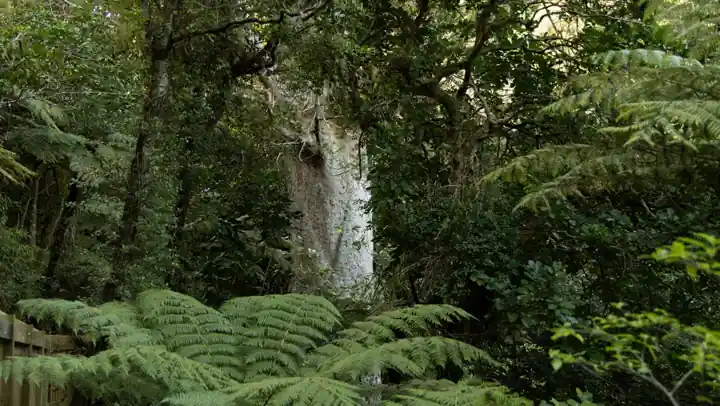

A positive soil test has confirmed kauri dieback beside a 1,200-year-old tree at Long Bay Kauri Walk on the Coromandel Peninsula. The ancient kauri has already received treatment, but officials cannot yet say whether it will survive.
The discovery is also a public biosecurity concern. Because the tree stands beside a well-used walking track near Coromandel town, visitors could unknowingly carry infected soil into other parts of New Zealand’s remaining kauri forests.
What visitors need to know
- Location: Long Bay Scenic Reserve, around three kilometres from Coromandel town.
- Disease confirmed: Soil testing detected Phytophthora agathidicida, or PA.
- Tree’s age: Approximately 1,200 years.
- Treatment: Phosphite has been injected into the tree.
- Survival: The treatment may slow its decline but cannot cure the infection.
- Track access: The initial announcement did not declare the entire walk closed.
From warning signs to a confirmed diagnosis
The tree did not suddenly become sick this week. Waikato Regional Council, Thames-Coromandel District Council and local iwi had monitored it since 2023 after receiving several reports that it appeared unwell.
Those symptoms were not enough to prove kauri dieback. Drought, physical root damage and other environmental pressures can also affect a tree’s canopy and general condition. Soil analysis was therefore needed to establish whether PA was present.
The official council announcement on August 4, 2026, confirmed the positive result. Biosecurity and Biodiversity Manager Patrick Whaley said the diagnosis was disappointing, particularly because recorded cases remain relatively limited on the Coromandel Peninsula.
Treatment offers hope, not certainty
Plant pathologist Dr Ian Horner was involved in treating the tree with phosphite. The substance is injected into the trunk to suppress the pathogen and encourage the kauri’s natural defences.
Phosphite cannot remove PA from the tree or surrounding soil. It is most useful when applied before an infection becomes too advanced, and treatment may need to be repeated every five or six years.
Results from other trees provide cautious hope. In one long-term trial cited by the council, all 28 treated kauri remained alive more than a decade later. Eight of 14 untreated comparison trees died, while the remaining six were in very poor health.
Specialists will now watch for changes such as drying lesions, healthier tissue and improved foliage. These signs can take months or years to emerge, so there is no immediate test that can predict the ancient tree’s survival.
Why one muddy shoe can matter
PA is a microscopic, fungus-like water mould that lives in soil. It infects kauri through their roots, restricting the transport of water and nutrients until the tree becomes progressively weaker.
Symptoms can include bleeding gum around the lower trunk, yellow leaves, dead branches and a thinning canopy. A tree may be infected for years or decades before those signs become obvious, while the pathogen can remain viable in soil for more than eight years.
Footwear, walking poles, tools, bicycles and vehicles can move contaminated soil. Animals—including pets, livestock and wild pigs—can also spread it, while rainwater may carry it over shorter distances.
Kenya Elephant Poisoning Near Amboseli: Cyanide Investigation and What Authorities Know
Golden Eagle Found With 17 Shotgun Pellets in Scotland: Wildlife Crime Investigation
Visit the homepage for the latest wildlife news, environmental updates and breaking stories
Is Long Bay Kauri Walk still open?
No full closure was announced when the diagnosis was confirmed. However, access conditions may change while officials assess the site, so visitors should check current Thames-Coromandel District Council notices before setting out.
Walkers should arrive with completely clean footwear, use every hygiene station and clean their shoes and equipment again when leaving. They must remain on the formed track, obey barriers and avoid approaching the tree for photographs.
Kauri roots are shallow and can spread far beyond the trunk—potentially reaching around three times the canopy’s radius. Stepping off the path can damage those roots while bringing visitors into contact with infected soil.
Why the loss would be irreplaceable
Kauri live for approximately 600 years on average, making the Long Bay tree about twice that age. Kauri are also taonga, or treasures, with deep cultural importance for Māori, and they help create habitat for other native plants, birds and insects.
Less than 1% of New Zealand’s original kauri forest remains after extensive historical logging. That limited natural inheritance makes the infection of an ancient, publicly accessible tree especially significant.
The diagnosis adds to recent concern about important Coromandel vegetation following the separate poisoning of pōhutukawa trees at Hahei Beach. Positive developments elsewhere, including the recovery of New Zealand’s rarest native bird population, show why long-term monitoring and protective action remain worthwhile.
Further soil testing may determine whether PA is present elsewhere around Long Bay. For now, treatment may prolong the tree’s life, while careful track use offers the best protection for the younger kauri growing around it.

Make Swikblog your go-to source on Google for reliable updates, smart insights, and daily trends.