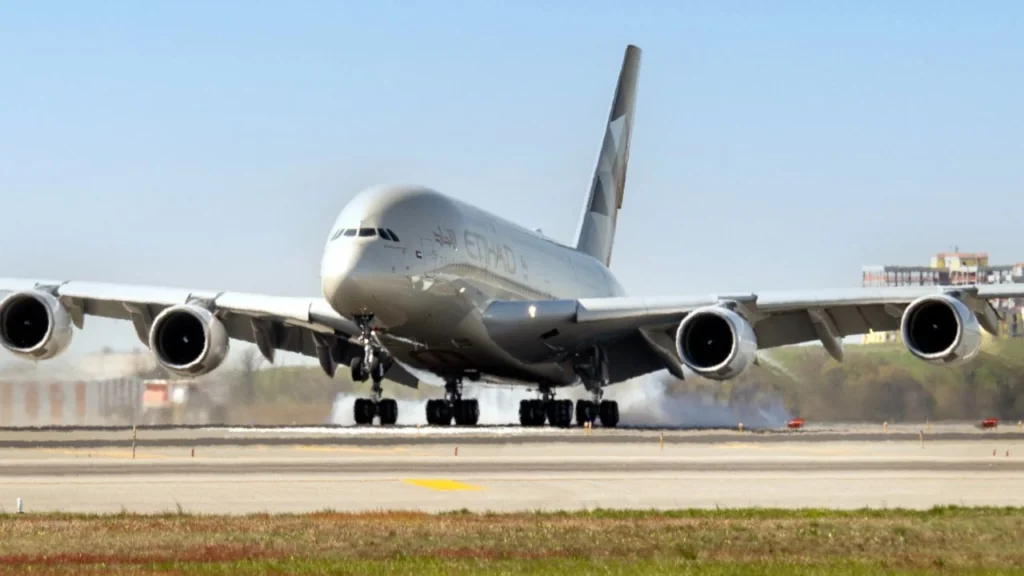

Etihad Airways’ Abu Dhabi to Toronto service faced an unexpected disruption after an Airbus A380 operating flight EY21 diverted to Munich following a medical emergency onboard. The aircraft, registered A6-APH, landed safely at Munich Airport on May 2, turning what is normally a direct long-haul journey to Canada into a rare aviation event in Germany.
The flight had departed Abu Dhabi Zayed International Airport for Toronto Pearson International Airport, one of Etihad’s key long-haul routes. Midway through the journey, the crew altered course and selected Munich as the diversion point, allowing medical support to be provided on the ground. In aviation, such decisions are taken quickly and are guided by safety, airport suitability, weather, and access to emergency services.
For more aviation updates and global travel developments, readers can also follow related coverage on Swikblog.
Etihad A380 Makes Rare Munich Landing
The aircraft involved was an Airbus A380-861, one of Etihad’s flagship double-decker jets. The A380 is not a regular visitor on Etihad’s Munich route, which makes this diversion especially notable for passengers, airport staff, and aviation enthusiasts.
Etihad usually operates its scheduled Abu Dhabi–Munich service with Boeing 787-9 Dreamliner aircraft. Munich is therefore not part of the airline’s normal A380 schedule, even though the airport itself is fully capable of handling superjumbo operations.
Munich Airport has the runway length, ground handling capability, and infrastructure required for Airbus A380 movements. The airport also sees A380 activity from other major carriers, which made it a suitable alternate airport when EY21 needed to land urgently.
The diversion was caused by a medical emergency onboard. While details about the passenger’s condition were not publicly disclosed, medical diversions are standard practice when crew members believe a traveller needs urgent care that cannot wait until the planned destination.
Flight crews are trained to work with medical professionals where available, consult ground-based support if needed, and coordinate with air traffic control before diverting. The International Air Transport Association notes that safety remains the central priority in airline operations, and medical diversions are handled through established procedures involving crew, controllers, airport teams, and emergency responders.
The A380’s size adds another layer of complexity. Etihad’s superjumbo can carry around 486 passengers across multiple cabins, including Economy, Business, First Class Apartments, and The Residence. Managing an unscheduled stop for an aircraft of this scale requires more than simply assigning a runway. Ground teams must handle passenger movement, possible medical evacuation, baggage coordination, crew duty limits, catering, refuelling, and onward travel planning.
Read More
Why This Diversion Stands Out
What makes the incident more than a routine diversion is the combination of route, aircraft, and location. Etihad uses its A380 fleet on a small number of high-demand international routes from Abu Dhabi, including Toronto. Munich, however, is not one of the airline’s planned A380 destinations.
That made the sight of an Etihad A380 at Munich Airport unusual. For planespotters, the aircraft’s arrival represented a rare moment. For passengers, it meant delays while the airline worked through the operational challenge of getting hundreds of travellers back on their journey to Toronto.
Etihad’s A380 fleet has become increasingly visible again as the airline expands superjumbo operations on selected long-haul routes. The aircraft remains one of the most recognisable passenger jets in the world, known for its double-deck design and premium onboard products. Its deployment is carefully planned because the aircraft requires high demand, specialised airport support, and strong route economics.
On a route such as Abu Dhabi to Toronto, the A380 helps Etihad serve strong long-haul demand with a large number of seats. But when such an aircraft diverts, the airline must make quick decisions about whether the same aircraft can continue, whether passengers need to remain at the airport, or whether alternative arrangements are required.
Passengers on EY21 likely faced delays as Etihad assessed the medical situation, aircraft readiness, crew timing, and onward operating plan. These decisions can take time, particularly when a wide-body aircraft lands at an airport outside its scheduled network plan.
Still, the safe landing at Munich shows how global aviation systems are designed to respond when a flight plan changes suddenly. Long-haul aircraft cross multiple regions, and airlines must always have suitable alternates available in case of medical issues, technical concerns, weather disruption, or other unexpected events.
For Toronto-bound passengers, the diversion was an inconvenience, but it also reflected the correct safety-first approach. Airlines cannot take risks when a medical emergency develops at cruising altitude. In such cases, reaching a capable airport quickly becomes more important than maintaining the original schedule.
The incident also highlights Munich Airport’s importance as a reliable European diversion point. Its ability to receive an Airbus A380, support large passenger volumes, and coordinate emergency response makes it a practical choice for long-haul flights crossing European airspace.
Etihad’s EY21 diversion will likely be remembered not only for the medical emergency but also for the rare appearance of the airline’s A380 at a German airport where it does not normally operate the type. The episode underlines the unpredictable nature of long-haul aviation, where even the most carefully planned flights can change course within minutes when passenger safety demands it.
As Etihad continues to rebuild and expand its A380 network, such unscheduled appearances remain uncommon. But when they do happen, they offer a clear reminder of the operational depth behind every international flight — from cockpit decision-making to airport readiness and passenger care on the ground.

Make Swikblog your go-to source on Google for reliable updates, smart insights, and daily trends.