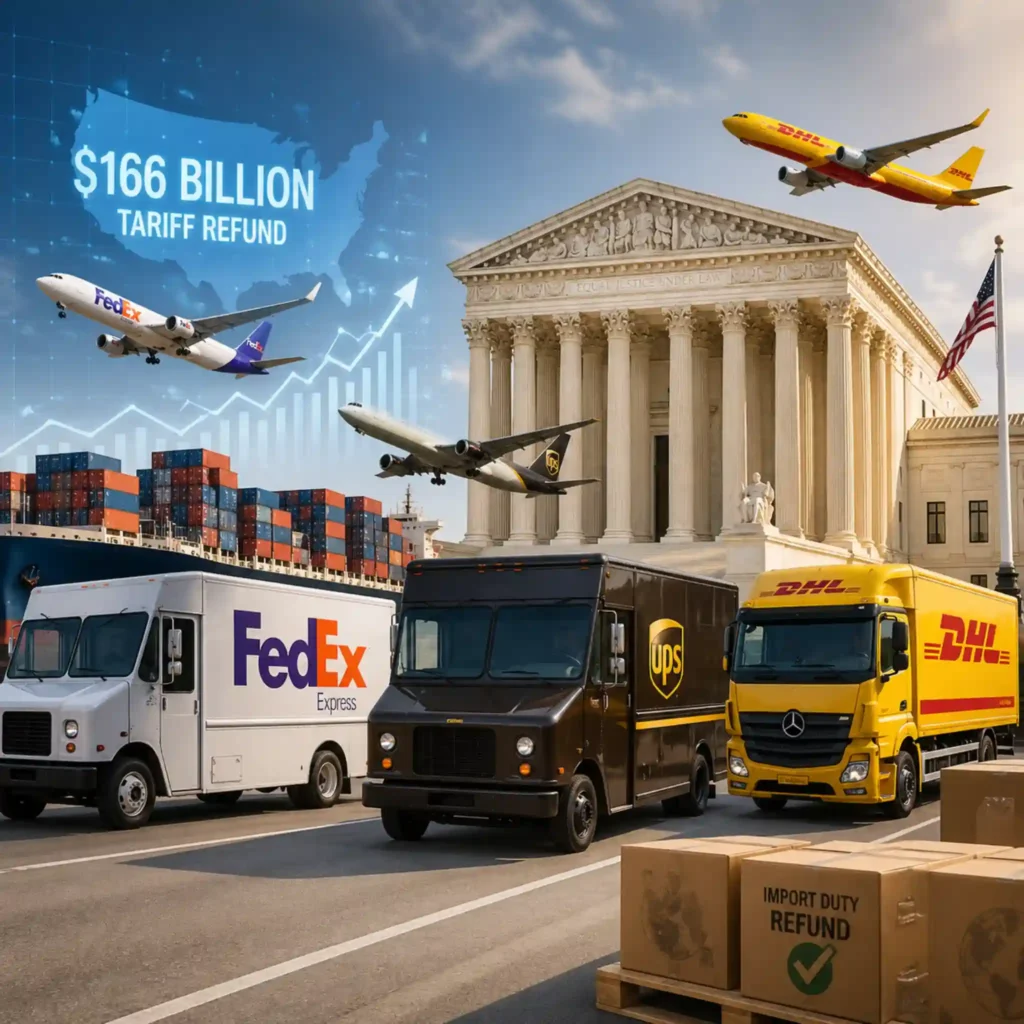

FedEx, UPS, and DHL are moving rapidly to claim a share of an estimated $166 billion in tariff refunds after a landmark U.S. Supreme Court ruling struck down key trade duties imposed over the past year. The decision is now triggering one of the largest refund processes in U.S. trade history, with logistics companies stepping in first—and promising to pass the money back to customers who ultimately paid higher prices.
The ruling centered on tariffs imposed under the 1977 International Emergency Economic Powers Act (IEEPA), which the Supreme Court determined had been applied unlawfully in this case. As a result, billions of dollars collected from importers are now eligible for repayment, opening a narrow but high-stakes window for claims.
Shipping giants begin filing claims immediately
FedEx confirmed it has already begun filing claims to recover tariffs paid over the past year, signaling a fast response from the logistics sector. DHL and UPS have also announced similar moves, positioning themselves at the forefront of the refund process.
The urgency reflects both the scale of potential recoveries and the structure of the system. Only the importer of record—the entity that originally paid the tariffs—can apply for refunds. In many cases, this responsibility falls on large shipping and logistics companies, which handled cross-border transactions on behalf of businesses.
To facilitate the process, U.S. Customs and Border Protection (CBP) has launched an online claims portal, allowing companies to begin submitting refund applications. Early filings suggest that major logistics players are acting quickly to secure their share of the available funds.
Refunds tied to customer payments on shipping invoices
Unlike many trade-related costs, tariffs are often clearly itemized on shipping invoices. This transparency strengthens the case for customers seeking reimbursement, as businesses can directly link tariff charges to specific shipments.
Recognizing this, all three major shipping firms have publicly committed to returning funds to customers once refunds are received from the government. DHL stated it is “committed to helping customers recover tariffs they paid,” while UPS emphasized it is filing claims on behalf of customers. FedEx has also indicated it is developing processes to distribute funds back to payors.
However, customers will need to wait. Companies have clarified that refunds will only be issued after they themselves receive funds from CBP, creating a multi-step timeline before any money reaches end users.
Refund timeline suggests summer payouts
The refund process is expected to take several months. Government estimates indicate that claims could take around 45 days for review, followed by an additional 60 to 90 days for payment processing once approved.
This places the earliest realistic payout window in summer 2026. Logistics firms are already setting up dedicated information pages and communication channels to guide customers through the process and manage expectations.
Importantly, not all tariffs will be refunded. The Supreme Court ruling applies specifically to duties imposed under IEEPA, leaving other sector-specific tariffs outside the scope of repayment. Even with these limitations, the total eligible amount remains substantial at approximately $166 billion.
Political pressure and legal scrutiny intensify
The refund process is unfolding under significant political and legal scrutiny. At least 17 lawsuits have already been filed against companies including FedEx, UPS, and major retailers, alleging that businesses may retain funds instead of passing them to customers.
Lawmakers have also stepped in. During recent hearings before the House Ways and Means Committee, U.S. Trade Representative Jamieson Greer faced repeated questions about ensuring that refunds reach consumers rather than remaining within corporate balance sheets.
The debate reflects a broader issue in global trade: while companies pay tariffs at the border, the cost is frequently passed along through supply chains, ultimately affecting consumer prices. As a result, there is growing pressure to ensure that refunds reverse those price increases where possible.
Additional complexity comes from the political stance of former President Donald Trump, who has openly criticized the refund process. He suggested that companies choosing not to pursue refunds could receive favorable recognition, adding a layer of strategic decision-making for corporations weighing financial recovery against political considerations.
Some refund money may flow overseas
Another dimension of the debate involves the destination of refund payments. Officials have acknowledged that some funds may be returned to foreign companies that acted as importers or are integrated into global supply chains.
This has sparked discussion around whether U.S. trade policy outcomes could inadvertently benefit overseas firms, particularly those connected to manufacturing networks in China and other major export economies.
Despite these concerns, trade officials have emphasized that the refund system is designed to return money to the original payors, regardless of their geographic location.
Investor focus shifts to logistics sector
The developments are drawing strong attention from investors, with logistics companies emerging as key beneficiaries of the refund process—at least in the short term. The ability to recover billions in previously paid tariffs could strengthen cash positions and improve financial flexibility.
However, the ultimate financial impact will depend on how much of the refunded money is passed back to customers. While companies have made public commitments, the mechanics of distribution and potential administrative costs could influence outcomes.
For markets, the situation introduces both opportunity and uncertainty. The ruling sets a precedent for challenging trade policies, raising questions about the stability of future tariff regimes and the potential for additional legal disputes.
As the claims process accelerates, logistics firms will play a central role in determining how quickly funds move through the system. With billions at stake, heightened political attention, and growing consumer expectations, the tariff refund push is shaping up to be one of the most closely watched financial developments of the year.
Full reporting on this development can be followed via Yahoo Finance coverage, which continues to track updates as claims progress.

Make Swikblog your go-to source on Google for reliable updates, smart insights, and daily trends.