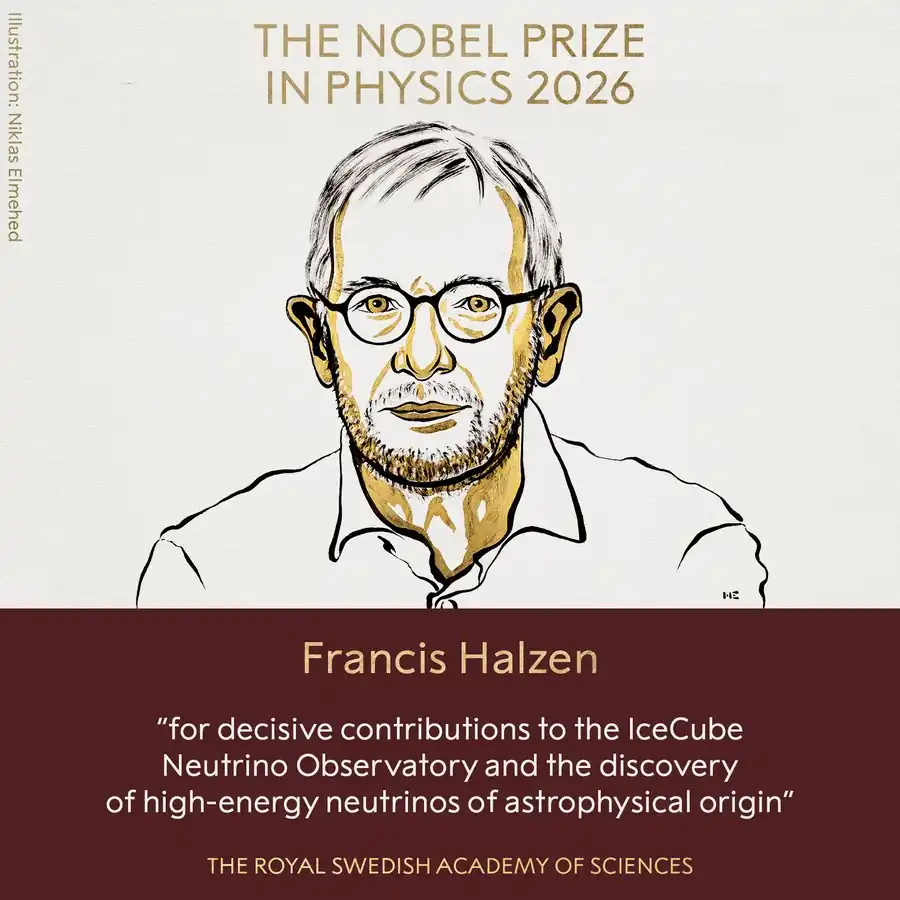

Francis Halzen has won the 2026 Nobel Prize in Physics for his decisive contributions to the IceCube Neutrino Observatory and the discovery of high-energy neutrinos from beyond the solar system — work that opened a new way of observing the universe.
BREAKING NEWS The Royal Swedish Academy of Sciences has decided to award the 2026 #NobelPrize in Physics to Francis Halzen “for decisive contributions to the IceCube Neutrino Observatory and the discovery of high-energy neutrinos of astrophysical origin.” https://t.co/UcPBWk0RiK
— The Nobel Prize (@NobelPrize) October 6, 2026
The Royal Swedish Academy of Sciences announced the award on October 6, naming the University of Wisconsin–Madison physicist as the sole Physics laureate for 2026. Halzen will receive the full 12 million Swedish kronor prize for a scientific effort that turned a vast section of Antarctic ice into a telescope for detecting some of nature’s most elusive particles.
Francis Halzen’s IceCube breakthrough wins the Nobel
The Academy awarded Halzen the prize “for decisive contributions to the IceCube Neutrino Observatory and the discovery of high-energy neutrinos of astrophysical origin.”
The Royal Swedish Academy of Sciences said Halzen presented his vision for using South Pole ice to detect neutrinos in 1988. Earlier work with the AMANDA experiment helped demonstrate that deep Antarctic ice could serve as a particle detector, paving the way for the much larger IceCube project.
How IceCube detects ‘ghost particles’ beneath Antarctica
Neutrinos are electrically neutral elementary particles that interact so weakly with matter that enormous numbers can pass through Earth without being detected. That elusive behavior has earned them the informal nickname “ghost particles.”
IceCube tackles the detection problem by using roughly one cubic kilometre of Antarctic ice. The observatory contains 5,160 light-sensitive sensors installed deep beneath the South Pole.
On rare occasions, a neutrino interacts with matter in or near the detector. Charged particles produced by the interaction generate a faint flash of Cherenkov light. IceCube’s sensors capture that light, helping researchers estimate the incoming neutrino’s direction and energy.
The completed IceCube detector began operating in 2011, following years of construction in one of the world’s most challenging environments.
The 2013 discovery changed neutrino astronomy
The breakthrough recognized by the Nobel Committee became clear in 2013, when the IceCube Collaboration reported compelling evidence of a population of extremely energetic neutrinos originating beyond the solar system.
The discovery mattered because neutrinos can reach Earth from environments that may be difficult to investigate with ordinary telescopes. Unlike charged cosmic rays, neutrinos are not significantly deflected by magnetic fields, making their arrival directions valuable clues to their origins.
Scientists can combine neutrino observations with visible light, radio waves, X-rays, gamma rays and gravitational waves — an approach known as multi-messenger astronomy.
María Corina Machado Missing Before Nobel Peace Prize Appearance Canceled in Oslo
IceCube has traced neutrinos toward cosmic sources
Researchers have since moved from simply proving that astrophysical neutrinos exist toward identifying where they come from.
A high-energy neutrino detected in 2017 was associated with the distant blazar TXS 0506+056, an active galaxy powered by a supermassive black hole. IceCube has subsequently reported evidence involving the active galaxy NGC 1068 and high-energy neutrino emission from the Milky Way.
These observations give scientists another way to investigate powerful cosmic particle accelerators and environments surrounding black holes and other extreme astronomical objects.
Francis Halzen’s Decades-Long Journey to the Nobel Prize
Halzen was born in Tienen, Belgium, in 1944 and received his PhD from KU Leuven in 1969. He later joined the University of Wisconsin–Madison, where his research has spanned particle physics, astrophysics and cosmology.
He remains the principal investigator of IceCube. His decades-long effort has taken the project from an ambitious Antarctic experiment to an international observatory involving hundreds of scientists.
Halzen’s Nobel recognition adds another chapter to the history of discoveries that changed how scientists observe nature. In India, that tradition is strongly associated with C.V. Raman, whose Nobel-winning research is remembered through National Science Day and the Raman effect.
IceCube’s search is far from over
The Nobel Prize recognizes a breakthrough, but IceCube continues operating beneath the South Pole. Scientists are using its growing dataset to search for additional neutrino sources and better understand the universe’s most energetic processes.
The U.S. National Science Foundation renewed a $53 million, five-year agreement for 2026–2031 with the University of Wisconsin–Madison for IceCube operations and maintenance, underscoring the observatory’s continuing scientific role.
The research also fits into the wider story of how new observational tools transform science, explored in Swikblog’s coverage of light and technologies used to observe the universe.
Halzen is expected to formally receive his Nobel Prize on December 10, the anniversary of Alfred Nobel’s death. By then, the detector that helped earn him science’s most famous award will still be watching the universe from kilometres beneath the Antarctic ice.

Make Swikblog your go-to source on Google for reliable updates, smart insights, and daily trends.