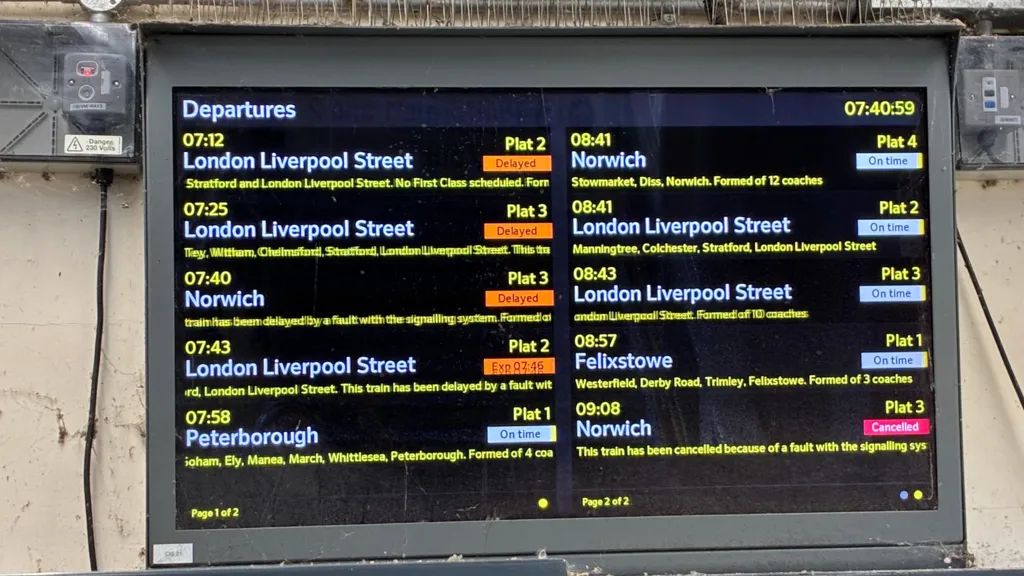

Greater Anglia passengers travelling between London and parts of Essex, Suffolk and Norfolk faced widespread disruption on Monday after a signalling fault at Beaulieu Park near Chelmsford affected around 50 train services.
The failure blocked all lines between Witham and Chelmsford, disrupting trains between London Liverpool Street and Norwich, Ipswich, Clacton-on-Sea, Colchester and Braintree. Services could be cancelled, altered or severely delayed while Network Rail engineers worked to identify and repair the fault.
The disruption began early on Monday morning and had a significant impact on the Great Eastern rail route through Chelmsford towards London. Jonathan Denby, Greater Anglia’s corporate affairs director, said the fault was having a very significant effect on services across the route.
Which Greater Anglia services are affected?
Around 50 services were reported to be affected. Because Beaulieu Park sits on an important section of the Great Eastern Main Line, the consequences extend well beyond Chelmsford.
Passengers travelling to or from Norwich, Ipswich, Colchester, Clacton-on-Sea, Braintree, Chelmsford and London Liverpool Street could face cancellations, delays or revised journeys.
Network Rail engineers were sent to the site, while Greater Anglia advised passengers to check their individual service before travelling. The operator’s official Greater Anglia disruption information should be checked for the latest journey advice.
Passengers should not assume every train on an affected route is cancelled. Some services may operate late or with alterations, while others may require passengers to use a different route.
Norwich and Ipswich passengers face lengthy diversions
Greater Anglia warned that some alternative journeys could take up to three hours, making the disruption particularly difficult for longer-distance passengers.
People travelling from Norwich to London were advised to travel towards Stansted Airport and change for Stansted Express services to London Liverpool Street, or travel via Cambridge.
Passengers travelling from London to Norwich could use Stansted Express to Stansted Airport and change for Norwich services, or travel via Cambridge and Ely.
Those travelling between Ipswich and London were advised to use Cambridge as an alternative route. Passengers using any of these options should allow considerably more time for connections.
Local bus services were also operating in Essex to help passengers travel around the disruption. Greater Anglia was trying to arrange replacement buses, but warned that sourcing enough vehicles was proving difficult because operators had other commitments.
Replacement transport may therefore have less capacity than the normal train service. Passengers with airport connections, appointments or onward journeys should leave substantially more time than usual.
The disruption has similarities with a previous major UK rail signalling fault affecting Stafford and Stoke, where a technical failure led to cancellations, altered journeys and knock-on delays across several important routes.
American Airlines Flight 1760 Hit by Bird Strike
UK Railcard Rule for 18-Year-Olds: What Passengers Need to Know
Wickford derailment adds to Essex rail disruption
Monday’s Beaulieu Park signalling fault is separate from another major problem already affecting Greater Anglia passengers in Essex.
A train derailment at Wickford on Friday had prompted warnings of days of disruption. Greater Anglia said the railway between Billericay and Hockley, on the Shenfield to Southend Victoria route, would remain closed while emergency repairs were carried out.
The two incidents affect different parts of the network. The Beaulieu Park fault is disrupting the main corridor through Chelmsford, while the Wickford derailment affects services towards Southend Victoria.
Having both incidents at the same time can make alternative travel more complicated for passengers moving through Essex.
Rail networks can also remain disrupted after the original technical fault has been fixed because cancelled or delayed services leave trains and crews out of position. A previous Southern England rail communication system failure showed how technical problems can continue to affect passengers while operators work to restore the timetable.
What passengers should do before travelling
Passengers should check live departure information before leaving home and again when reaching the station. During major disruption, departure times, platforms, stopping patterns and alternative travel arrangements can change at short notice.
Travellers using Cambridge, Ely or Stansted Airport as alternative routes should check both their first train and their connecting service.
Passengers delayed by the disruption should retain their ticket and journey details and check Greater Anglia’s Delay Repay rules to see whether they qualify for compensation.
Those who decide not to travel should check the refund conditions applying to their ticket with the retailer from which it was purchased.
Even after engineers restore the signalling system, passengers should not assume the normal timetable will resume immediately. Residual delays, cancellations and short-notice alterations can continue while trains and crews are moved back into position.

Make Swikblog your go-to source on Google for reliable updates, smart insights, and daily trends.