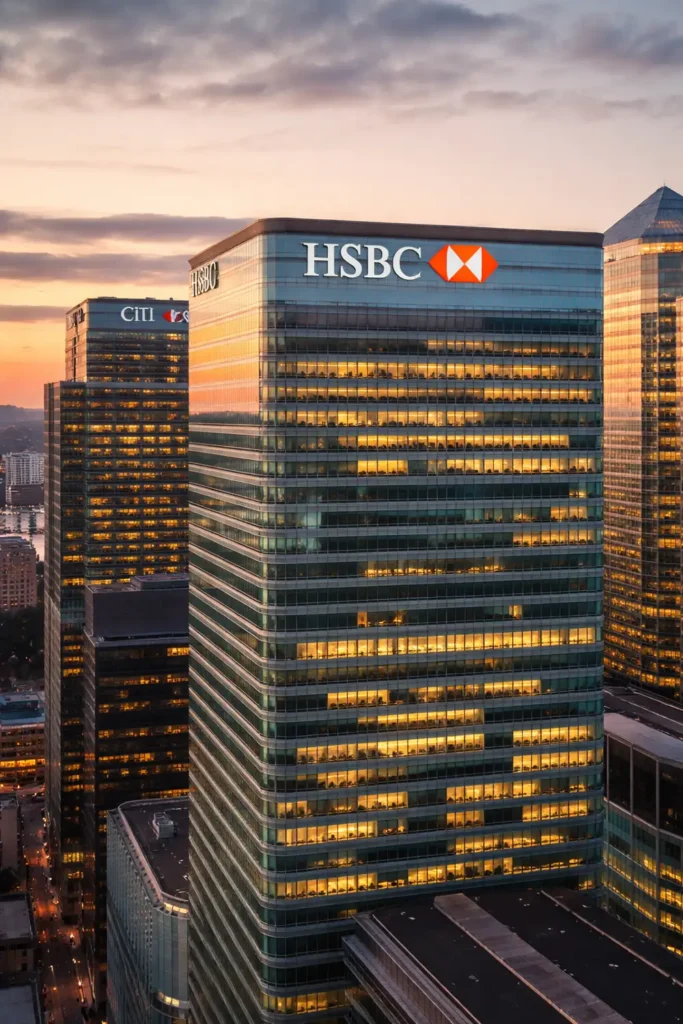

HSBC Holdings plc (HSBA.L) slipped Thursday, but the bigger driver investors are watching isn’t just the red on the screen—it’s whether a fresh wave of market rotation keeps steering money toward large, dividend-paying financials and away from crowded AI trades.
The London-listed shares traded around 1,285.40p, down 12.40p or 0.96% intraday, after opening at 1,306.80p. The stock moved within a day’s range of 1,285.20p to 1,307.00p, putting it near the lower end of the session but still close to its recent highs.
HSBC’s 52-week range is wide—698.70p to 1,322.60p—yet the stock remains within striking distance of that peak. With earnings due next week, investors are weighing whether rotation flows and a steady dividend profile are enough to keep the shares supported and potentially push them back toward the top of the range.
Rotation talk grows louder as investors reassess AI leadership
After months of AI-linked names dominating performance tables, the market mood is shifting. Instead of simply chasing the highest-growth theme, investors are increasingly rotating into sectors seen as more durable—financials, energy, and other value-heavy corners of major indices. In the UK, that rotation tends to benefit big banks, because they combine liquidity, global earnings exposure, and shareholder returns in a way that fits a “stability trade.”
In a segment carried by Bloomberg, HSBC Global Investment Research chief multi-asset strategist Max Kettner said signals in markets suggest downside risk in AI-related stocks may be constrained. That framing matters: it implies investors may not be dumping tech outright, but instead reallocating at the margin—trimming crowded winners and adding to areas offering income and lower volatility.
For HSBC, that’s the kind of environment that can keep dips shallow and allow the stock to grind higher even without a dramatic headline catalyst.
HSBC checks the boxes rotation money tends to like
Even on a down day, the snapshot investors see is a familiar one for big-cap bank bulls: HSBC’s market capitalization was shown around £220.651B, while its beta (5Y monthly) of 0.44 signals lower historical volatility than the broader market. For investors shifting from high-beta momentum trades to steadier names, that difference can be meaningful.
Income is part of the story too. HSBC’s forward dividend and yield were listed at 0.50 and around 3.82%. When rotation takes hold, yield often matters more, because investors are buying a total-return profile—price stability plus cash distributions—rather than paying up solely for potential future growth.
The valuation picture is also being watched. HSBC’s P/E (TTM) of 18.38 and EPS (TTM) of 0.70 reflect the market’s expectation that the bank can keep generating earnings at scale, but they also leave little room for a major stumble. That makes the upcoming earnings report a central test for the “back toward highs” narrative.
Why 1,300p is the line in the sand for traders
Round numbers matter in markets, and for HSBC, 1,300p is a key psychological level. The shares came into the session after a previous close near 1,297.80p, and slipping below that area places attention on whether buyers return quickly—or whether investors stay cautious into earnings.
A decisive move back above 1,300p would likely refocus the discussion on a retest of the 1,322.60p 52-week high. The distance isn’t huge, which is why rotation flows can have an outsized impact: when large institutions allocate, mega-cap financials can move steadily because they’re liquid and widely owned.
Thursday’s volume also adds context. Trading volume was shown around 5,396,610, notably below the listed average volume of 20,656,457. That doesn’t prove anything on its own, but it can suggest the slide wasn’t driven by a broad institutional rush for the exits—more a cautious pullback while the market waits for fresh information.
Earnings next week could determine whether this dip is just noise
HSBC’s earnings date is listed as Feb 25, 2026, and that event is likely to decide whether the stock stays pinned near the upper end of its range or gives back more ground. Investors will be watching for signs of stable profitability, disciplined costs, credit quality trends, and management’s tone on capital returns.
One data point that stands out is the listed 1-year target estimate of 1,182.56p, which sits well below where the stock is currently trading. Targets are estimates, not guarantees, but they highlight why the market’s positioning is sensitive: when a stock trades above target consensus, the company often needs to keep delivering clean results to justify the premium.
If the report reinforces confidence—especially around cash generation and shareholder returns—HSBC’s path back toward its 1,322.60p high can look less like a stretch and more like a natural retest. If the numbers or guidance disappoint, the market could demand a wider cushion.
What investors are watching from here
For now, the rotation thesis is doing a lot of the heavy lifting. Investors are tracking three things closely: whether the “AI trade” continues to cool, whether global risk sentiment stays supportive, and whether HSBC’s earnings next week confirm the bank can keep delivering steady returns.
At 1,285p, the stock is pulling back—but it’s pulling back from a position of strength. If rotation keeps favouring banks and dividend payers, HSBC may not need a perfect environment to drift back toward its 52-week high. It may simply need the market to keep rewarding stability again.
Read more markets coverage on Swikblog, and explore our latest UK reader trend here: North London Derby coverage.

Make Swikblog your go-to source on Google for reliable updates, smart insights, and daily trends.