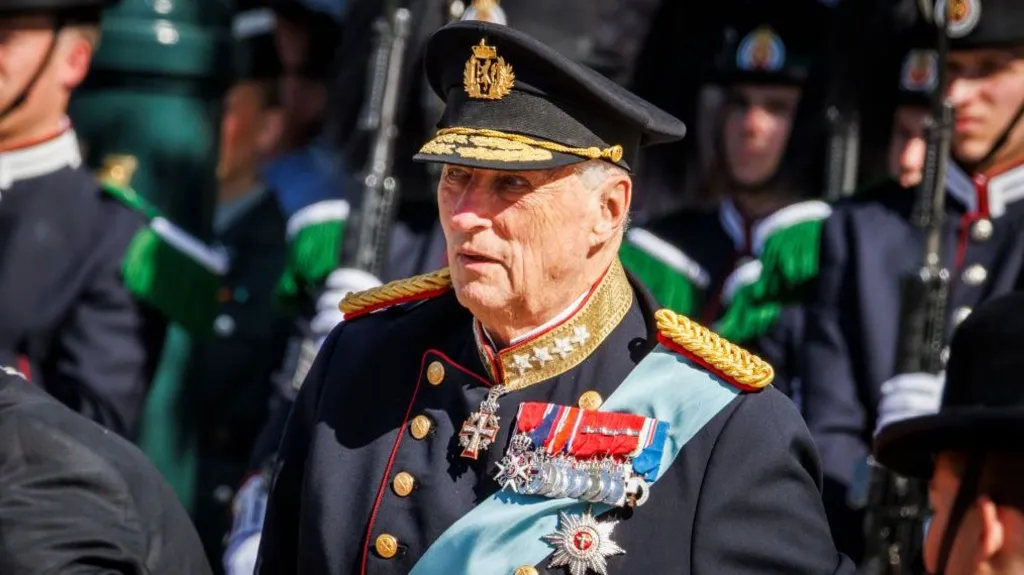

King Harald V of Norway has died aged 89, ending a 35-year reign during which he modernised the monarchy and became a prominent national figure in times of celebration and crisis. Harald died peacefully at Oslo University Hospital Rikshospitalet at 06:35 local time on Friday, August 28, after his health deteriorated during treatment for a rare blood condition. His son Haakon, 53, immediately succeeded him as King Haakon VIII.
The death brings Norway its first change of monarch since 1991. The royal flag at the palace in Oslo was lowered to half-mast as people gathered to leave flowers and Norwegian flags.
What happened to King Harald?
Harald had been receiving cortisone treatment for haemolytic anaemia, a rare condition in which red blood cells are destroyed faster than the body can replace them.
He entered hospital on August 17. His condition later worsened, and the palace said he was being treated with antibiotics for a bacterial infection in his bloodstream.
By August 27, his condition was described as very serious. Members of the royal family visited during his final 24 hours before the Royal Court of Norway announced his death the following morning.
Haakon becomes Norway’s new king
Haakon, who had served as regent during his father’s illness, became king immediately upon Harald’s death. Norway does not wait for a coronation before the successor assumes the throne.
Haakon was born in 1973 and married Mette-Marit Tjessem Høiby in 2001. Their daughter, Princess Ingrid Alexandra, is now first in line to the throne, followed by her younger brother Prince Sverre Magnus.
Health concerns involving Norway’s royals had already attracted attention, including Princess Astrid’s hospitalisation following a royal engagement.
A 35-year reign that changed the monarchy
Harald became king following the death of his father, King Olav V, on January 17, 1991. His royal motto was “Alt for Norge”, or “All for Norway.”
During more than three decades on the throne, Harald helped make the institution more accessible and informal while serving as Norway’s ceremonial head of state. He was Europe’s oldest reigning monarch before his death.
Harald was born at Skaugum near Oslo on February 21, 1937. When Nazi Germany invaded Norway in 1940, the three-year-old prince escaped with his mother, Crown Princess Märtha, and his sisters. They eventually spent part of the Second World War in the United States before returning to Norway in 1945.
His marriage to Sonja broke royal convention
Harald’s marriage helped change expectations surrounding Norway’s royal family. He fell in love with Sonja Haraldsen, the daughter of a businessman, but the couple waited nine years for royal approval because she was a commoner.
Harald reportedly made clear that he would remain unmarried if he could not marry Sonja. King Olav eventually consented, and the couple married at Oslo Cathedral on August 29, 1968.
Harald is survived by Queen Sonja, their daughter Princess Märtha Louise, their son King Haakon and six grandchildren.
Harald became a unifying figure after the 2011 attacks
One of the defining moments of Harald’s reign came after the July 2011 terrorist attacks in Oslo and on Utøya, which killed 77 people.
The king addressed a grieving country and expressed solidarity with victims and their families. His emotional response strengthened his reputation as a monarch able to connect personally with Norwegians during national trauma.
In 2016, Harald again gained international attention with a speech embracing Norway’s diversity across ethnicity, religion and sexual orientation, reinforcing the inclusive approach associated with his later reign.
An Olympic sailor and environmental advocate
Harald was an accomplished sailor who represented Norway at three Olympic Games and carried the country’s flag at the opening ceremony of the 1964 Tokyo Olympics. He later won a sailing world championship and continued competing for decades.
He was also closely associated with environmental causes, helping establish the Norwegian branch of the World Wide Fund for Nature and serving as president of WWF Norway for 20 years.
Health problems increasingly limited his duties
Harald underwent treatment for bladder cancer in 2003 and experienced several health problems in later life. In 2024, he developed an infection while travelling in Malaysia and was medically flown home. A permanent pacemaker was subsequently implanted and his public workload was reduced.
Prince George Plane Crash: Emergency Landing Leaves One Dead
King Haakon inherits a monarchy under scrutiny
Haakon begins his reign during a difficult period for the royal household. Crown Princess Mette-Marit has faced serious health problems and scrutiny over her past association with Jeffrey Epstein, while her son Marius Borg Høiby’s criminal case has brought further unwanted attention.
Harald’s death will also reshape the royal family’s presence at some of Norway’s most familiar national traditions. The monarchy has long played a prominent role in Norway’s Constitution Day celebrations, when members of the royal family traditionally greet children’s parades from the Royal Palace balcony in Oslo.
What happens next in Norway?
Norway now enters a period of mourning as King Haakon assumes his constitutional responsibilities. Official details about Harald’s funeral, memorial events and opportunities for the public to pay their respects are expected through the Royal Court.
Harald’s death closes a reign stretching from the early 1990s through profound social change. Attention now shifts to how King Haakon leads the monarchy while Norway remembers a king closely associated with continuity, openness and national unity.

Make Swikblog your go-to source on Google for reliable updates, smart insights, and daily trends.