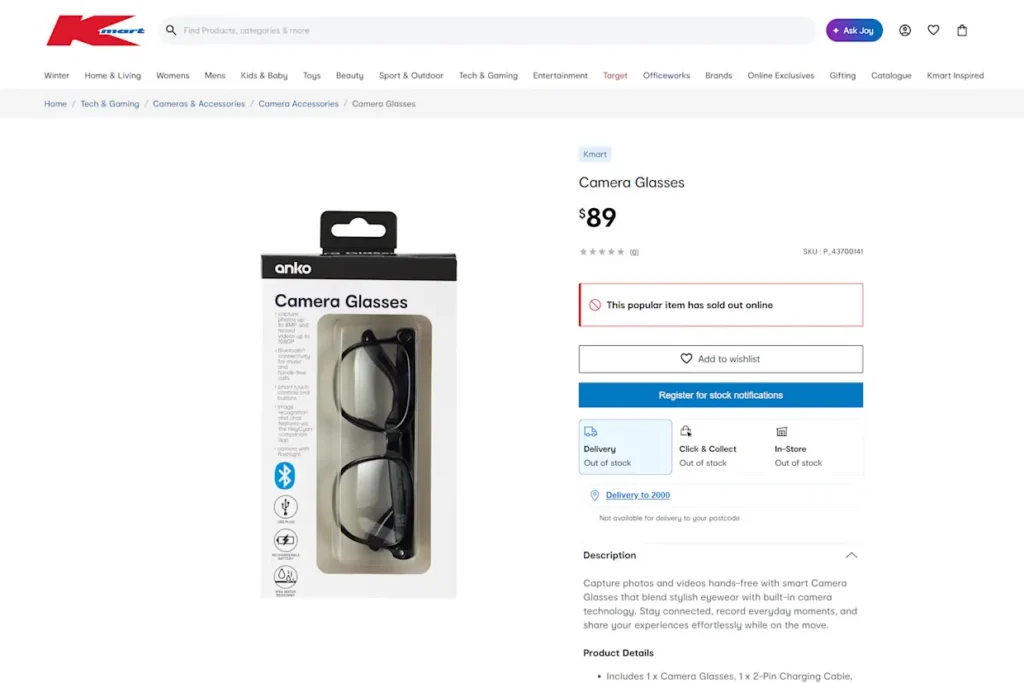

Kmart’s inexpensive camera glasses have disappeared from shelves across Australia, with the $89 Anko wearable reported sold out online and in stores by Tuesday afternoon, August 4.
The rush has widened a debate previously centred on premium smart glasses: how can people know they are being recorded when a camera looks almost identical to everyday eyewear?
A premium technology reaches the budget aisle
Kmart’s clear-lens, black-framed glasses contain an eight-megapixel camera that can record video in 1080p. The frame also carries a microphone, speakers, Bluetooth connectivity, touch controls and physical buttons.
When paired with a smartphone, the glasses support calls, music, photo and video transfers, image recognition and assistant-style chat features. Reports identify the connected software as HeyCyan.
At $89, the Anko model costs substantially less than Ray-Ban Meta glasses. Australian prices for those products begin at approximately $367 and can reach $709, depending on the frame and configuration.
Kmart has not disclosed how many Anko units were available before the sell-out. The lack of sales figures means demand cannot be measured precisely, but the lower price makes camera-equipped eyewear accessible to consumers who may not consider a premium model.
The recording light may be easy to miss
A small white light reportedly indicates when the camera is active. The problem, according to critics, is that people may not notice the signal or understand what it means.
A person holding a smartphone towards someone creates an obvious recording cue. Camera glasses naturally point wherever the wearer is looking, allowing photographs or first-person video to be captured without the same visible action.
That does not make every user a privacy risk. The glasses could support hands-free travel footage, instructional videos, accessibility functions and phone calls. Concern centres on misuse in sensitive locations or for social-media content recorded without meaningful consent.
Experts want answers about captured data
Tom Sulston, head of policy at Digital Rights Watch, has warned that discreet wearable cameras could be used to harass or secretly film people, including women targeted for online views or attention.
Dr Victoria Macarthur of Monash University has highlighted a second issue: what happens after a photograph or video is taken. Questions include where files are stored, how long they remain available, who can access them and whether captured information could be processed by AI systems.
Buyers should examine the HeyCyan app’s permissions and current privacy policy before connecting the device. They should check whether material remains locally on the glasses or phone, whether cloud processing is involved and how files can be permanently deleted.
Legal to buy does not mean legal everywhere
Australians can legally purchase and own camera glasses. Their use is more complicated because surveillance and listening-device laws vary between states and territories.
Ordinary photography in a public place is not automatically prohibited. However, secretly recording a private conversation may be unlawful in some jurisdictions even when the conversation takes place in public.
Recording in bathrooms, bedrooms, changing areas or other locations where people reasonably expect privacy can carry serious consequences. Separate laws may also apply when intimate material is distributed without consent.
Schools, workplaces, courts, gyms and private businesses can establish their own recording rules. A lawful consumer product does not give its owner an unrestricted right to film on every property.
The Office of the Australian Information Commissioner explains that the federal Privacy Act primarily covers eligible organisations and government agencies. Personal recording by an individual is generally outside that Act, although state and territory legislation may still apply.
Are Polymarket and Kalshi Legal in Australia? ASIC Warns Users Could Lose All Their Money
Optus Faces Multi-Million Dollar Fine Over Triple Zero Outage: What Happened?
Visit the homepage for the latest Australian news, business updates and consumer alerts
Australia’s privacy rules are being tested
The Privacy and Other Legislation Amendment Act 2024 created a civil pathway for certain serious invasions of privacy. It can potentially cover a serious intrusion upon someone’s seclusion or misuse of private information when the conduct is intentional or reckless.
Appearing incidentally in an ordinary public video would not automatically establish a claim. The circumstances, reasonable expectation of privacy, seriousness of the conduct, reason for recording and any public interest would matter.
A spokesperson for Attorney-General Michelle Rowland said the government recognised concerns about technologies collecting personal information without people’s knowledge. Further reforms are expected as authorities consider whether existing protections remain suitable for the digital age.
The challenge extends beyond wearable cameras. Australia is also considering new obligations affecting major digital platforms, while overseas regulators have acted on safety concerns involving hidden electronic car-door handles. Both show how quickly everyday technology can outpace established rules.
No Kmart restock date yet
Kmart had not confirmed when the $89 glasses would return. Stock may vary between locations, so buyers should use the retailer’s official product page and store checker rather than depend on resale listings.
Consumers should compare battery life, recording limits, storage, warranty protection, app security and data controls before purchasing. Compatibility with prescription lenses was also not clearly confirmed in the available product details.
Kmart says camera glasses are part of a mainstream wearable category and expects customers to use them responsibly and lawfully. In practice, owners should disclose recording, seek permission during private conversations and switch the camera off wherever people reasonably expect privacy.

Make Swikblog your go-to source on Google for reliable updates, smart insights, and daily trends.