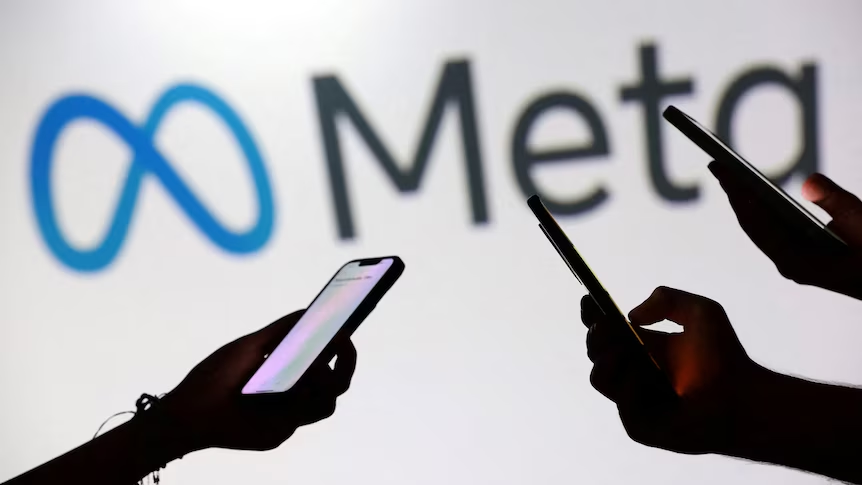

Meta, Google and other major digital platforms could face a charge equal to 2.5% of their Australian digital advertising revenue if they fail to make enough commercial agreements with local news publishers.
The revised News Bargaining Incentive is intended to make negotiation cheaper than refusing to pay for journalism. It also removes a major escape route: covered platforms could still owe the charge even if they stop carrying Australian news.
Current position: This is proposed legislation, not an active levy. The federal government expects to introduce the bill to Parliament within weeks.
What has changed?
The government originally proposed a charge of 2.25% and required platforms to reach agreements with at least four Australian news organisations. The revised model raises the rate to 2.5% and increases the minimum to six local news services.
Technology companies have, however, secured an important concession. The levy will apply only to digital advertising revenue earned in Australia rather than a platform’s total Australian revenue.
Revenue from hardware, subscriptions, cloud services and other non-advertising activities would generally fall outside the calculation. The percentage is higher, but the final bill could be smaller because it is applied to a narrower revenue base.
Who would be expected to pay?
The scheme targets large search and social-media platforms with significant Australian operations. Meta and Google are central to the policy because of their advertising businesses and their influence over how audiences find news.
AI companies will remain excluded. That distinction may face future scrutiny as artificial intelligence services increasingly summarise reporting, but those businesses will not be covered solely because they process news content.
Why Meta is central to the dispute
Australia introduced the News Media Bargaining Code in 2021. Meta initially reached agreements with publishers but later declined to renew them and reduced the visibility of news on Facebook and Instagram.
The proposed incentive responds directly to that decision. Removing or deprioritising news would no longer automatically allow a covered platform to avoid its financial obligation.
Meta has criticised the plan as a government-mandated transfer of wealth. It has not, however, announced another Australian news block in response to the revised 2.5% proposal.
How Google could be affected
Google already has commercial arrangements with several Australian media companies. To avoid the levy, its agreements would need to satisfy the final rules covering value, eligibility and publisher diversity.
It would also need qualifying deals with at least six news services. Google’s advertising income would be relevant to the calculation, while revenue such as device sales would not automatically be included.
Will Facebook or Google services change?
Nothing changes immediately for users. Facebook, Instagram and Google remain available, and no company currently owes the new levy.
Meta temporarily blocked Australian news during the 2021 bargaining dispute, so another restriction cannot be ruled out. Assistant Treasurer Daniel Mulino said the government was confident platforms would not leave Australia, describing it as a large and profitable market.
What smaller publishers could receive
The offset for qualifying agreements with small publishers will rise from 170% to 200%. This is intended to encourage platforms to negotiate with regional and independent outlets, not only Australia’s biggest media groups.
Five per cent of any money collected through the levy will fund grants for small publishers and media start-ups. Eligibility will also expand beyond traditionally employed reporters to include freelancers and essential journalism production roles.
The policy arrives as Australian media companies confront falling traditional advertising income and newsroom restructuring. Recent job cuts affecting Nine Entertainment publications show why the financial sustainability of journalism has become a national policy issue.
Read More:
What happens if platforms refuse to negotiate?
Companies that do not complete enough qualifying agreements would pay the 2.5% charge. Money collected would be distributed back to the Australian news-media sector, with 5% reserved for grants supporting smaller and emerging publishers.
The government’s official News Bargaining Incentive announcement says direct commercial agreements remain the preferred outcome.
Why this proposal matters beyond news payments
The levy forms part of a wider effort to make global digital companies accept greater responsibility for their Australian operations. Other measures, including higher penalties tied to Australia’s under-16 social-media rules, reflect the government’s increasingly firm approach to platform regulation.
The bill must pass Parliament before the levy can begin. The final legislation should clarify which platforms meet the coverage thresholds, how Australian advertising revenue will be calculated, which publisher deals qualify and when the system starts.
Until those rules are approved, the 2.5% rate remains a proposal and Australian publishers are not guaranteed payments.

Make Swikblog your go-to source on Google for reliable updates, smart insights, and daily trends.