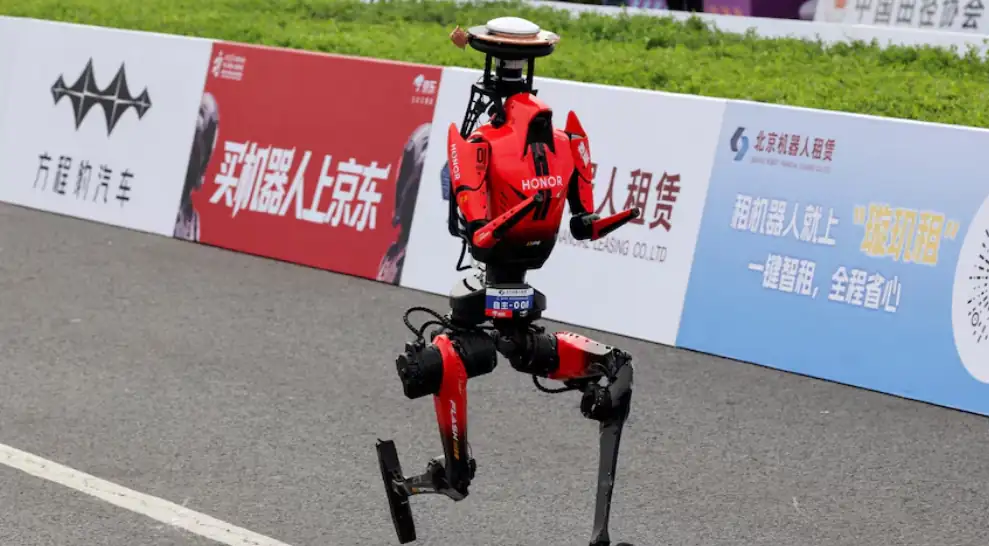

A Chinese humanoid robot named Lightning has run 100 metres in a reported 9.32 seconds, producing a time faster than Usain Bolt’s 9.58-second human world record during a preparatory test for the 2026 World Humanoid Robot Games in Beijing.
The robot, developed by Chinese smartphone maker Honor, reached a peak speed of 14.5 metres per second during the test. The performance immediately drew attention because Bolt’s 9.58-second run, set at the 2009 World Athletics Championships in Berlin, has stood for 17 years.
There is an important distinction, however. Lightning has not replaced Bolt in the athletics record books. The robot’s result came from a robotics test, while Bolt’s mark remains the official men’s 100m world record for human competition.
Lightning was already a record-setting distance runner
The 100m sprint is not Lightning’s first eye-catching performance. In April, the humanoid won a 21-kilometre Beijing robot half-marathon in 50 minutes and 26 seconds, a pace faster than the elite men’s human half-marathon world-record pace.
At that event, Lightning stood 169 centimetres tall and had 95-centimetre legs. Researchers later lengthened its legs by 10 centimetres ahead of the World Humanoid Robot Games, increasing the dimensions of a machine already designed for high-speed running.
The development illustrates how robotics teams are refining mechanical design alongside control software and artificial intelligence. Similar efforts to move automation from demonstrations into practical use can be seen in a Beijing robot-operated coffee shop that set a Guinness World Record, where speed must be combined with consistency and reliability.
Beijing’s ‘Robot Olympics’ are getting more demanding
The second World Humanoid Robot Games run from August 22 to 26 at Beijing’s National Speed Skating Oval. The event has been widely described as a “Robot Olympics,” but its purpose extends well beyond racing machines around a track.
According to official information from the Beijing municipal government, the 2026 competition includes both sporting events and scenario-based challenges. The 100m event has also been upgraded to require fully autonomous robots.
New tests are designed to measure dexterity and practical capability. Robots face tasks involving precision handling, while scenario competitions move into environments resembling factories, hotels and homes. Other challenges test skills such as housekeeping, firefighting and retail assistance.
This shift matters because a machine that can sprint quickly is not automatically useful in everyday settings. A practical humanoid must maintain balance, identify objects, manipulate them accurately, respond to changing surroundings and operate safely for long periods.
China is using robot competitions as a proving ground
Robot contests in China have evolved over the past decade from specialist demonstrations into increasingly visible showcases for commercial technology. Humanoid robotics is now being developed for possible roles in manufacturing, logistics and consumer services.
The challenge is turning impressive prototypes into dependable products. Robotics demonstrations can generate attention, but successful deployment depends on control, durability, safety and the ability to complete useful work repeatedly.
That gap between demonstration and real-world reliability has already become visible at major technology events. A robot dog controversy at an AI summit in India showed why the origin, capabilities and presentation of robotic systems can attract scrutiny as interest in embodied AI grows.
Why the 9.32-second run matters
Lightning’s result is significant because running at this speed demands more than powerful motors. Engineers must coordinate rapid leg movement, balance, stride timing and control while keeping the machine stable as forces increase.
The improvement to Lightning’s leg design also shows how hardware remains central to humanoid robotics. AI can influence planning and control, but motors, joints, sensors, batteries and mechanical structure ultimately determine what a physical robot can achieve.
A fast robot is only part of the bigger test
For people following the headline comparison with Bolt, the key takeaway is straightforward: Lightning’s 9.32-second test run is numerically faster than 9.58 seconds, but the two performances belong to different categories and should not be treated as equivalent sporting records.
The more consequential story is what happens away from the stopwatch. The 2026 Games are increasingly testing whether humanoid robots can combine speed, autonomy, dexterity and control in realistic environments. If those capabilities become reliable enough for factories, logistics and service work, Lightning’s sprint may be remembered less as a challenge to human athletics and more as a marker of how rapidly humanoid hardware is progressing.

Make Swikblog your go-to source on Google for reliable updates, smart insights, and daily trends.