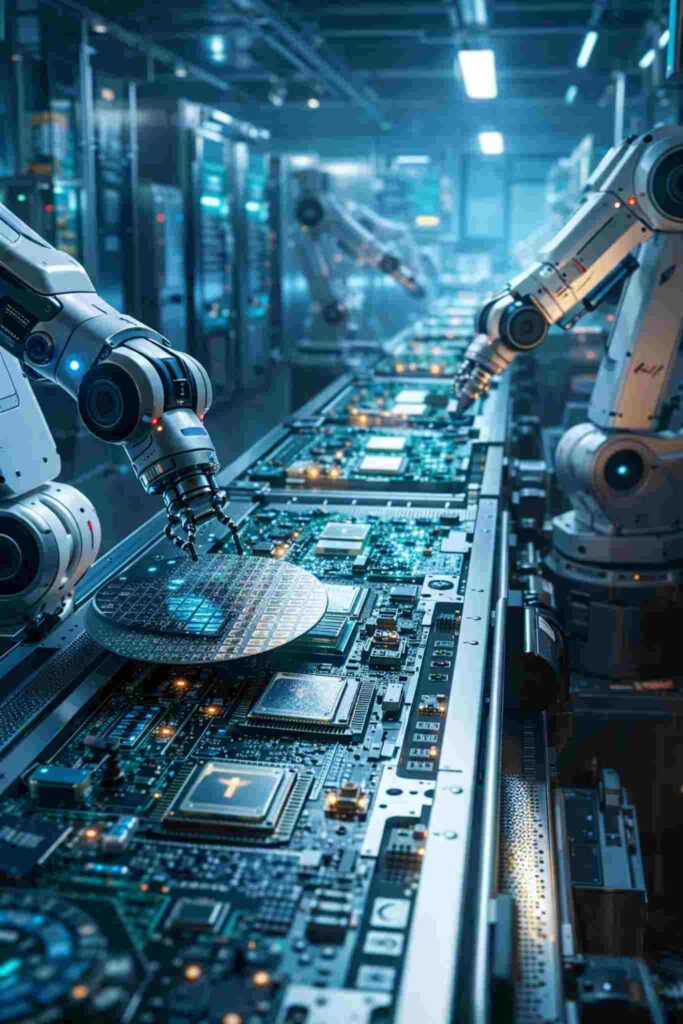

Tesla stock surged 2.8% to $378 after Elon Musk unveiled an ambitious new semiconductor initiative called “Terafab,” a project that could redefine the company’s future beyond electric vehicles. The proposed $25 billion effort, which could ultimately require up to $45 billion in investment, aims to build one of the world’s most advanced chip manufacturing ecosystems to support Tesla’s growing artificial intelligence, robotics, and autonomous driving ambitions.
Unlike a typical factory expansion, Terafab is being positioned as a vertically integrated semiconductor hub that combines chip design, fabrication, memory production, and packaging under one roof. The facility is expected to be built at Tesla’s Giga Texas site in Austin and could exceed the scale of existing factory infrastructure. Musk described it as “the most epic chip-building exercise in history,” highlighting the urgency behind securing sufficient computing power for Tesla’s next phase of growth.
Why Tesla is building Terafab
The core driver behind Terafab is simple: chip supply is becoming a major constraint for AI development. Musk has openly stated that current global semiconductor production is not scaling fast enough to meet the needs of Tesla, SpaceX, and xAI. According to his estimates, global AI compute output stands at around 20 gigawatts annually, far below what his companies require for future expansion.
This shortage becomes critical when looking at Tesla’s roadmap. The company is rapidly shifting toward AI-heavy products, including Full Self-Driving (FSD), robotaxis, and its Optimus humanoid robots. Each of these applications requires specialized chips capable of handling real-time inference and large-scale data processing. By building its own semiconductor ecosystem, Tesla aims to reduce reliance on external manufacturers like TSMC and Samsung, while accelerating its ability to deploy AI systems at scale.
Optimus robots could drive massive chip demand
Among all Tesla initiatives, the Optimus humanoid robot program stands out as the biggest driver of future chip demand. Estimates suggest that Tesla’s Giga Texas facility alone could eventually produce up to 10 million robots per year, requiring roughly 20 million chips annually. That figure is already multiple times higher than Tesla’s current chip demand across its entire automotive business.
Looking further ahead, Musk has outlined a long-term target of producing 100 million Optimus robots annually. If achieved, that would translate into demand for more than 200 million chips per year, a scale that far exceeds what Tesla currently consumes. This explosive growth in demand is one of the main reasons Terafab is being considered not as an option, but as a necessity.
Advanced 2-nanometer chip ambitions
Terafab is not just about producing chips—it is about producing some of the most advanced chips in the world. The project is expected to target 2-nanometer process technology, a cutting-edge node that even established semiconductor leaders like TSMC are only beginning to scale. Achieving this level of manufacturing sophistication would place Tesla among the most technologically advanced players in the semiconductor industry.
The chips themselves will serve two primary purposes. One category will focus on edge inference processors designed for Tesla vehicles, robotaxis, and Optimus robots. The other will be high-power, space-hardened chips intended for SpaceX applications, including satellites, orbital data centers, and AI workloads linked to xAI. This highlights how Terafab is not just a Tesla project, but a broader ecosystem play spanning multiple Musk-led companies.
SpaceX and AI infrastructure connection
One of the most overlooked aspects of Terafab is its connection to SpaceX and the concept of space-based computing. Musk has indicated that a significant portion of future AI compute capacity could be deployed in orbit, supporting next-generation data infrastructure. This aligns with SpaceX’s broader vision of satellite networks and potentially orbital data centers, where advanced chips would be essential.
By integrating chip production with both terrestrial and space-based applications, Terafab could position Musk’s companies at the center of a new computing paradigm. It also suggests that Tesla’s valuation narrative may increasingly include elements of AI infrastructure, not just transportation and energy.
Cost, timeline, and execution risks
Despite the excitement surrounding the announcement, Terafab faces significant challenges. Semiconductor manufacturing is one of the most complex and capital-intensive industries in the world. Analysts have described the project as a “Herculean task,” noting that advanced process technologies are built on decades of incremental innovation and expertise.
Financially, the project could require between $35 billion and $45 billion in total capital investment, well above the initial estimates. Tesla has also indicated that Terafab costs are not included in its 2026 capital expenditure plans, suggesting that funding and timelines remain uncertain.
Even under optimistic scenarios, analysts believe that meaningful chip production from Terafab may not begin until 2028 at the earliest. This long timeline introduces additional risk, particularly if Tesla faces pressure in its core automotive business or if execution challenges arise during development.
What this means for Tesla stock
The immediate market reaction—Tesla stock rising 2.8% to $378—reflects investor optimism about the company’s long-term direction. Terafab reinforces the idea that Tesla is evolving beyond an EV manufacturer into a diversified technology company focused on AI, robotics, and energy systems.
However, the project also raises important questions. The scale of investment required, combined with the technical complexity of semiconductor manufacturing, means that Terafab could become a major financial and operational challenge. Investors will likely watch closely for updates on timelines, partnerships, and execution milestones.
In the broader context, Terafab represents a high-risk, high-reward strategy. If successful, it could give Tesla a significant competitive advantage in AI and robotics, enabling faster innovation and greater control over critical infrastructure. If it falls short, it could strain resources and delay progress in other key areas.
For more insights into the global semiconductor race and Tesla’s evolving strategy, readers can explore coverage from Yahoo Finance and industry analysis on Reuters Technology.
For now, one thing is clear: Terafab is not just another factory—it is a bold statement about where Tesla sees the future, and how far Musk is willing to go to control it.
You May Also Like
GOOG Stock Jumps Toward $300 as Google Expands Drone Delivery Business

Make Swikblog your go-to source on Google for reliable updates, smart insights, and daily trends.