
Ronda Rousey walked back into MMA after nearly a decade away from the sport and finished Gina Carano in just 17 seconds, but the numbers released after the fight generated almost as much attention as the result itself. According to disclosed purse figures from the California State Athletic Commission, Rousey earned $2.2 million for the main event of Most Valuable Promotions’ first MMA card at the Intuit Dome in Los Angeles.
Carano, who fought professionally for the first time since 2009, received a disclosed purse of $1.05 million. Francis Ngannou was the third fighter on the card to secure a seven-figure payday, taking home $1.5 million for his heavyweight bout against Philipe Lins, who earned $100,000.
The event was promoted as a landmark moment for women’s MMA because of the history attached to both Rousey and Carano. Before Rousey became the face of women’s fighting in the UFC, Carano had already pushed female MMA into the mainstream through Strikeforce and later Hollywood. Their long-awaited matchup finally happened years after both women had stepped away from the cage.
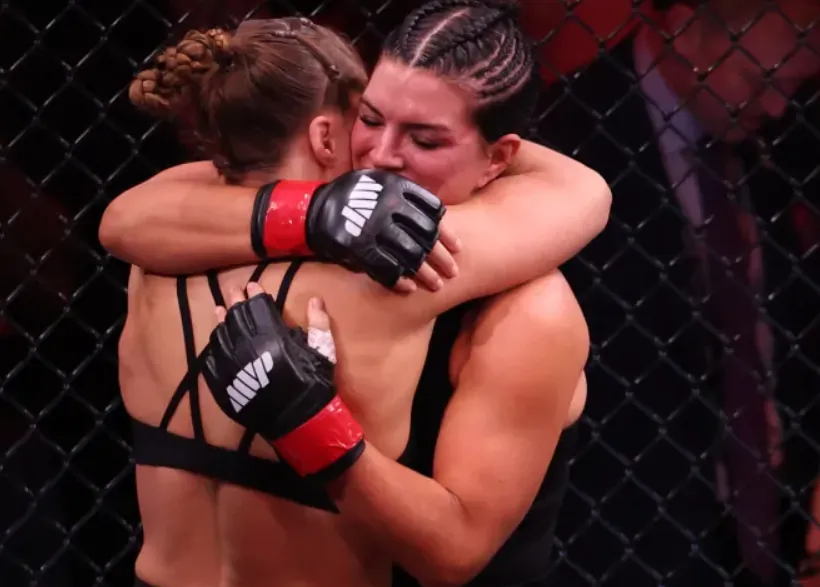
Rousey wasted no time once the fight started. She quickly took Carano down, transitioned into her trademark armbar and forced the tap almost immediately. The ending was abrupt, but it perfectly reflected the style that made Rousey one of the biggest stars in MMA history during her peak years.
RAPIDÍSIMOOO ⚡
— VictorAA (@Victormma593) May 17, 2026
Ronda Rousey 🇺🇸 (13-2) se lleva la victoria vía Sumisión (ArmBar) a los 17 segundos del primer round frente a Gina Carano 🇺🇸 (7-2).
Rousey recibió una bolsa de 2.2 millones de dólares por esta pelea.#RouseyCarano
pic.twitter.com/FjZBKYsU5g
Rousey Announces Another Retirement After Quick Finish
After the fight, Rousey made it clear the comeback was likely a one-time appearance. The former UFC champion said there was no better way to close her MMA career and explained that Carano was the only opponent who could have convinced her to return.
“Gina is the only person who could have brought me back into MMA,” Rousey said after the fight. “She’s my hero. She changed my world, and we changed the world.”
Rousey also spoke emotionally about wanting to focus on family life, adding that she hoped to have more children. The comments reinforced the feeling that Saturday night was designed as a final chapter rather than the start of another run inside the cage.
The fight officially moved Rousey’s professional MMA record to 13-2. Ten of those victories came by submission, further cementing the armbar as one of the most iconic finishing moves in combat sports history.
Carano, meanwhile, handled the loss with honesty. The 44-year-old admitted she wanted the fight to last longer after spending months preparing for her return. Despite the defeat, she described simply making it back into the cage after 17 years as a personal victory.
She revealed before the event that she had lost more than 100 pounds during her preparation for the comeback. That transformation became one of the most discussed stories leading into the fight week.
Read More
Ngannou, Diaz and Perry Also Earn Massive Payouts
Beyond the headline bout, MVP spent heavily across the card. Ngannou’s $1.5 million payday showed how valuable his name remains outside the UFC. Nate Diaz also secured a major check, earning $500,000 for his welterweight fight against Mike Perry, who received $400,000.
Former Bellator champion Jason Jackson earned $110,000, making him the only other fighter outside the top stars to receive a disclosed six-figure purse.
The remaining disclosed salaries included:
- Junior dos Santos — $80,000
- Adriano Moraes — $80,000
- Salahdine Parnasse — $70,000
- Phumi Nkuta — $60,000
- Kenneth Cross — $50,000
- Robelis Despaigne — $50,000
- Jefferson Creighton — $50,000
- David Mgoyan — $50,000
- Chris Avila — $50,000
- Namo Fazil — $40,000
- Jake Babian — $40,000
- Albert Morales — $40,000
- Aline Pereira — $40,000
- Jade Masson-Wong — $40,000
- Brandon Jenkins — $40,000
Importantly, the disclosed purse figures do not include potential performance bonuses, sponsorship deals or private pay agreements. They also do not account for deductions tied to taxes, insurance or commission-related fees. Even so, the figures offer one of the clearest public looks into how MVP structured fighter compensation for its first MMA event.
The promotion’s willingness to pay large guarantees to recognizable names immediately became part of the conversation around the event. Fighter pay remains one of the most debated topics in MMA, particularly when comparing UFC salaries with payouts from rival organizations and crossover events.
The California State Athletic Commission, which oversees professional combat sports events in the state, publishes official disclosed purses after major cards. Additional information about the commission’s role can be found on the official CSAC website.
For MVP, the event delivered exactly what it wanted from a business perspective: global headlines, social media attention and crossover appeal built around legendary names. Whether the promotion can maintain that momentum without a nostalgia-driven main event remains uncertain, but the Rousey-Carano card succeeded in creating mainstream interest far beyond traditional MMA audiences.
The quick finish itself will divide opinion. Some fans wanted a more competitive fight after years of anticipation surrounding the matchup. Others viewed the outcome as a reminder of just how dominant Rousey was during her prime years in the UFC.
The event also continued a growing trend in combat sports where legacy matchups and crossover attractions are becoming major commercial drivers. Swikblog recently explored a similar conversation around fighter safety and long-term career decisions in this report on the UFC weight-cutting debate following Cameron Smotherman’s collapse.
For now, Rousey leaves again with another viral moment attached to her career. A 17-second submission, a $2.2 million payday and a farewell speech about family and legacy ensured her return became one of the biggest MMA stories of the year.

Make Swikblog your go-to source on Google for reliable updates, smart insights, and daily trends.