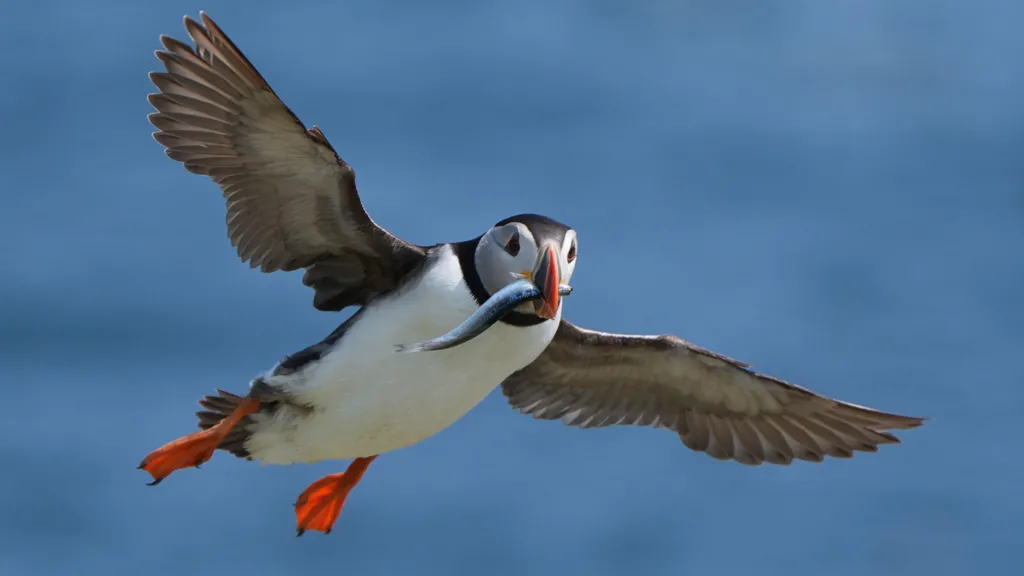

Thousands of puffins are believed to have died after a series of powerful storms swept through European waters, leaving conservationists worried that this year’s breeding season could expose the real scale of damage to one of the continent’s most recognisable seabirds.
The concern is not only about the birds already found dead on beaches. It is about what happens next. Puffins are long-lived, slow-breeding seabirds, and a sudden loss of adults or young birds can echo through colonies for years. After months spent at sea, surviving birds now have to return to nesting sites, form pairs, lay eggs and raise chicks at a time when many may already be weakened by hunger and exhaustion.
Wildlife experts in the Channel Islands have warned that around 40,000 seabirds washed up dead on European beaches after severe storms earlier this year. Puffins were among the most affected. In Alderney, 56 dead seabirds were recorded, and 44 of them were puffins, a striking sign of how badly the species was hit in local waters.
The storms created exactly the kind of conditions puffins struggle to survive. Unlike some larger seabirds that can range widely and feed in different ways, puffins rely on sight to catch fish underwater. They need workable sea conditions and reasonably clear water. When storms churn the sea, reduce visibility and make diving harder, puffins can spend too much energy searching for food and still fail to eat enough.
That is why seabird ecologists are treating this as more than a short-term weather disaster. Birds that survive a difficult winter may arrive at breeding colonies in poor condition. Some may skip breeding altogether. Others may lay eggs but fail to raise chicks if they cannot find enough fish, particularly sandeels and other small prey that young puffins depend on.
The timing makes the situation especially sensitive. From March to July, puffins and other seabirds are at their most vulnerable around breeding colonies. They need time to rest, feed, preen, pair up, incubate eggs and care for chicks. Any extra disturbance from boats, jet skis, kayaks or paddleboards can force them to take flight or leave feeding areas, wasting energy they cannot afford to lose.
Conservation groups in the Channel Islands are urging watercraft users to avoid or respect puffin protection areas. Off Herm, two puffin awareness markers have been placed near Puffin Bay to remind boat users of the six-knot speed limit. Around Alderney, the puffin-friendly zone near Burhou has been in place since 2018 to protect breeding birds. In Jersey, a seabird protection zone extends 200 metres from the shore between Plemont and Greve de Lecq.
Not all of these zones can be marked with buoys. Around Alderney and Jersey, strong tides make floating markers difficult or risky because they could drag and damage the seabed. Instead, protection areas are shown through sailing charts, shore information and local guidance. The message remains the same: keep distance from breeding seabirds and reduce avoidable stress.
For puffins, even small disruptions can matter. A group of birds resting together on the sea, often called rafting, may look calm from a boat. But if people move too close, the birds can become anxious and take flight. That interrupts feeding, resting and nesting behaviour. During a normal season, disturbance is harmful. After a winter of deadly storms, it may be even more damaging.
The Atlantic puffin is already a species under pressure. The IUCN Red List classifies the Atlantic puffin as vulnerable globally, reflecting concern over population declines across parts of its range. BirdLife International’s species data also shows a decreasing population trend, with mature individuals estimated at 12 million to 14 million worldwide.
The problem is that puffins face several threats at the same time. Climate change is bringing more unstable weather and changing the distribution of prey fish. Pollution, disease, offshore development, human disturbance and pressure on marine food chains all add to the risk. A BirdLife International report on Europe’s seabirds found that seabirds are among the bird groups with the highest share of threatened or near-threatened species in Europe.
Food remains one of the biggest worries. Puffins usually bring small fish back to their chicks, often carrying several at once in their colourful bills. When sandeels and other prey become scarce or shift farther north, adult birds must travel longer distances from the colony. That means chicks may be fed less often, grow more slowly or fail to survive.
Read More
- Visit Swikblog Homepage
- Ebola Outbreak in Congo: 65 Deaths, 246 Suspected Cases
- Smoking Monkey Pizza Files Chapter 11 Bankruptcy After Store Closure
- Texas Roadhouse New Texas Locations 2026: Full List of Cities
- Toronto FIFA Fan Festival Tickets: World Cup 2026 Free Pass Release
- Belfast March for Jesus: No Israeli or UK Flags
There is also a delayed-risk problem. Puffins do not usually breed until they are around five years old. If many of the birds lost in the storms were juveniles, the effect may not show up immediately in nest counts. A colony can appear stable for a short time, especially if younger birds move into spaces left by dead adults. But the missing age groups may become obvious years later when fewer birds return to breed.
That slow reveal makes puffin conservation difficult. A single breeding season cannot tell the whole story. Puffins can live for decades, with some individuals exceeding 40 years, so colonies may absorb a shock for a while before the damage becomes clear. Scientists often need several years of monitoring to understand whether a major seabird wreck has changed the future of a colony.
There are still encouraging signs. Skomer Island off Pembrokeshire recorded 52,019 puffins this year, about 8,000 more than in 2025 and a record count for the second year running. That does not cancel out the losses elsewhere, but it shows that protected colonies can still perform strongly when conditions are favourable.
The mixed picture is important. Puffins are not disappearing everywhere at the same speed, and some local colonies may look healthy even while the wider species faces pressure. That is why conservationists focus on practical action: protecting nesting sites, reducing disturbance, improving marine management and tracking food availability.
The latest storm deaths also follow years of concern over bird flu and seabird losses around Britain and Europe. Swikblog recently reported on the Farne Islands Puffin Cam returning after bird flu killed nearly 10,000 seabirds, showing how closely conservation teams are watching colonies after repeated shocks from disease, weather and food-chain changes.
For the public, the most immediate role is simple. Stay away from restricted seabird zones, slow down near puffin areas, avoid approaching rafting birds, and follow local wildlife guidance during the breeding season. These actions may seem small, but they reduce one pressure that humans can control.
This year’s puffin season is therefore more than a wildlife spectacle. It is a test of how well fragile seabird colonies can recover after a major storm-driven mortality event. The birds that made it back to shore now need enough food, calm nesting space and minimal disturbance. After thousands of deaths at sea, giving puffins room to breed may be one of the most practical ways to help them endure what comes next.

Make Swikblog your go-to source on Google for reliable updates, smart insights, and daily trends.