
Updated: August 18, 2026
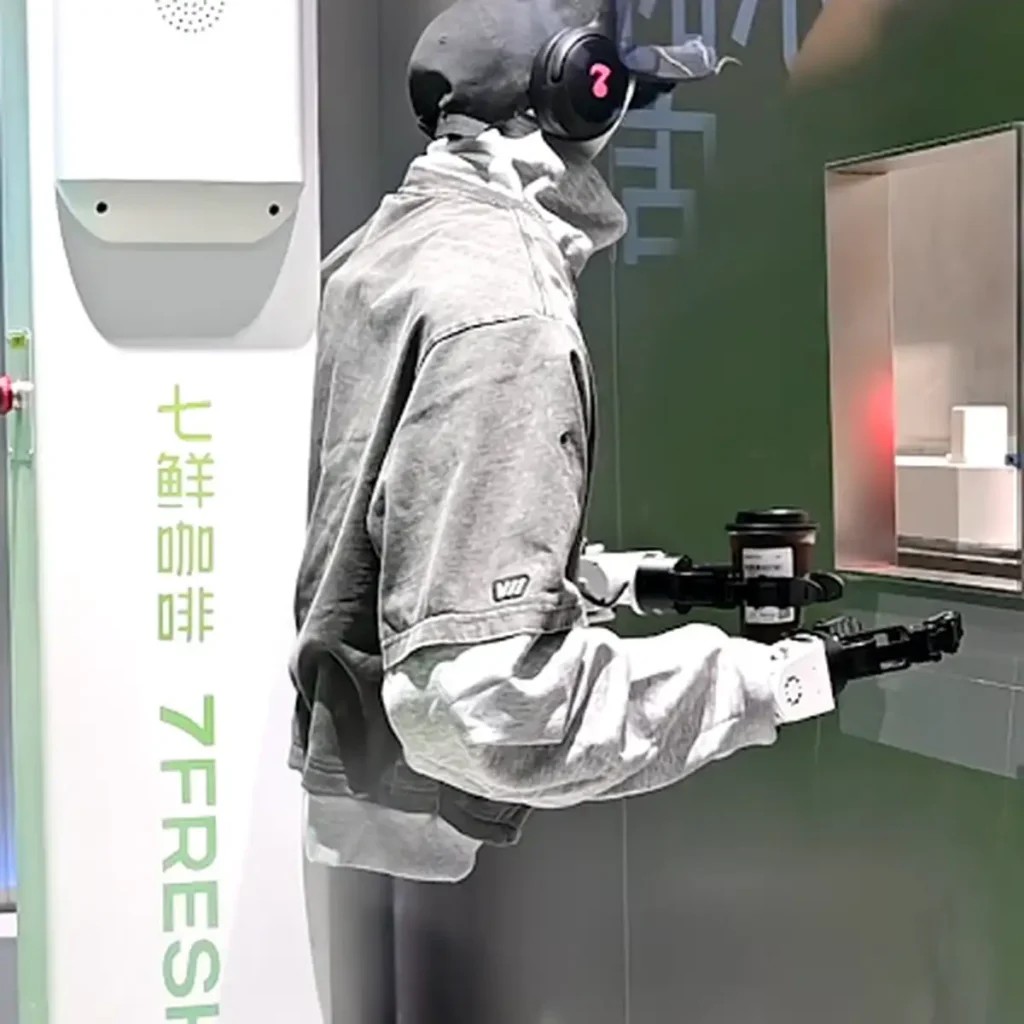
JD.com has pushed further into automated retail with a 24-hour robot-operated coffee shop in Beijing that produced 202 cups in one hour during a Guinness World Records challenge.
The outlet, operated under JD.com’s Qixian Coffee brand, opened on August 16 at Galaxy SOHO in Beijing’s Chaoyang district. The launch offers a real-world test of whether automated drink production can combine speed, personalisation and round-the-clock service without relying on a conventional barista team.
Customers can place orders through the store’s digital ordering system, while automated equipment handles cup placement, grinding, coffee extraction, mixing, dispensing and delivery to the collection area. A digital display lets customers follow the preparation process as their order moves through the system.
JD robot coffee shop serves record 202 cups in one hour
The Beijing store attempted a Guinness World Records challenge for the most cups supplied by a robot-operated coffee shop in one hour. The target was 130 cups, but the automated operation completed 202 during the record attempt.
That works out to approximately 3.37 finished drinks every minute, or an average of one completed cup every 17.8 seconds.
The figure should not be interpreted as every individual coffee taking less than 18 seconds to prepare. Multiple stages of production can operate at the same time, allowing several orders to move through the automated system simultaneously. JD.com says individual drinks can generally be completed in around 30 seconds.
A Guinness World Records adjudicator was present for the attempt and confirmed the result.
Some reports have described the operation as a café run by a “single robot,” but the store is more accurately described as a robot-operated or fully automated coffee shop. The system combines automated production equipment with robotic handling rather than depending on one humanoid machine to perform every step independently.
The store operates 24 hours a day, giving customers access to freshly prepared drinks outside conventional café opening hours. That could make the format particularly attractive in office districts, transport hubs, hospitals and other locations where demand continues late into the night.
The contactless production process is designed to maintain consistent measurements across different orders and shifts. Human involvement has not disappeared completely, however. Ingredients still need replenishing, machines require cleaning and calibration, and technicians or support staff are needed when equipment develops a fault.
Qixian Coffee products are generally listed in roughly the 15 to 20 yuan range before promotions and subsidies, although prices can vary by drink, location and ordering platform. JD.com has previously used discounts to push some Qixian Coffee drinks below 10 yuan, while particularly aggressive promotions have brought selected drinks down even further.
That pricing puts Qixian Coffee into direct competition with China’s rapidly expanding affordable coffee chains, where discounts and digital ordering have become central to attracting repeat customers.
Personalised drinks are central to JD.com’s automated café experiment
The automated system is not limited to repeating one standard coffee recipe. Customers can adjust elements such as sweetness, coffee strength and juice concentration, allowing considerably more control over drinks than a traditional vending machine.
Customers can also name personalised drinks and create recipe cards that can be shared with other users. The production system is designed to handle more than coffee, including tea-based drinks, sparkling beverages, fermented-milk products and fruit drinks.
JD.com has said artificial intelligence can be used to analyse popular drink trends and consumer preferences during product development. Longer-term ideas include recommending drinks based on individual tastes and potentially providing caffeine-related suggestions using information voluntarily supplied by customers.
Any service that uses personal or health-related information would bring additional privacy responsibilities. Customers would need clear information about what data is collected, how long it is stored and whether recommendations are intended simply as general guidance rather than medical advice.
The automated café also fits into a much broader expansion by Qixian Coffee. The brand initially emerged in Beijing and has been expanding beyond its earliest locations, while JD.com has promoted a strategy combining its retail, delivery and physical-store infrastructure.
The company has previously said Qixian Coffee uses fresh milk in its milk-based drinks rather than non-dairy creamer or powdered substitutes. That positioning gives JD.com another way to differentiate the brand as it competes in China’s crowded value-focused coffee market.
The company has explored a similar combination of infrastructure and consumer services through its partnership with BYD on EV charging stations, where retail and coffee services can be offered to motorists while their vehicles charge.
For JD.com, automated drink production could address several problems that conventional cafés face at the same time: staffing costs, employee turnover, training requirements, variations in preparation and the higher labour expense associated with keeping stores open overnight.
But the 202-cup record does not by itself prove that an automated café is cheaper to operate. Installation costs, maintenance, electricity consumption, software monitoring, ingredient replenishment and equipment depreciation all affect the economics of the model.
Google Gemini 3.7 Flash Arrives With Lower AI Pricing
The toughest test will come after the publicity surrounding the record attempt fades. A normal trading day brings ingredient refills, cleaning cycles, customised orders, payment problems and potential equipment failures that do not necessarily appear during a controlled one-hour capacity challenge.
Coffee quality is another factor. Automated systems can repeat grinding time, water temperature and ingredient measurements with high consistency, but only if beans remain fresh and machines are cleaned, calibrated and maintained properly.
The opening also adds to the debate about how artificial intelligence and robotics could affect service-sector employment. Highly automated cafés could reduce demand for repetitive counter and drink-preparation roles, particularly in locations where customers prioritise speed and extended opening hours.
The shift forms part of a wider discussion around how artificial intelligence could affect jobs. Automation may remove some tasks while increasing demand for technicians, equipment maintenance workers, software operators, logistics staff and remote support teams.
Human-run cafés still offer something much harder for machines to reproduce: conversation, hospitality and personal recommendations. That means automated stores may initially be better suited to office complexes, airports, railway stations, hospitals and other high-traffic environments than independent neighbourhood cafés built around human interaction.
For customers, the attraction of JD.com’s Beijing experiment is straightforward: coffee at any hour, shorter waits and detailed control over recipes. For JD.com, the bigger question is whether those benefits can be delivered reliably and profitably enough to turn a record-setting technology showcase into a scalable retail business.

Make Swikblog your go-to source on Google for reliable updates, smart insights, and daily trends.