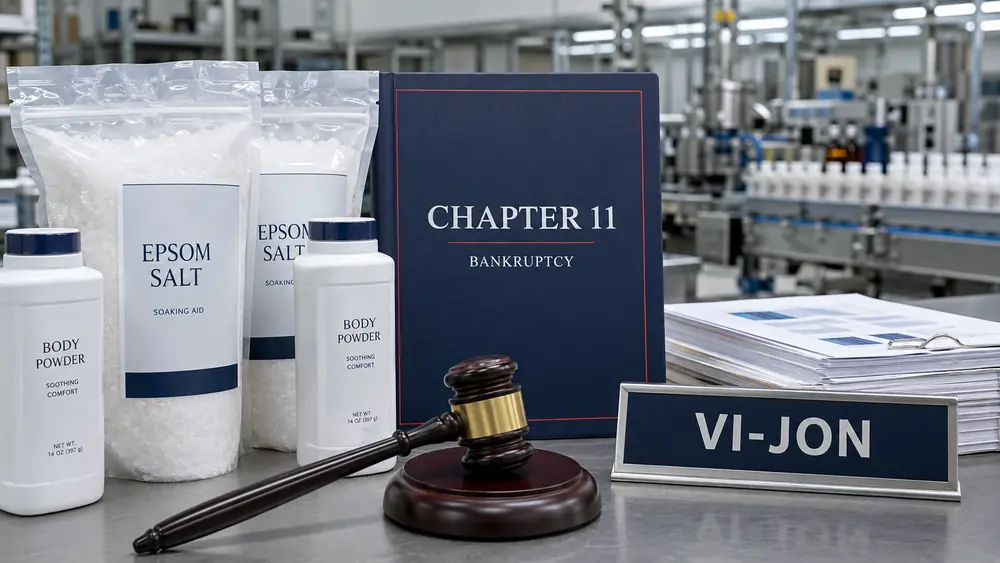

Vi-Jon, LLC has filed for Chapter 11 bankruptcy protection after hundreds of lawsuits involving its historical talc-based products created costs the company says it can no longer sustain. The St. Louis-based private-label personal-care manufacturer filed on August 2, 2026, in the U.S. Bankruptcy Court for the District of Delaware.
The petition estimates assets between $1 million and $10 million and liabilities between $500 million and $1 billion. Case number 26-11216 has been assigned to Judge Mary F. Walrath. Vi-Jon indicated that funds should be available for distribution to unsecured creditors after administrative expenses.
Why Vi-Jon Filed for Chapter 11
The bankruptcy is primarily intended to resolve present and future claims alleging that exposure to Vi-Jon’s former talc products caused serious illnesses. The company disputes those allegations and maintains that its historical products were safe.
Vi-Jon is named in 367 active talc cases: 356 involving alleged mesothelioma and 11 involving alleged lung cancer. None of the active cases identified in the filing involves an ovarian cancer allegation.
The company stopped producing and selling talc products in 2016. The litigation therefore concerns historical exposure claims and is not a newly announced recall affecting products currently in stores.
How Vi-Jon Became Responsible for the Claims
Vi-Jon began in 1908 as the Peroxide Specialty Company and adopted its current name in 1933. It later became a major supplier of private-label health, beauty and personal-care products.
Some liabilities trace back to Cumberland Swan’s 1999 purchase of assets from Perrigo. Vi-Jon assumed those obligations after merging with Cumberland Swan in 2006.
Two recent verdicts increased the financial risk. A Minnesota jury returned a $10.2 million verdict in May 2026 and assigned 20% of the responsibility to Vi-Jon, subject to offsets. In July, an approximately $16.75 million judgment was entered against the company in New York.
Vi-Jon continues to contest the claims, but its restructuring officer said repeated trials, defence costs and higher settlement amounts were unsustainable. Court papers also state that 28 law firms began bringing talc claims after a liability forecast was prepared in 2023.
What the Liability Estimate Means
The stated $500 million-to-$1 billion liability range is a bankruptcy estimate, not a final amount Vi-Jon has been ordered to pay. It includes disputed, unresolved and potential future personal-injury claims.
Because many creditors are represented claimants, Vi-Jon asked to list the 20 law firms representing the largest numbers of claimants instead of a conventional list of its 20 largest unsecured creditors. Emprise HPC, LLC directly holds 100% of Vi-Jon’s equity, while Emprise Group indirectly owns the debtor through Emprise HPC.
Is Vi-Jon Closing or Liquidating?
Vi-Jon has not announced a shutdown. Chapter 11 permits a company to continue operating while it restructures liabilities under court supervision. The company has requested permission to maintain bank accounts, pay wages and benefits, and continue essential manufacturing, logistics and administrative arrangements.
A Village Inn franchisee’s Chapter 11 restructuring similarly involved continued operations rather than an immediate closure.
Chapter 7 is different because it normally focuses on liquidation. The Wren Kitchens U.S. bankruptcy and store closures show how liquidation can have a more immediate effect on customers and employees.
What Happens to Vi-Jon Products?
Following a 2023 corporate reorganization, Vi-Jon retained a private-label dry-goods business focused mainly on Epsom salts and body powders. Court records identify Amazon, Dollar General, Kroger, TopCo and Walgreens among retailers it has served, although they do not provide a complete current product list for each chain.
Vi-Jon recorded approximately $26 million in net sales in 2025 and expects around $21 million in 2026 after losing a substantial portion of its body-powder business. Epsom salts generated about 65% of annual sales in 2024 and 2025 and remain its most profitable category.
No general product recall accompanied the Chapter 11 filing. The bankruptcy itself does not mean items currently on shelves have been recalled, declared unsafe or immediately discontinued.
Is Germ-X Included in the Bankruptcy?
Although Vi-Jon historically developed Germ-X, the branded hand-sanitizer operation is not the debtor in this case. The 2023 reorganization transferred Germ-X and other branded and liquid products to Vivos Holdings and its subsidiaries.
Vi-Jon retained the dry-goods operation and alleged talc liabilities. Describing the case as a Germ-X bankruptcy would therefore misrepresent its scope.
How the Proposed Talc Trust Would Work
Vi-Jon signed a restructuring support agreement on July 30. The company says lawyers representing more than 80% of outstanding talc claims support the framework.
The proposed plan would create a trust for eligible current and future claimants. Non-debtor affiliates would provide a guaranteed $25 million contribution, with insurance rights and other consideration potentially added. Vi-Jon reports more than $900 million in historical liability insurance, although the amount ultimately available remains unresolved.
The debtor has no secured debt and does not presently plan to obtain conventional bankruptcy financing. It expects to use available cash, customer receipts and equity support from affiliates.
Who Is Managing the Case?
Sidley Austin LLP is serving as bankruptcy counsel, with Eric J. Monzo of Morris James LLP acting as Delaware counsel. Houlihan Lokey Capital is the investment banker, and Berkeley Research Group is the financial adviser. BRG managing director Mackenzie Shea has served as chief restructuring officer since May 14, 2026.
Omni Agent Solutions is handling claims and notices. Court motions, orders and hearing information are available through the official Vi-Jon Chapter 11 docket.
What Happens Next?
The court must review Vi-Jon’s initial operating requests and eventual restructuring plan. The proposed trust, insurance rights, treatment of unsecured claims and any asset transfers will remain subject to judicial approval.
For customers, operations are intended to continue and no bankruptcy-related recall has been announced. Claimants and creditors should monitor official case notices because payment procedures, filing deadlines and eligibility requirements will depend on future court orders.

Make Swikblog your go-to source on Google for reliable updates, smart insights, and daily trends.