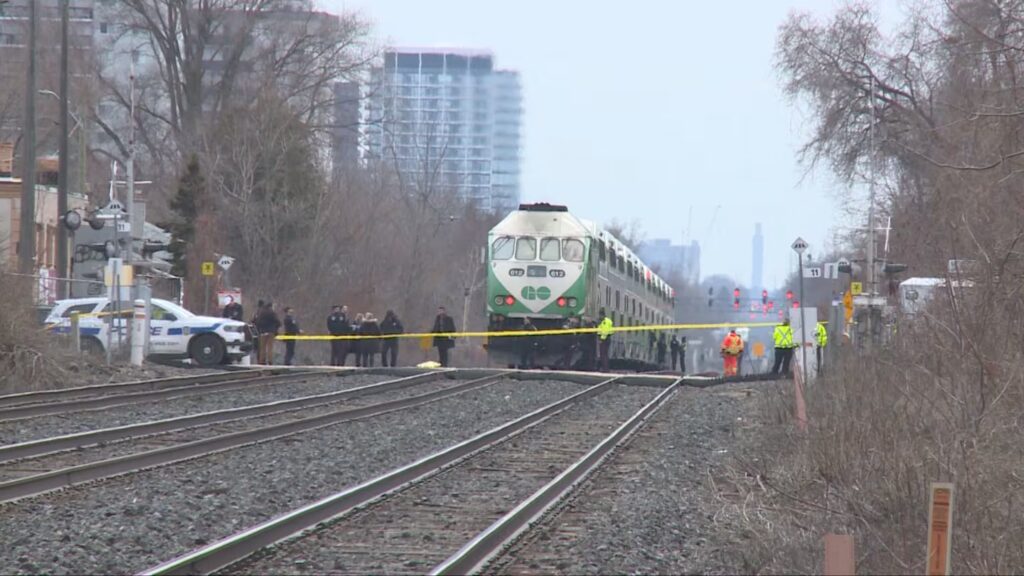

A heartbreaking incident on the Lakeshore West GO line has left a community in mourning after a 13-year-old boy was fatally struck by a train in Mississauga on Wednesday, March 18, 2026. The collision occurred in the afternoon near Alexandra Avenue and Lakeshore Road East, triggering a massive emergency response, widespread transit disruption, and an ongoing investigation into the circumstances surrounding the child’s death.
Peel Regional Police confirmed that emergency crews were called to the railway crossing at approximately 2:45 p.m. Upon arrival, first responders located a young boy who had been struck by a westbound GO train. Despite efforts at the scene, the child was pronounced dead, marking what authorities described as an “absolutely horrible situation” for the family.
What police revealed about the moments before the crash
Investigators shared critical early details that help piece together what led to the fatal collision. According to police, the boy — believed to be between 12 and 13 years old — was riding a motorized bike in the area along with another young child. Notably, officials confirmed that the children were not under adult supervision at the time.
Preliminary findings suggest that the boy entered the railway crossing by going around an active safety barrier. Authorities emphasized that the crossing protection systems were fully operational at the time of the incident. Barrier arms were lowered, warning lights were flashing, and audible signals were sounding — all indicating an approaching train.
Despite these warnings, the boy appears to have bypassed the barrier, placing himself directly in the path of the westbound GO train. Police have not assigned blame but have indicated that these early findings will form a central part of the ongoing investigation.
Location of incident and impact on GO Transit network
The fatality occurred on the Lakeshore West GO line between Long Branch and Port Credit stations — one of the busiest commuter corridors in the Greater Toronto Area. The incident immediately halted train movement through the area, causing significant disruption across both Lakeshore West and Lakeshore East lines.
For several hours, no trains were able to pass through the affected section. GO Transit confirmed that service was suspended between key points, and bus shuttles were deployed to help move passengers between stations. Commuters faced delays, cancellations, and route modifications during the late afternoon rush.
Train service resumed around 6:30 p.m., but GO Transit warned that residual delays and schedule changes could continue into the evening. Officials issued an apology to passengers, acknowledging both the inconvenience and the emotional weight of the situation. Riders were advised to monitor updates via GO Transit’s official website.
Major emergency response and road closures in Mississauga
The severity of the incident led to a large-scale emergency response in the Lakeshore area. Police, paramedics, and transit officials secured the scene, while nearby roads were shut down to allow investigators to work safely.
Authorities confirmed that Fourth Street was closed between Ogden Avenue and Alexandra Avenue, while Alexandra Avenue itself was also shut down from Fourth Street to Lakeshore Road East. Drivers were urged to avoid the area and seek alternate routes as congestion built up in surrounding neighborhoods.
The scene remained active for several hours, with police tape, emergency vehicles, and halted rail traffic underscoring the seriousness of the event. For residents and commuters alike, the disruption was a stark reminder of how quickly a routine day can be transformed by tragedy.
Investigation led by Metrolinx with police support
The investigation into the fatal collision is being led by Metrolinx, the agency responsible for GO Transit operations, with assistance from Peel Regional Police. Officials are expected to examine multiple aspects of the incident, including crossing signal functionality, train operations, and witness accounts.
Early statements from authorities indicate that all crossing signals were functioning correctly at the time, shifting focus toward how the child accessed the tracks despite active warnings. Data from the train, signal systems, and potential surveillance footage will likely play a role in determining the final sequence of events.
Police also confirmed that they will conduct their own investigation into the death, ensuring that all contributing factors are carefully reviewed.
Community reaction and emotional impact
The loss of such a young life has deeply affected the Mississauga community. Incidents involving children often carry a profound emotional impact, and this tragedy has sparked conversations among parents, residents, and commuters about safety near railway crossings.
Police expressed their condolences to the boy’s family, acknowledging the devastating nature of the loss. Officials also used the moment to issue an important reminder about rail safety, particularly for children and teenagers who may not fully understand the risks associated with active train tracks.
One officer noted that while young people should be able to enjoy activities like riding bikes, it is critical to remain aware of surroundings and respect railway barriers and signals at all times.
Railway safety back in focus after fatal Lakeshore West incident
This Lakeshore West GO train fatality has once again highlighted the importance of railway safety awareness. Even with modern warning systems in place, trains cannot stop quickly, and attempting to cross tracks after signals are activated can have fatal consequences.
Safety organizations continue to stress that barriers, flashing lights, and alarms are designed to provide clear and urgent warnings. Ignoring them — even for a few seconds — can lead to irreversible outcomes. More information on railway crossing safety can be found through Operation Lifesaver Canada, which works to prevent such incidents nationwide.
For Mississauga, this tragedy is more than a news story. It is a painful reminder of the risks present at railway crossings and the importance of constant vigilance. As investigations continue, the focus remains on understanding what happened and ensuring that awareness around rail safety is strengthened to prevent similar incidents in the future.
You may also like: Auckland Golf Course Future: Why the 12-Hole Plan at Takapuna, AF Thomas Park Is Drawing Attention

Make Swikblog your go-to source on Google for reliable updates, smart insights, and daily trends.