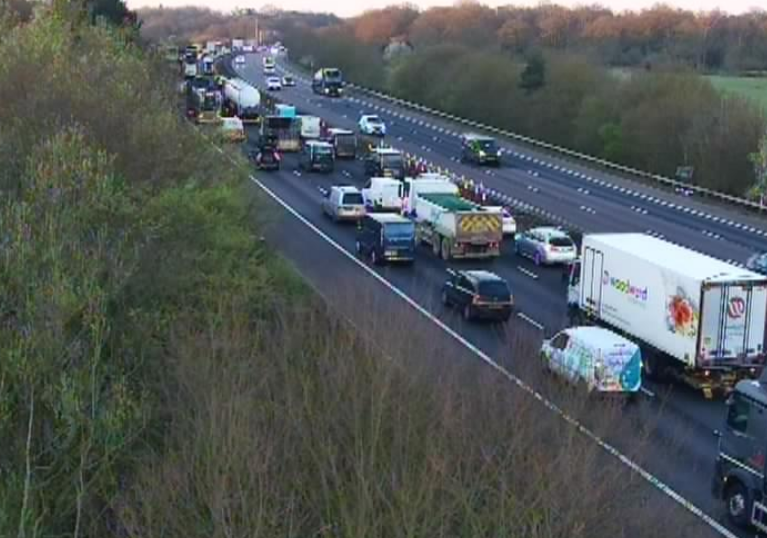

The M25 has been thrown into major chaos after a serious crash involving three lorries forced a full motorway closure near Brentwood, sparking gridlock and delays of up to three hours during the morning commute.
The incident occurred in the early hours of Wednesday, March 18, 2026, with emergency services rushing to the scene shortly after 3:00am. The collision happened on the clockwise carriageway between Junction 27 (M11) and Junction 28 (A12), a critical stretch of one of the UK’s busiest motorways.
According to updates reported by BBC News and confirmed by National Highways, the crash involved three heavy goods vehicles (HGVs) and resulted in a fuel spillage, significantly complicating recovery and cleanup operations.
M25 clockwise closure between J27 and J28 brings traffic to a standstill
Following the crash, the entire clockwise carriageway was shut down between Junction 27 and Junction 28, immediately halting traffic flow. Vehicles quickly built up behind the closure, creating long queues and severe congestion during the early morning hours.
Traffic monitoring system Inrix confirmed the crash was first logged at around 03:00 GMT. By approximately 5:20am, traffic that had been trapped within the closure began to be released through lane one, providing limited relief to drivers who had been stuck for hours.
However, for motorists approaching the area, the situation remained extremely difficult. Authorities warned as early as 6:30am that delays of up to three hours were expected to continue, particularly as the morning rush intensified.
Fuel spillage and multiple HGVs slow recovery efforts
The scale of the disruption was worsened by a fuel spill caused by the crash. Fuel spillages on major roads require specialist handling due to the risks they pose, including fire hazards and dangerously slippery surfaces.
With three lorries involved, recovery operations were further delayed. Heavy goods vehicles require large recovery equipment and careful coordination to remove safely, especially when there is debris, damage, or potential load spillage. Crews had to work in stages to secure the area, clear the vehicles, and treat the affected road surface before any wider reopening could take place.
Emergency services and traffic officers deployed
All emergency services were in attendance, including Essex Police, ambulance teams, and National Highways Traffic Officers. Their role was not only to respond to the crash but also to manage traffic, coordinate recovery efforts, and ensure the safety of drivers in the area.
National Highways said: “The M25 in Essex is closed clockwise between J27 and J28 due to a collision involving three HGVs. All emergency services including Essex Police are in attendance. National Highways Traffic Officers are also on scene assisting with traffic management.”
Drivers were urged to allow extra journey time, plan ahead, and consider alternative routes or delaying travel altogether.
Diversion routes implemented as congestion spreads
With the motorway closed, diversion routes were quickly put in place. Drivers were advised to follow the hollow triangle diversion symbol on road signs.
The main diversion route directed motorists from M25 Junction 27 onto the M11 towards London. From there, drivers were guided onto the A406 Southbound North Circular Road, then onto the A12 at Redbridge Interchange. They were instructed to follow the A12 toward Chelmsford, continue to Gallows Corner, and then proceed for approximately two miles to the Brook Street roundabout before rejoining the M25 at Junction 28.
An alternative diversion route saw traffic diverted via the M11 northbound towards Harlow, then across the A414 to Chelmsford, before rejoining the A12 towards London.
These diversions quickly came under heavy strain as motorway traffic flooded onto local and regional roads, causing additional congestion beyond the immediate crash site.
Traffic impact spreads beyond crash zone
The M25 is one of the most important transport routes in the UK, linking key regions, freight corridors, and commuter flows around London. When a section like this is closed, the impact is rarely isolated.
Drivers across Essex and surrounding areas experienced knock-on delays as traffic spilled onto alternative routes. Local roads, already busy during peak hours, struggled to cope with the sudden surge in vehicles diverted from the motorway.
For commuters, logistics operators, and long-distance drivers, the disruption meant extended travel times, missed schedules, and increased uncertainty throughout the morning.
Another week of disruption on the M25
This latest incident follows another lorry-related crash earlier in the week near the Dartford Tunnel. In that case, two HGVs collided on the anti-clockwise carriageway at Junction 30, forcing lane closures for several hours and causing major delays.
Images from that earlier crash showed one lorry partially flipped onto its side, leaning against another vehicle, highlighting the severity of incidents involving large freight vehicles.
The repeated disruptions have raised concerns among drivers about ongoing reliability on the M25, particularly during peak travel periods.
What drivers should expect next
Although some traffic has been released through lane one, full reopening of the affected stretch depends on the completion of recovery work, including vehicle removal, road surface inspections, and final safety checks following the fuel spillage.
Even after the motorway reopens, residual delays are expected to continue as congestion clears and normal traffic flow gradually resumes.
Drivers are advised to continue monitoring live traffic updates, allow extra time for journeys, and consider alternative routes where possible.
The M25 crash near Brentwood serves as a clear reminder of how quickly a single motorway incident can escalate into widespread disruption. With three lorries involved, a fuel spill, and hours-long delays, the effects of this early-morning collision have stretched far beyond the crash site—impacting thousands of drivers across one of the UK’s busiest road networks.

Make Swikblog your go-to source on Google for reliable updates, smart insights, and daily trends.