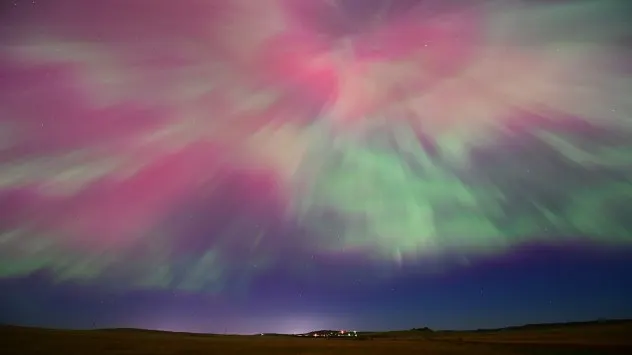

Heightened solar activity could send the northern lights across a wide sweep of the United States tonight, with forecasts suggesting the aurora may be visible in up to 20 states as a geomagnetic storm strengthens overhead. The prospect of a rare display beyond the usual far northern latitudes has pushed the phenomenon into the spotlight, with skywatchers from the northern Plains to parts of the Northeast watching for one of the weekend’s most striking natural events.
The surge in interest follows a series of solar eruptions that have unsettled Earth’s magnetic field over the past several days. Forecasters say the latest conditions are being driven by the lingering effects of a coronal mass ejection, combined with a fast-moving stream of charged particles flowing from a coronal hole on the sun. When that energy reaches Earth, it can trigger geomagnetic storm conditions strong enough to expand the auroral oval and bring the lights into view much farther south than usual.
That matters because the northern lights are not simply a spectacle for Alaska or northern Canada during episodes like this. Under stronger storm conditions, faint green, red and purple curtains can appear low on the northern horizon in states that do not often make aurora headlines. For many people, the story is not only that the lights may show up, but that they may appear within reach of major population centres that rarely get a credible chance to see them.
The best odds remain in northern parts of Alaska, Washington, Idaho, Montana, North Dakota, South Dakota, Minnesota, Wisconsin, Michigan and Maine. But if the storm intensifies, the viewing zone could expand into parts of Oregon, Wyoming, Nebraska, Iowa, Illinois, Indiana, Ohio, New York, Vermont and New Hampshire. Visibility will vary sharply by local conditions, with dark skies and a clear northern horizon likely to make the difference between a dramatic show and no sighting at all.
Why tonight’s aurora matters
Unlike a meteor shower or an eclipse, aurora forecasting comes with a degree of uncertainty that makes each event unusually dynamic. Space weather models can outline the likely strength of a storm, but the most vivid displays often depend on the behaviour of the solar wind in real time. A favourable shift in the magnetic field can rapidly improve conditions, while a less cooperative pattern can leave expected displays weaker than hoped.
That uncertainty is part of what is driving the attention around tonight’s event. People are not only responding to the possibility of seeing the aurora, but to the sense that the window could open quickly and without much warning. In an age of heavily scheduled spectacle, the northern lights still retain an element of unpredictability that feels both old-fashioned and immediate.
There is also a wider context. Solar activity has been ramping up as the sun moves through a more active phase of its cycle, increasing the frequency of flares, coronal mass ejections and geomagnetic disturbances. That has turned the aurora into a more regular headline in recent months, but frequency has not made these displays ordinary. Each storm still brings a different footprint, a different intensity and a different chance for regions well south of the Canadian border to witness something usually reserved for more polar skies.
For readers hoping to catch it, the timing will be crucial. Earlier evening hours may offer the best balance between darkness and clearer skies before moonlight becomes more intrusive later at night. Rural areas away from city glare will have the strongest chance, especially where the northern horizon is unobstructed. Even when the aurora looks faint to the naked eye, phone cameras using night mode can often pull out richer colour and structure than the eye can immediately detect.
Beyond the visual appeal, stronger geomagnetic storms are a reminder that solar weather has practical consequences as well as aesthetic ones. Disturbances of this kind can interfere with satellites, navigation systems, radio communications and parts of the power grid, which is why agencies such as the NOAA Space Weather Prediction Center are watched closely during active periods. For most people tonight, though, the impact will be simpler: a reason to step outside, look north and see whether the sky delivers on the forecast.
If it does, the attraction will lie partly in its rarity and partly in its scale. A natural display powerful enough to draw attention across 20 states is not an everyday occurrence, and it arrives with the kind of immediacy that digital audiences respond to instinctively. For a few hours, the biggest show in America may not be on a screen at all, but unfolding in silence above it.
You may like: Yaxel Lendeborg injury update ahead of the national championship

Make Swikblog your go-to source on Google for reliable updates, smart insights, and daily trends.