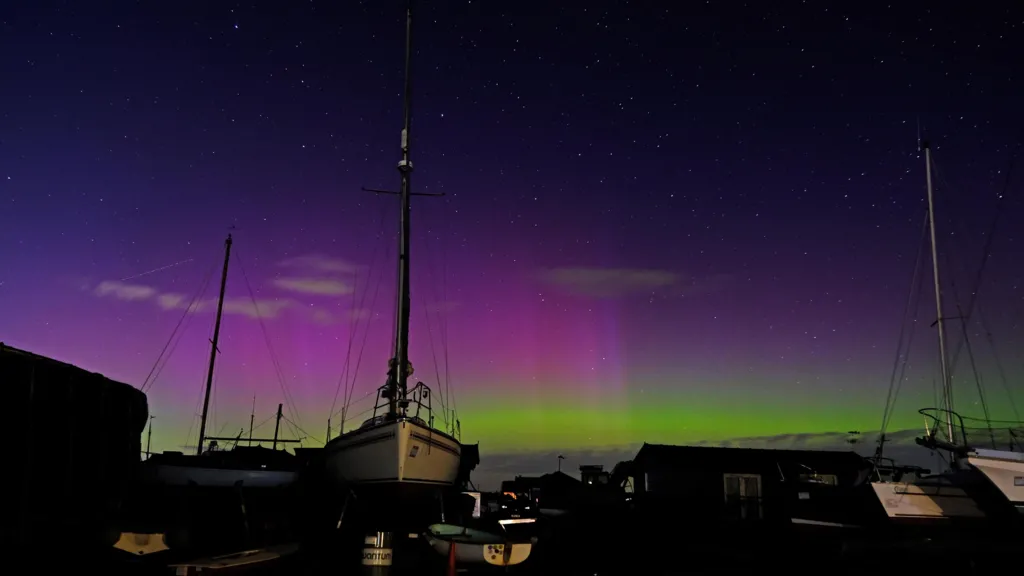

LONDON, October 11, 2026 — The Northern Lights lit up skies across Britain over the weekend, with rare pink, purple and green displays reaching England’s south coast. Residents from Scotland to Kent, Devon and Hampshire witnessed the spectacle on October 9–10, while the Met Office says further aurora sightings could remain possible through Tuesday, October 13.
Northern Lights stun UK down to England’s south coast https://t.co/TyeKfg2FgN
— BBC News (UK) (@BBCNews) October 11, 2026
The unusually widespread display followed heightened solar activity that disturbed Earth’s magnetic field, bringing the Aurora Borealis much farther south than its usual viewing areas near the Arctic Circle.
Northern Lights Sweep Across England and Scotland
Photographs shared with BBC Weather Watchers captured colourful skies across southern England, including Herne Bay in Kent, Salisbury in Wiltshire and Holmwood in Surrey. Sightings also extended to Dorset, Devon and Hampshire.
East Anglia experienced striking displays, with auroras photographed above Felixstowe in Suffolk, Great Yarmouth and Weybourne in Norfolk, Cottenham in Cambridgeshire, and Peterborough.
Other sightings included Dovercourt in Essex, Hitchin in Hertfordshire, Marlow in Buckinghamshire, Kendal in Cumbria and Scarborough in North Yorkshire.
Farther north, observers photographed green and purple skies over Saltburn-by-the-Sea, while Scotland’s Orkney Islands and Inverclyde also witnessed the phenomenon.
Powerful Solar Storm Behind Rare UK Aurora
The display followed coronal mass ejections (CMEs), large eruptions of magnetised plasma released from the Sun.
According to the Met Office’s October 11 space weather assessment, geomagnetic activity reached G3 strong storm levels during two intervals on October 10, alongside a G2 moderate storm interval.
BBC Weather reported magnetic disturbance readings reaching approximately 600 nanotesla on Saturday evening, helping explain the unusually extensive sightings.
These measurements describe different aspects of geomagnetic activity and should not be treated as equivalent storm scales.
Northern Lights UK Tonight: October 11–13 Forecast
The Met Office’s official space weather forecast indicates that further geomagnetic disturbances could produce additional Northern Lights displays.
- Sunday, October 11: Minor G1 storms are likely, with moderate G2 activity possible.
- Monday, October 12: Continued solar activity could create further aurora opportunities.
- Tuesday, October 13: Sightings remain possible, although storm activity is expected to weaken.
Scotland and northern England generally offer better viewing prospects, while another widespread display across southern England depends on stronger geomagnetic conditions.
Cloud cover could also restrict visibility. The Met Office expects increasing cloud across parts of England overnight Sunday, with rain and low cloud affecting some western areas.
Solar Storm Creates Stunning Pink, Purple and Green Aurora Displays
Auroras occur when charged particles interact with gases high in Earth’s atmosphere, releasing visible light.
Oxygen produces green and red emissions, while nitrogen contributes blue and purple shades. Stronger geomagnetic disturbances can expand the auroral zone, making the lights visible farther south.
The Sun’s approximately 11-year activity cycle also influences the frequency of geomagnetic storms.
However, not every unusual coloured sky is an aurora. Artificial lighting reflected by clouds can create similar effects, as seen during the unusual pink sky reported over Birmingham earlier in 2026.
Best Time and Places to See the Northern Lights
Anyone hoping to see another display should find a dark location away from streetlights, preferably with an unobstructed view towards the northern horizon.
Clear skies and limited light pollution are equally important for other astronomical events, including the 2026 Perseid meteor shower.
There is no confirmed peak viewing hour for Sunday night. Smartphone night mode can capture faint aurora colours that may be difficult to distinguish with the naked eye.
Coastal viewpoints and rural locations can offer darker skies, but visitors should avoid unsafe cliff edges and isolated areas during poor weather.
More Aurora Activity Possible, but Visibility Uncertain
Geomagnetic storms can also affect satellite navigation, radio communications and electrical infrastructure, although no major UK disruption has been established from this weekend’s display.
For residents hoping to catch the next aurora, the coming nights will depend on both solar activity and local weather. The Met Office continues to monitor conditions, with further sightings possible through October 13 but another nationwide spectacle far from guaranteed.

Make Swikblog your go-to source on Google for reliable updates, smart insights, and daily trends.