
NVIDIA has launched its Open Agent Safety Platform with support from more than 100 organizations, introducing a new security framework designed to control what autonomous AI agents can access, change and execute as businesses give AI systems greater responsibility.
AI agents are taking on more critical work.
— NVIDIA (@nvidia) September 28, 2026
The security behind them needs stronger boundaries.
We’re building the NVIDIA Open Agent Safety Platform with partners across the industry to help people put agents to work with greater confidence.
Hear from @JensenHuang: https://t.co/3GCVTfQvqT
The platform combines NVIDIA OpenShell, an open-source secure runtime for AI agents, with NVIDIA Sentry, an independent monitoring layer built around BlueField-4 infrastructure. The announcement targets a growing problem for companies adopting agentic AI: how to let an AI system perform useful work without giving it unrestricted access to sensitive data, credentials and infrastructure.
Why NVIDIA is putting security around AI agents
AI agents differ from conventional chatbots because they can do more than generate an answer. Depending on their permissions, agents can read and modify files, write code, use APIs, communicate with external services and carry out multi-step tasks.
That makes security increasingly important as agents move into software development, customer operations, financial workflows and enterprise infrastructure.
NVIDIA CEO Jensen Huang has framed AI safety as a full-stack engineering challenge. The company’s approach is to place enforceable controls around an agent rather than depending solely on instructions inside the AI model.
OpenShell controls what an AI agent can do
At the center of the platform is NVIDIA OpenShell, which runs agents inside isolated environments and applies policies governing their access.
Administrators can restrict which files an agent can read or modify, which processes it can execute and which network destinations or services it can reach. The goal is to follow a least-privilege model: give an agent enough access to complete its assignment without automatically opening the rest of a company’s systems.
For example, a coding agent could be permitted to work inside a specific repository while being prevented from accessing unrelated directories containing confidential documents or credentials.
OpenShell is also designed to work across different AI ecosystems rather than requiring companies to use only NVIDIA models. NVIDIA documentation describes agent workflows involving tools such as Claude Code, Codex and GitHub Copilot CLI.
Credentials can remain hidden from the agent
One less obvious security issue involves credentials. Agents may need API keys or authentication tokens to use external services, but exposing those secrets directly to an autonomous process creates additional risk.
OpenShell can keep sensitive credentials away from the agent itself while allowing authorized requests to be authenticated through controlled infrastructure.
Policies can also be changed as a task develops. An agent that needs additional access can request it rather than simply expanding its own privileges, creating a path for human approval of more sensitive actions.
OpenAI Hacked? Anthropic Claude Security Claims and What We Know
Sentry provides an independent watchdog
NVIDIA Sentry adds another layer by monitoring agent activity separately from the environment where the agent is running.
The architecture uses NVIDIA’s BlueField-4 technology to provide infrastructure-level oversight. NVIDIA says an agent that moves outside established security boundaries can be quarantined rapidly.
The distinction is important: OpenShell establishes and enforces what an agent is permitted to do, while Sentry provides an independent monitoring and containment layer outside the agent’s immediate control.
It adapts familiar cybersecurity concepts — including sandboxing, least privilege and zero-trust controls — for software capable of making decisions and taking actions autonomously.
More than 100 organizations join NVIDIA’s push
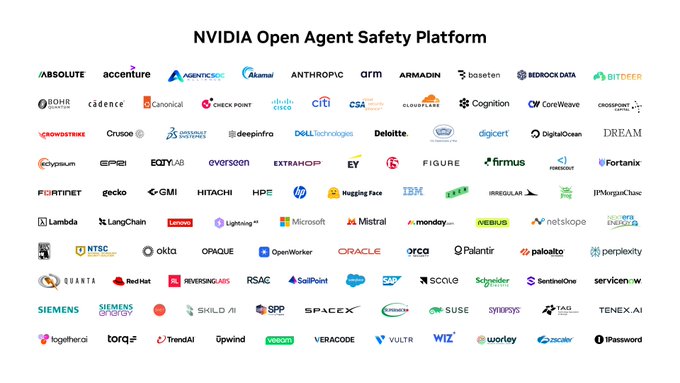
NVIDIA says more than 100 organizations are working with technologies connected to the Open Agent Safety Platform ecosystem.
Companies named in the broader initiative include Anthropic, Microsoft, Salesforce, SAP, Cisco, CrowdStrike, Dell Technologies, HPE, Hugging Face, JPMorganChase, Palantir, Palo Alto Networks, Perplexity, Red Hat, Scale AI, ServiceNow and SpaceXAI.
The range of participants shows why securing agents extends beyond AI-model developers. Operating systems, cybersecurity products, enterprise applications, cloud infrastructure and hardware can all become part of the security chain when an agent receives permission to act.
Salesforce and Microsoft show how this could work
Salesforce is working with OpenShell in enterprise scenarios, including integrations that can give people visibility into agent activity and allow additional permissions to be reviewed rather than automatically granted.
Microsoft and NVIDIA have also worked on secure environments for agents on Windows, combining operating-system security with OpenShell policy controls.
The approach could eventually allow organizations to deploy agents from different providers while maintaining a common layer of access and security policies.
NVIDIA is building more than an AI model business
The announcement also illustrates NVIDIA’s expanding ambitions. The company is building an AI stack spanning GPUs, CPUs, networking, models, inference software and security infrastructure.
Swikblog has previously covered NVIDIA’s growing focus on AI inference and autonomous agents, as well as its Nemotron 3.5 Lightning model for agentic AI workloads.
AI Agents Are Gaining More Power — Security Must Keep Up
The central challenge is straightforward. A chatbot that produces an incorrect answer creates one category of risk; an AI agent with permission to alter code, access customer information or operate business systems creates another.
Better AI models alone cannot remove that problem. Organizations still need technical limits governing what software can access and mechanisms capable of stopping activity that crosses those limits.
NVIDIA’s Open Agent Safety Platform is an attempt to make those safeguards part of the computing infrastructure itself — a potentially important shift as AI evolves from systems that mainly answer people to agents increasingly trusted to act for them.

Make Swikblog your go-to source on Google for reliable updates, smart insights, and daily trends.