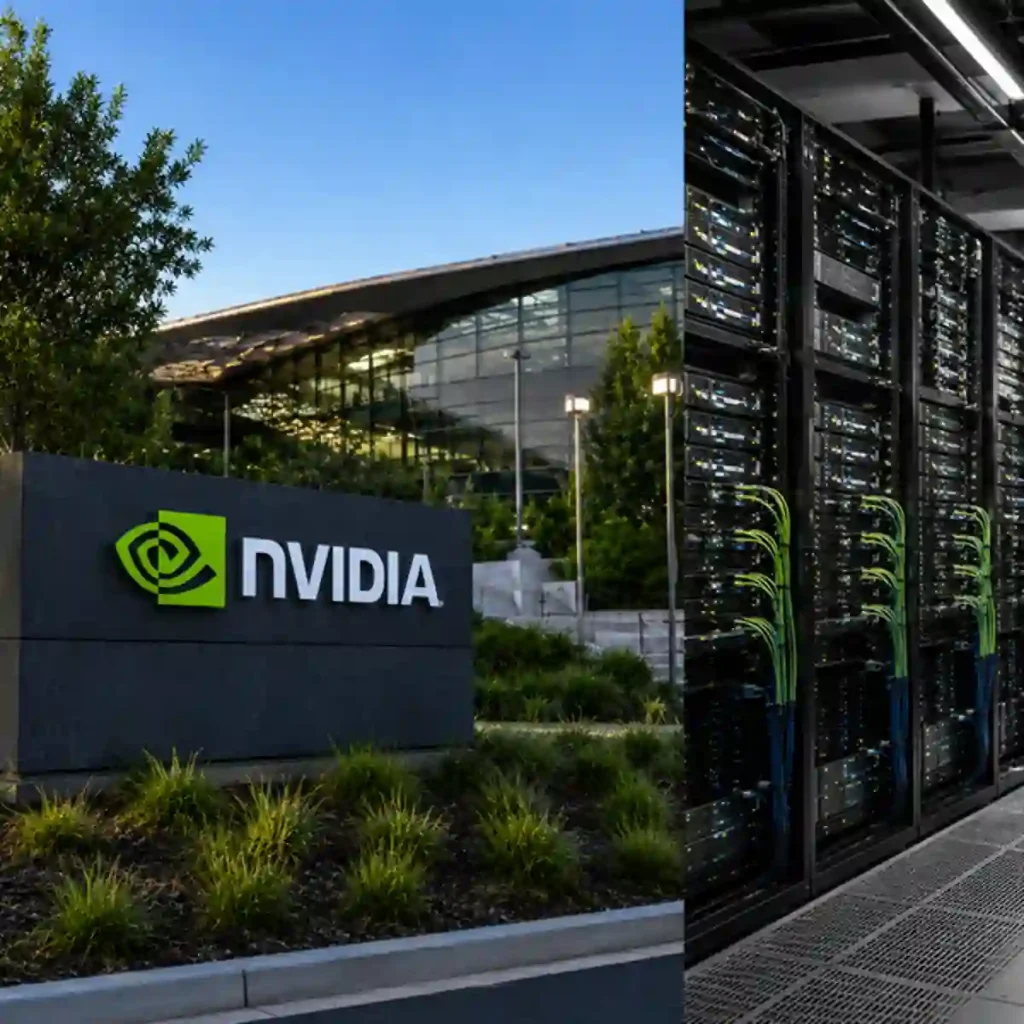

Nvidia has received a striking $515 stock price target from Raymond James analyst Simon Leopold after another blockbuster earnings report, putting one of Wall Street’s most aggressive valuations on the world’s leading AI chipmaker.
Leopold raised his target from $352 to $515 — a roughly 46% increase — while maintaining a Strong Buy rating. From Nvidia’s $227.98 post-earnings closing level cited in the analyst coverage, $515 would represent about 126% upside and could value the company at more than $12 trillion if its share count remained broadly similar.
But the target is a bull-case valuation, not a prediction that Nvidia will automatically reach $515. The argument depends on extraordinary revenue growth continuing, Vera Rubin scaling successfully, supply constraints easing and AI infrastructure spending remaining exceptionally strong.
Why Raymond James sees much more upside
Leopold’s $515 target stands well above most major Wall Street forecasts. Recent post-earnings targets cited in analyst coverage include Evercore ISI at $465, Bernstein at $400, JPMorgan at $320, Citi at $315 and Morgan Stanley at $300.
The difference reflects more than a higher valuation multiple. Leopold believes Nvidia could eventually approach $1 trillion in annual revenue by fiscal 2029, compared with a FactSet consensus cited in analyst reporting of just under $750 billion.
His central argument is that Nvidia’s immediate problem is not finding customers. It is securing enough memory, manufacturing, networking and other capacity to satisfy extraordinary AI demand.
Nvidia’s latest numbers support the bull case
Nvidia reported fiscal Q2 2027 revenue of $96.2 billion, up 106% year over year and 18% sequentially. Data Center revenue surged 117% to $89 billion, accounting for roughly 92.5% of total quarterly sales.
Non-GAAP diluted earnings reached $2.22 per share, up 120% from a year earlier, while non-GAAP gross margin was 75%.
Nvidia now expects approximately $108 billion in fiscal third-quarter revenue, plus or minus 2%. Significantly, that forecast assumes no Data Center compute revenue from China.
The complete figures are available in Nvidia’s official fiscal Q2 2027 earnings report.
The scale of the beat is clearer when compared with what investors were expecting from Nvidia before the August 26 earnings report, including the growth and AI-demand signals Wall Street was watching closely.
Vera Rubin is crucial to Nvidia’s next growth phase
Nvidia says its next-generation Vera Rubin platform is ramping into full production, with systems running at partners including Microsoft Azure, Google Cloud, Oracle Cloud Infrastructure, CoreWeave and Nebius.
That matters because Nvidia increasingly sells complete AI infrastructure rather than relying only on individual GPUs. Its opportunity now extends across CPUs, accelerators, networking, software and large-scale AI factory systems.
Rubin’s rollout will therefore be one of the most important indicators for investors testing whether the aggressive long-term revenue forecasts are achievable.
Nvidia is spending heavily to overcome its supply problem
The scale of Nvidia’s supply commitments shows just how much capacity the company believes it may need.
Its supply and capacity commitments increased from $119 billion last quarter to $279 billion as of July 26, primarily covering memory and manufacturing capacity for Data Center infrastructure.
That can be a major advantage if demand remains strong because Nvidia may have access to scarce components competitors cannot easily secure. But it also creates risk: if AI spending slows, large long-term commitments could become considerably more burdensome.
PayPal Stock Drops as Stripe and Advent Abandon Takeover Bid
Oracle Stock Down Nearly 40%: Why Citi Sees a Buying Opportunity in ORCL
Nvidia is taking bigger financial exposure to the AI boom
Nvidia is also helping expand the infrastructure needed to run its hardware.
The company disclosed up to $3.5 billion of gross guarantee exposure involving selected AI cloud partners. Separately, Nvidia entered guarantees capped at $105 billion supporting land, power and shell infrastructure at SB Energy’s PORTS-Pike campus in Ohio, where OpenAI is the tenant for the initial development.
Nvidia also reported $99 billion of equity investments and another $25 billion of equity investment commitments as of July 26.
These arrangements could accelerate deployment of Nvidia-powered infrastructure, but they also introduce counterparty, financing and execution risks that investors need to consider alongside booming GPU demand.
What could stop Nvidia stock reaching $515?
Margins are one issue. Nvidia produced a 75% gross margin in Q2 but expects approximately 74%, plus or minus half a percentage point, in Q3. Rising memory and component costs could put further pressure on profitability even if revenue keeps climbing.
Competition is another. AMD is expanding its AI accelerator portfolio, while major cloud companies are investing in custom silicon designed to reduce their dependence on third-party GPUs.
Customer concentration also deserves attention. Heavy reliance on a relatively small number of enormous buyers means changes in spending by a major customer can affect Nvidia’s growth trajectory.
China remains another uncertainty, with Nvidia’s $108 billion Q3 forecast currently assuming no Data Center compute revenue from the country.
The reaction to Nvidia also comes during a period of heightened investor interest in technology and other risk assets. Similar shifts in market sentiment have been visible in areas such as the recent Bitcoin surge above $80,000 and the factors driving that rally, highlighting how quickly expectations can change when growth and liquidity narratives strengthen.
For $515 to become more than an extreme Wall Street bull case, investors will need to see several things continue together: rapid Data Center growth, a successful Rubin ramp, improving supply availability, resilient gross margins and sustained spending from hyperscalers, AI laboratories, enterprises and specialized cloud providers.
The $515 figure will attract attention, but those operating numbers matter more. If Nvidia can keep converting unprecedented AI infrastructure demand into profitable sales, Leopold’s forecast becomes easier to defend. If growth or margins fall materially short, the large gap between his target and most of Wall Street could close quickly.

Make Swikblog your go-to source on Google for reliable updates, smart insights, and daily trends.