
NYT Connections today, Saturday, October 31, 2026, brings puzzle #1238 with a clever mix of misleading meanings, cocktail terminology and hidden wordplay. Some words may seem connected at first glance, but finding the correct four groups takes a closer look.
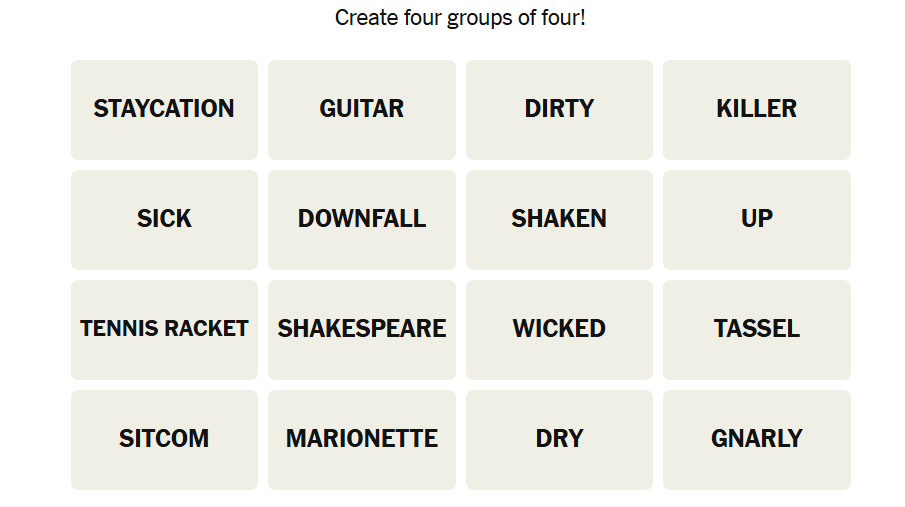
NYT Connections hints for October 31
Today’s NYT Connections puzzle #1238 for Saturday, October 31, 2026, features positive slang, martini terminology, objects with strings and a tricky wordplay category involving dog commands. Here are spoiler-free hints before the complete answers.
- Yellow: Good or bad? Think of words that sound negative but are often used to describe something impressive or excellent.
- Green: James Bond’s favorite drink. Consider different ways to order or prepare a martini.
- Blue: Strings attached! Look for objects that use strings, cords or tightly stretched strands.
- Purple: Woof! Think about common commands given to dogs, but look for them hidden at the beginning of longer words.
Main trap: DIRTY, SICK and WICKED may appear connected because they can suggest something unpleasant. However, DIRTY belongs to the martini category, while SICK and WICKED are part of the yellow group describing something good.
Blue clue: GUITAR and TENNIS RACKET both rely on stretched strings, although they serve completely different purposes. The other two answers also involve strings in their construction or operation.
Purple clue: SITCOM begins with SIT, while STAYCATION starts with STAY. Both are familiar dog commands. The remaining two answers follow the same hidden-command pattern.
Today’s NYT Connections answers
Reveal the Yellow Group
Category: Words meaning good that sound bad
Answers: GNARLY, KILLER, SICK, WICKED
All four words can describe something excellent or impressive in informal English, despite having negative meanings in other contexts.
GNARLY: Although it can describe something twisted, rough or difficult, the word is also used in slang to mean impressive or exciting.
KILLER: Beyond its literal meaning, killer can describe something exceptionally good, such as a killer performance or a killer outfit.
SICK: Commonly associated with illness, sick can also mean amazing, cool or impressive in casual conversation.
WICKED: Traditionally associated with evil or wrongdoing, wicked is also used to describe something excellent or particularly impressive.
The shared connection is positive slang built around words that otherwise sound negative, making yellow today’s most approachable category.
Reveal the Green Group
Category: Martini specifications
Answers: DIRTY, DRY, SHAKEN, UP
Each word describes a particular characteristic, preparation method or serving preference associated with a martini.
DIRTY: A dirty martini contains olive brine, which adds a salty, savory flavor to the drink.
DRY: A dry martini generally contains relatively little dry vermouth compared with the amount of gin or vodka.
SHAKEN: Describes a martini prepared by shaking its ingredients with ice rather than stirring them.
UP: A drink served up is chilled and strained into a glass without ice.
The connection becomes clear when these words are considered as instructions someone might give while ordering a martini.
Reveal the Blue Group
Category: Things with strings
Answers: GUITAR, MARIONETTE, TASSEL, TENNIS RACKET
Each answer refers to an object that contains or uses strings, although their functions vary considerably.
GUITAR: A musical instrument that produces sound through vibrating strings when they are plucked or strummed.
MARIONETTE: A puppet controlled using strings attached to its body and operated by a puppeteer.
TASSEL: A decorative ornament made from hanging threads or cords, commonly found on clothing, curtains and accessories.
TENNIS RACKET: Sporting equipment featuring a tightly stretched network of strings used to strike a tennis ball.
The challenge is recognizing a shared physical feature among objects used for music, entertainment, decoration and sport.
Reveal the Purple Group
Category: Starting with dog commands
Answers: DOWNFALL, SHAKESPEARE, SITCOM, STAYCATION
Each answer begins with a word commonly used as a command when training or directing a dog.
DOWNFALL: Begins with DOWN, a command used to tell a dog to lie down.
SHAKESPEARE: Begins with SHAKE, a command often used to teach a dog to offer its paw.
SITCOM: Begins with SIT, one of the most familiar commands used to ask a dog to sit.
STAYCATION: Begins with STAY, a command used to instruct a dog to remain in place.
The connection depends on recognizing commands hidden at the beginnings of unrelated words. Unlike the other categories, the words themselves do not need to describe dogs or pet training. This makes purple today’s trickiest group.
Play today’s puzzle on the official NYT Connections website.

Make Swikblog your go-to source on Google for reliable updates, smart insights, and daily trends.