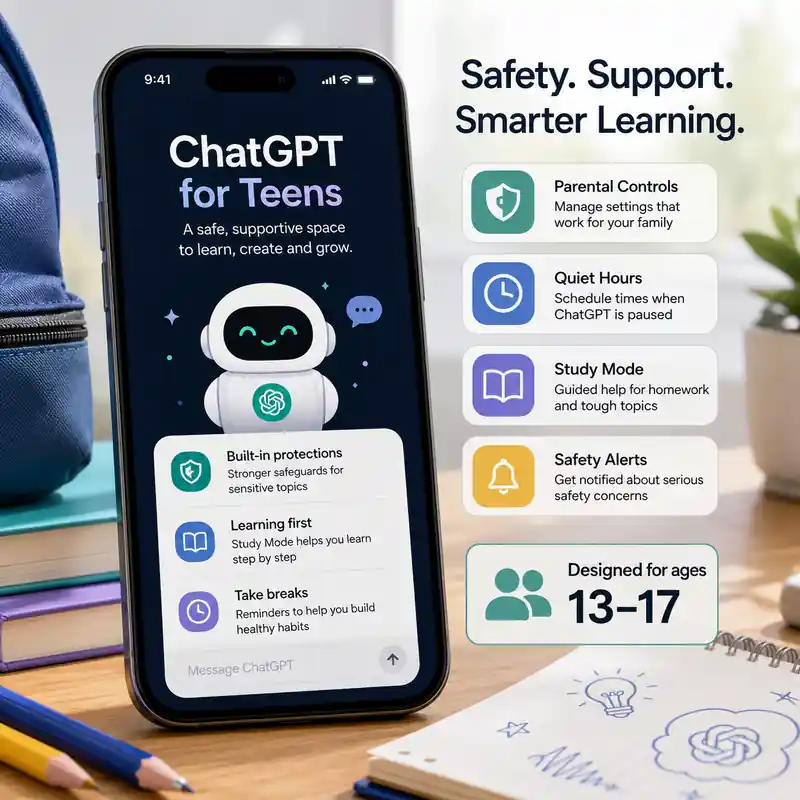

OpenAI has launched a dedicated ChatGPT experience for teenagers aged 13 to 17, adding stronger safety guardrails, parental controls and learning-focused features as the use of conversational AI among young people continues to grow.
ChatGPT for Teens is designed to become the default experience for accounts identified as belonging to someone under 18. OpenAI says it can use self-reported age, account and behavioural signals, and age verification to determine which experience should apply. When it is unsure, the company says it will default to the safer teen setting.
The changes focus on some of the most sensitive areas of chatbot use, including self-harm, violence, eating disorders, dangerous activities and explicit or graphic material. OpenAI is also trying to reduce the risk of teenagers treating the chatbot as a substitute for real-world relationships.
What changes with ChatGPT for Teens
The teen experience adds stronger default restrictions around sensitive content and interactions. OpenAI’s current guidance says its “Reduce sensitive content” setting is turned on by default for teen accounts, covering areas such as graphic violence, risky viral challenges, sexual or violent roleplay, extreme beauty standards and unhealthy dieting content.
Teen onboarding also warns users not to upload private or sensitive images. The experience includes more reminders to take breaks and reinforces that ChatGPT is an AI tool rather than a person.
OpenAI has also put more emphasis on avoiding responses that could encourage emotional dependency. The aim is to keep the chatbot from positioning itself as more important than family, friends, teachers, mentors or other trusted people in a teenager’s life.
Age assurance is becoming a wider technology-industry issue. Discord, for example, has moved toward a default teen-appropriate experience backed by age verification for access to restricted features, showing how major platforms are increasingly separating adult and younger-user experiences.
Parents get Quiet Hours and selected safety controls
Parents or guardians can link their ChatGPT account with a teen account and manage selected settings. OpenAI’s official parental controls guidance says linked adults can manage features including Voice Mode, image generation, Study Mode and Quiet Hours.
Quiet Hours allow a family to set a period when ChatGPT cannot be used from the linked teen account. Parents can also manage certain sensitive-content protections, while other age-based safeguards can continue to apply regardless of individual settings.
Crucially, parental controls do not give parents routine access to a teenager’s conversations. OpenAI says linked adults cannot continuously read or monitor chats. In limited safety situations, however, the company may send a notification with information needed to help support the teen.
The privacy trade-off is already part of a wider legal debate. A Louisiana court fight over social-media age verification showed how youth-safety measures can collide with concerns about privacy, access and online rights.
Study Mode is built around learning, not answer generation
Education is central to the new experience. OpenAI says nearly nine in 10 teens using ChatGPT turn to it for learning, information, skill-building or productivity during a typical week.
Study Mode is intended to guide students through a problem with explanations, questions and step-by-step support rather than simply handing over a final answer. The teen experience also includes learning tools such as quizzes, homework reminders and visualizations.
Study Hours can make Study Mode the default during selected periods. That gives families a practical way to steer ChatGPT toward guided learning when a teenager is doing schoolwork without blocking the tool entirely.
That distinction matters because one of the biggest concerns around generative AI in education is whether students are using it to understand difficult material or merely outsourcing assignments. OpenAI’s approach attempts to preserve the tutoring value while adding more friction around passive answer-taking.
Australia’s under-16 social media restrictions and how teens worked around them
Grok AI image-safety controversy puts generative AI safeguards under scrutiny
Why the teen experience matters
Chatbots create a different safety challenge from traditional search engines or social feeds because they can maintain long, personalised conversations and may be treated as confidants. That becomes especially important when a young user brings up loneliness, emotional distress or other high-risk subjects.
The new safeguards do not remove every risk. Their effectiveness will depend on how accurately OpenAI identifies younger users and how consistently the protections work in ambiguous conversations. But the product change is significant: teenagers are increasingly being given an age-specific ChatGPT experience rather than relying on the same defaults used for adults.
For families, the most practical changes are straightforward — stronger sensitive-content protections, Quiet Hours, guided Study Mode, selected parental controls and clearer reminders that AI should support learning and everyday tasks without replacing trusted people in the real world.

Make Swikblog your go-to source on Google for reliable updates, smart insights, and daily trends.