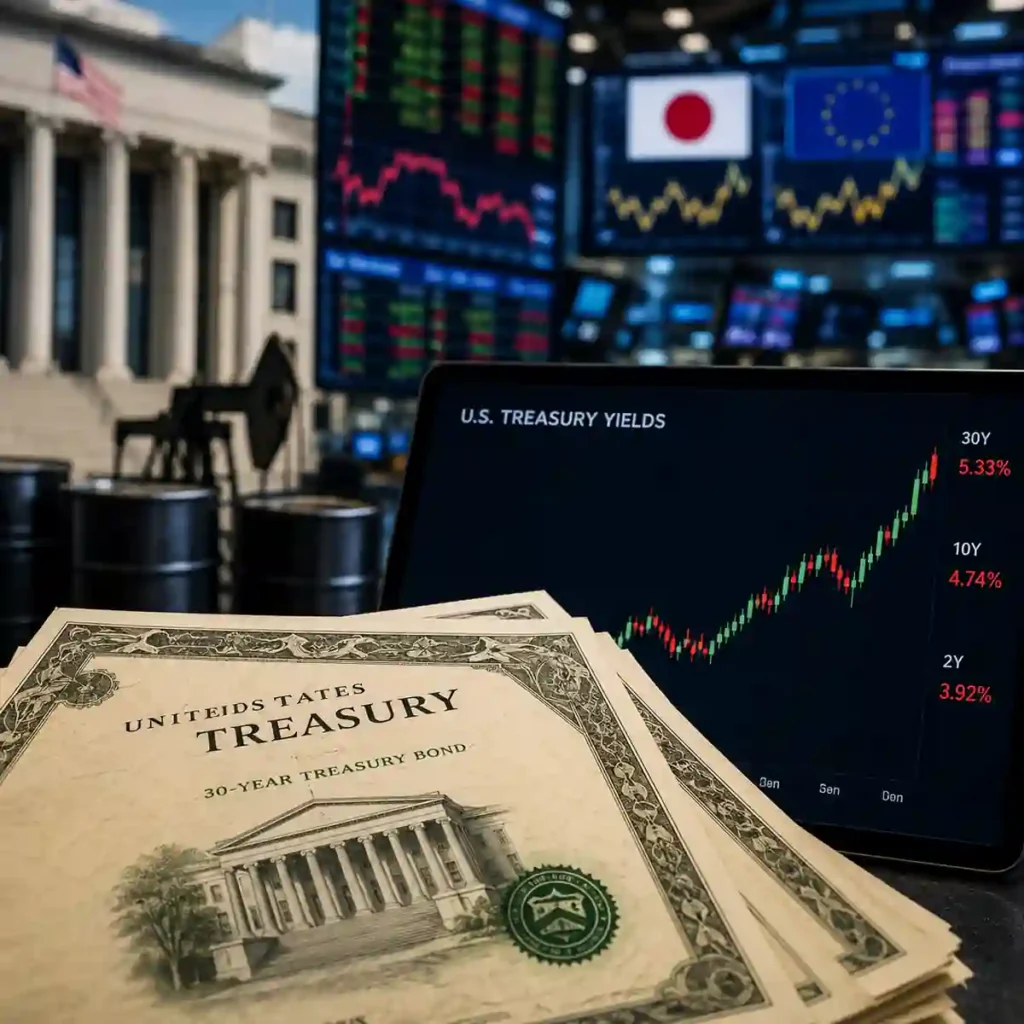

A global government bond sell-off pushed U.S. Treasury yields sharply higher Tuesday, sending long-term borrowing costs to levels not seen in nearly two decades and adding pressure to stocks, mortgages and corporate financing.
The 30-year Treasury yield climbed to roughly 5.33%, its highest level since 2007, while the benchmark 10-year yield traded around 4.72% to 4.74%. Government bond yields also climbed in Japan and Europe, making the move a broader repricing of long-term borrowing costs rather than an isolated U.S. event.
Why are Treasury yields rising today?
There is no single trigger. Investors are weighing inflation risks, heavy government borrowing, increased debt supply, elevated oil prices and competition for global capital.
Bond prices and yields move in opposite directions. When investors sell bonds, prices fall and yields rise. Long-term Treasuries can be particularly sensitive when investors become concerned about inflation or fiscal conditions because buyers are committing money for decades.
Large U.S. fiscal deficits also require substantial Treasury issuance. If investor demand does not keep pace with the supply of new debt, yields may need to rise to attract buyers.
Current rates across different maturities can be tracked through the U.S. Treasury’s official interest-rate data.
Oil above $90 adds to inflation concerns
Oil is adding another source of uncertainty. Global crude prices have moved above $90 a barrel amid Middle East tensions and concerns about energy supplies.
Expensive oil can increase transportation, manufacturing and household costs. If investors believe higher energy prices could keep inflation elevated, they may demand greater returns for holding long-term fixed-rate bonds.
The connection has appeared during other volatile sessions when rising Treasury yields and higher oil prices put Wall Street under pressure. Higher energy costs can strengthen inflation concerns, which can push yields higher and tighten financial conditions.
The bond sell-off is global
Japan’s government bond market is also under pressure, with long-term yields reaching multi-decade highs as investors reassess inflation and monetary conditions.
European government bonds, including German debt, have faced selling as well. International investors compare returns available across the United States, Europe and Japan, so higher overseas yields can increase competition for capital and influence U.S. Treasuries.
That makes Tuesday’s move a global repricing of long-duration debt rather than simply a reaction to one American economic report.
AI investment adds competition for capital
The AI infrastructure boom adds another dimension. Technology companies are spending heavily on data centers, processors, memory, networking equipment and power infrastructure, with some using debt markets to finance expansion.
Corporate AI borrowing is not the main cause of rising Treasury yields. However, additional corporate debt competes for investor money while governments are also issuing large amounts of bonds. That makes financing costs increasingly important to an AI expansion requiring enormous amounts of capital.
Nikkei Falls Over 4% as Japanese Stocks Sink in Market Selloff
World Shares Decline as AI Selloff and Geopolitical Risks Hit Global Markets
Why higher yields are hurting the Nasdaq
The bond sell-off quickly reached stocks. The Nasdaq fell more than 1% Tuesday, while Nvidia, Intel, Micron and other semiconductor shares declined.
Higher Treasury yields make government bonds more competitive with equities. They also reduce the present value investors assign to corporate profits expected years in the future, making high-growth technology stocks particularly sensitive.
A previous period of technology weakness linked to bond yields and interest-rate concerns showed why the Nasdaq can underperform more diversified indexes when investors reassess expensive growth valuations.
Why a 5.33% 30-year yield matters
The impact extends beyond financial markets. Treasury yields provide benchmarks for borrowing across the economy, and persistently higher rates can increase corporate financing and refinancing costs.
The 10-year Treasury is generally more closely connected to U.S. mortgage pricing than the 30-year bond. Still, a broad rise in long-term yields can contribute to tighter conditions for homebuyers, consumers and businesses.
That means the Federal Reserve does not have to raise its policy rate for borrowing conditions to become more restrictive. Markets can effectively tighten financial conditions when long-term yields rise.
What markets are watching now
Investors will closely watch whether the 30-year yield remains above 5% and whether the 10-year continues climbing. Oil is another important signal: persistent crude prices above $90 could keep inflation concerns elevated, while falling energy prices could ease some pressure.
Japan and Europe also matter. If global bond markets stabilize, U.S. Treasury yields could receive some relief. If yields continue rising together across major economies, higher borrowing costs could remain a significant headwind for technology stocks, corporate financing and households.

Make Swikblog your go-to source on Google for reliable updates, smart insights, and daily trends.