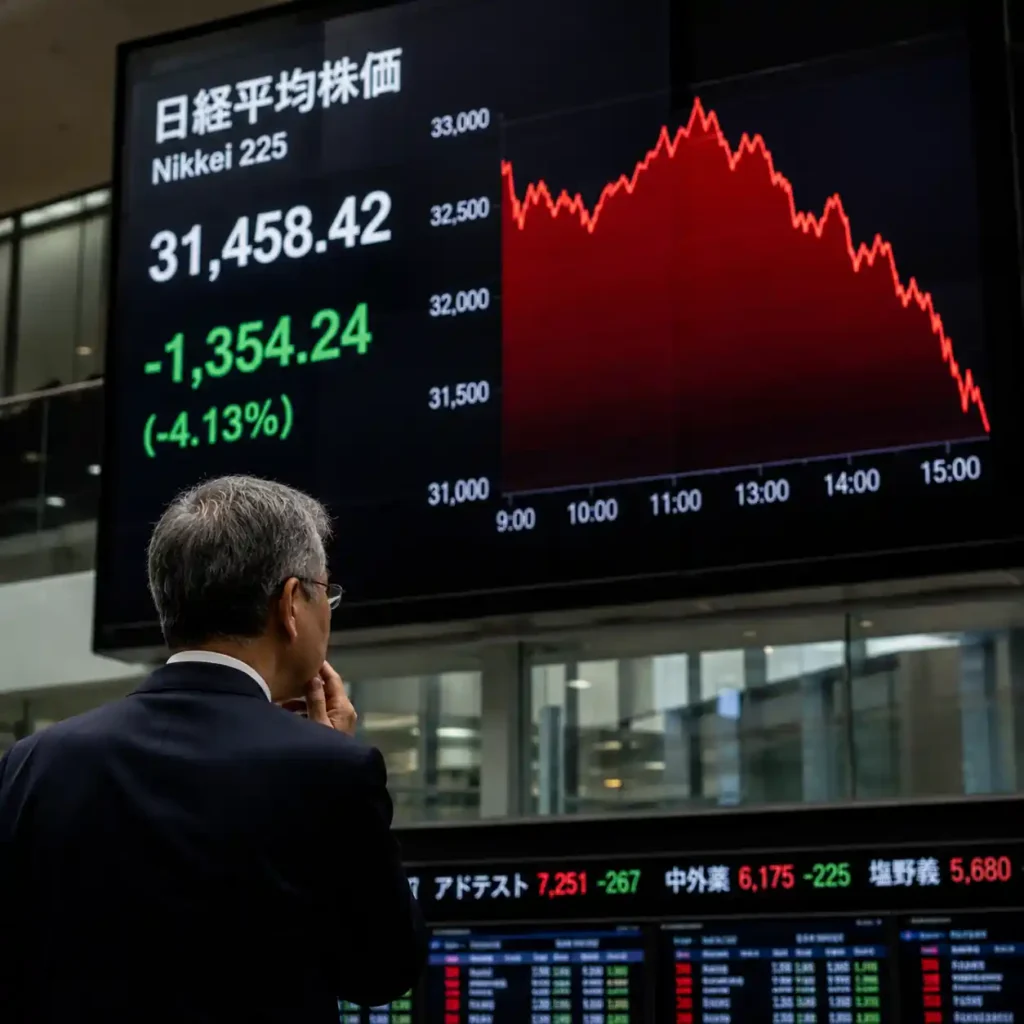

Japan’s Nikkei 225 suffered one of its sharpest declines in recent months on Monday, falling more than 4% as investors rushed to reduce exposure to technology and growth-focused stocks following a broader global market selloff.
The decline marked a significant shift in sentiment after Japanese equities recently reached record highs. The Nikkei’s drop reflected growing caution among investors who have fueled this year’s rally through aggressive bets on artificial intelligence, semiconductor demand and export-driven earnings growth.
Market participants pointed to weakness in U.S. technology stocks as a major catalyst behind the selloff. A sharp retreat in Wall Street’s growth-focused sectors triggered a wave of profit-taking across Asian markets, with Japan emerging as one of the hardest-hit regions due to its large concentration of technology-linked companies.
While the Nikkei has delivered strong gains over the past year, Monday’s decline highlighted how sensitive markets remain to changes in risk appetite. Investors who had previously embraced high-growth themes appeared more focused on protecting profits as concerns around valuations, interest rates and economic growth resurfaced.
Technology Stocks Face Renewed Pressure
Technology and semiconductor-related shares were among the biggest drags on Japanese equities. These sectors have played a central role in the market’s advance, benefiting from global enthusiasm surrounding artificial intelligence infrastructure and chip demand.
However, when investors begin questioning growth expectations or future earnings potential, these same stocks often become the first targets for selling pressure. Rising bond yields and uncertainty surrounding monetary policy can further weigh on growth-oriented sectors because future profits become less attractive when borrowing costs remain elevated.
The latest decline was not isolated to Japan. Several major Asian indices traded lower as investors reacted to broader concerns about global growth and technology valuations. The synchronized weakness suggests that the selloff reflects changing market sentiment rather than company-specific developments.
Adding to the cautious mood, Japan’s economic outlook remains under close scrutiny. Investors continue to assess domestic growth trends, inflation dynamics and the potential impact of future policy decisions from the Bank of Japan. While corporate earnings have generally remained resilient, markets are increasingly demanding stronger evidence that economic momentum can be sustained.
What Investors Are Watching Next
The focus now shifts to whether the latest decline represents a temporary correction or the beginning of a more extended pullback. Historically, strong rallies often experience periods of profit-taking as investors reassess valuations and market expectations.
Analysts will also be monitoring developments in the United States, where interest-rate expectations continue to influence global capital flows. Any signs of stabilisation in U.S. technology shares could help restore confidence across Asian markets, including Japan.
Broader market conditions remain challenging. Rising geopolitical tensions, fluctuations in energy prices and concerns about economic growth continue to create uncertainty for investors worldwide. Similar pressures have recently contributed to broader weakness in international equities, with AI sell-offs and geopolitical risks weighing on world shares across multiple regions.
Despite the sharp decline, many long-term investors continue to view Japan as one of the more attractive developed markets. Corporate governance reforms, stronger shareholder returns and increased foreign investment have helped improve confidence in Japanese companies over recent years.
Read More
Still, Monday’s selloff serves as a reminder that markets rarely move in a straight line. The Nikkei’s retreat underscores how quickly sentiment can change when investors begin questioning valuations, growth expectations and the sustainability of market rallies. The coming trading sessions will likely determine whether this move proves to be a short-term setback or the start of a broader correction in Japanese equities.
Source: Market data and economic analysis from Trading Economics.

Make Swikblog your go-to source on Google for reliable updates, smart insights, and daily trends.