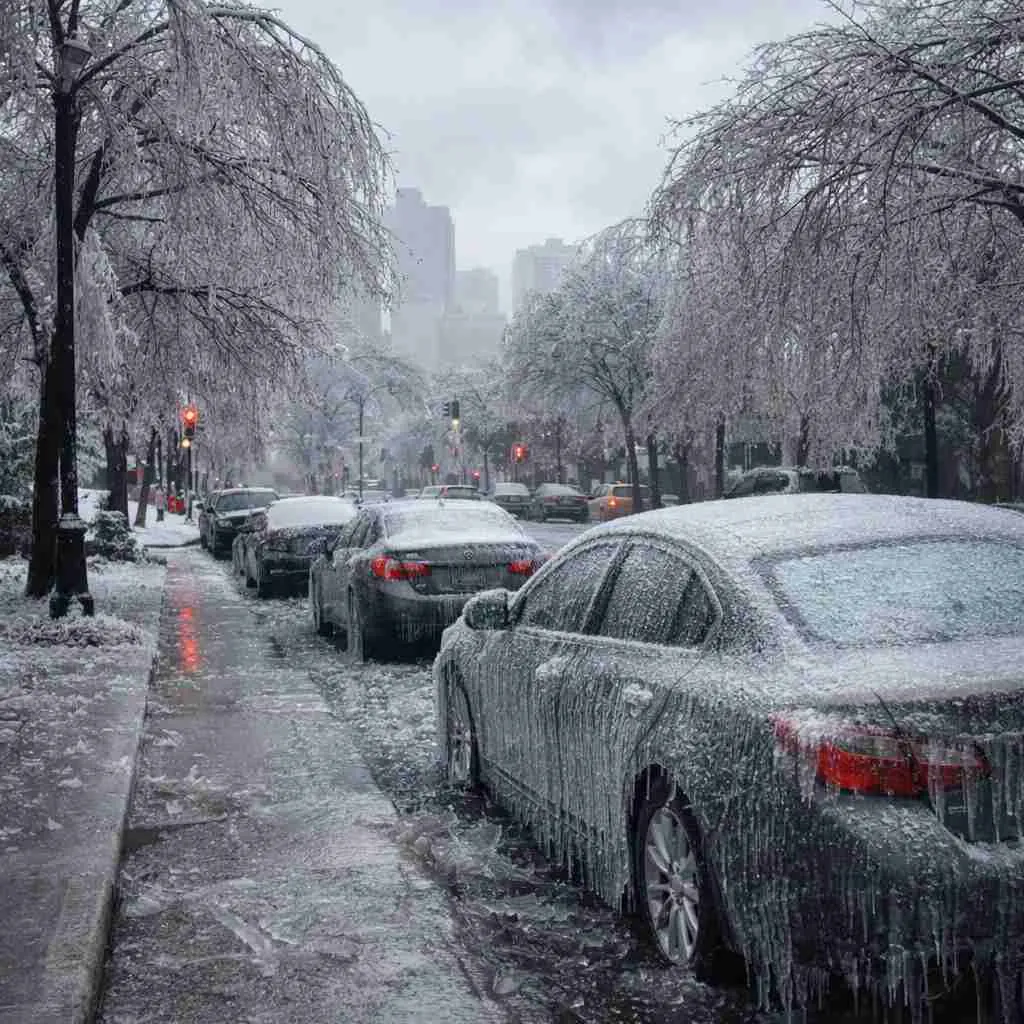

A powerful ice storm swept across Quebec on March 11, leaving a trail of disruption that stretched from Montreal to Montérégie, Outaouais, Laurentians, Lanaudière and Quebec City. What started as a freezing rain warning quickly turned into a major weather emergency, with more than 178,481 addresses without power by early Thursday morning, major transit interruptions, flooded roads and roughly one-third of flights cancelled at Montreal’s Trudeau airport.
The freezing rain event hit the Greater Montreal area especially hard. Environment and Climate Change Canada warned that total accumulations of 20 to 30 millimetres of critical freezing rain could paralyze services and trigger widespread outages. The agency said the storm would affect Greater Montreal, Montérégie, Outaouais, Laurentians, Lanaudière, Mauricie, Centre-du-Québec and the Quebec City region.
By Thursday at 5:15 a.m., the freezing rain warning for Greater Montreal had officially ended, but the damage and disruption were still being felt across the province. Thousands of homes remained in the dark, commuter services were still affected and crews continued working through the aftermath.
Power Outages Exploded Across Quebec
The biggest impact of the storm was the rapid rise in power outages. By early Thursday morning, Hydro-Québec reported 178,481 addresses without electricity across Quebec. The hardest-hit region was Montérégie with 82,542 outages, followed by Montreal with 30,888, Outaouais with 23,488, Centre-du-Québec with 20,361 and the Laurentians with 14,077. Laval was also affected, with 4,329 outages reported.
The numbers had been climbing steadily throughout Wednesday evening. At 4:15 p.m., outages across the province were just above 12,000. By 4:40 p.m., that number had surged to more than 46,000. At 5:30 p.m., Hydro-Québec was reporting nearly 60,000 customers without power. By 6:10 p.m., the total had moved above 72,000, then more than 84,000 by 7:45 p.m. At 8:45 p.m., outages were approaching 92,656, and by 10:05 p.m. they had surpassed 100,993 homes.
The regional pattern also shifted as the storm intensified. Earlier in the day, Lanaudière and the Quebec City region were among the hardest hit. Later in the evening, Montérégie became the most affected area, while conditions in Montreal worsened sharply as more households lost electricity. On the island of Montreal alone, 11,506 customers were without power by late evening, including 1,010 homes in Saint-Laurent. Montreal-Est had 3,158 outages, followed by Dollard-des-Ormeaux with 2,565 and Baie-D’Urfé with 1,367.
Montreal Airport Hit by Flight Cancellations
The storm also disrupted air travel in a major way. At Montreal-Pierre Elliott Trudeau International Airport, roughly one-third of flights were cancelled as freezing rain covered aircraft and complicated operations. Images from the airport showed travellers staring at departure boards filled with cancellations as the storm tightened its grip on the city.
Freezing rain creates serious problems for airports because planes must be de-iced before departure, ground crews work more slowly in dangerous conditions and runway operations can be affected by ice buildup. Even when the airport remains open, delays and cancellations can spread quickly across the schedule.
REM Service Interrupted as Montreal Transit Struggled
Montreal’s public transit network was also hit. The Réseau express métropolitain (REM) announced a service interruption between Brossard and Gare Centrale because of the weather. By Thursday morning, the interruption was still in effect and service resumption times were listed as undetermined, with the next official update expected at noon. Shuttle buses were expected to help commuters while crews assessed the situation.
Earlier बुधवार evening, the REM had said service between Brossard and Central Station in both directions was interrupted because of freezing rain. At one point, the system had projected a possible Thursday morning resumption, but the ongoing icy conditions made that uncertain.
Transit operators had tried to reduce the impact before the worst of the weather hit. Pulsar, the REM’s operator, said trains would keep running every five minutes on Wednesday to limit ice accumulation on the tracks. Meanwhile, the STM said most buses were maintaining service and generally running on time despite the storm.
Roads Turned Slick and Flooding Added to the Mess
Dangerous road conditions were reported across Quebec as freezing rain made highways and local streets slippery. Transport Quebec said conditions varied widely, with some routes in the Outaouais partially to completely covered. Visibility also changed from good to reduced depending on the region.
The Mauricie and Quebec City regions saw snow earlier in the day before that changed to freezing rain, making travel even more unpredictable. Emergency response teams had been on high alert since Tuesday evening, using a network of mobile and fixed weather stations to monitor air temperature, road temperature, precipitation and whether salt or abrasives were needed.
Officials warned that road closures could happen anywhere in the province if crews could no longer guarantee safe travel. Drivers were urged to check official road condition updates before leaving home. In Montreal, the storm was not just about ice. Flooding on roads also added to the transportation problems and became part of the broader emergency response discussion.
Montreal Took Emergency Steps
Montreal officials introduced temporary measures as conditions worsened. Mayor Soraya Martinez Ferrada announced that paid parking spaces and permit-holder spots would be free from 1 p.m. Wednesday until 8 a.m. Thursday because of the ice storm. She noted that reserved lanes, accessible spaces and secure zones would remain in effect, while urging people to avoid driving if possible.
The city was also dealing with pressure on community services. The Old Brewery Mission said it had put measures in place to maintain maximum shelter capacity during the storm. Staff volunteered to stay through the night to help vulnerable people get indoors and stay safe as temperatures dropped and outside conditions became more dangerous.
Officials Warned the Worst Could Come Overnight
One of the most important warnings came late Wednesday afternoon, when Environment Canada said the most serious problems could arrive near the end of the weather event. Meteorologist Giselle Dhookie said the overnight period was especially concerning because once enough freezing rain had accumulated, trees could begin falling onto power lines while temperatures dropped.
That warning proved accurate. Outages continued to jump through the evening, and by Thursday morning hundreds of thousands of Quebecers were still dealing with the effects. Premier François Legault said the government was monitoring the situation closely and that Hydro-Québec crews were ready for the night and overnight response.
What This Storm Means for Quebec
This was not just a routine winter storm. It was a province-wide disruption that affected electricity, roads, transit, shelters and air travel all at once. Ice storms are especially destructive because they do not need huge snowfall totals to create chaos. A thick coating of ice on trees, vehicles, sidewalks and hydro infrastructure is enough to shut down normal life very quickly.
Residents looking for the latest outage information can follow updates from Hydro-Québec, while travellers can monitor flight and airport status through Montréal-Trudeau Airport. Even though the freezing rain warning has ended in some areas, the broader recovery is still ongoing. For many across Quebec, this storm has already become one of the most disruptive weather events of the season.

Make Swikblog your go-to source on Google for reliable updates, smart insights, and daily trends.