
Rheinmetall shares fell 5.20% to €1,567 today despite the German defence giant reporting record earnings and forecasting rapid growth as Europe accelerates military spending. The decline came after the company announced that profit and orders surged in 2025, highlighting the powerful demand wave currently reshaping the global defence industry.
The Düsseldorf-based group said its core operating profit jumped roughly a third to a record €1.8 billion in 2025. At the same time, its order backlog climbed 36% to €63.8 billion, the highest level in the company’s history. Despite those strong results, investors appeared to take profits after a sharp rally in defence stocks across Europe.
Sales could jump as much as 45% in 2026
Rheinmetall expects the growth momentum to accelerate even further this year. The company forecast that sales could rise as much as 45% in 2026 to between €14 billion and €14.5 billion, compared with about €9.9 billion in revenue last year. The outlook reflects rising demand for military equipment as European governments rebuild defence capabilities.
Chief executive Armin Papperger said the company is well positioned to benefit from the changing geopolitical landscape. “The world is changing rapidly, and Rheinmetall is well prepared,” he said. The group manufactures a wide range of military products, including ammunition, artillery systems, armoured vehicles, air defence technology and advanced combat systems.
Analysts expect the company’s expansion to continue over the long term. According to forecasts compiled by the company, Rheinmetall’s annual revenue could surpass €42 billion by 2030, reflecting the scale of defence investment now taking place across Europe.
Europe’s rearmament boom fuels defence demand
The surge in Rheinmetall’s business is closely linked to Europe’s changing security environment. Russia’s invasion of Ukraine in 2022 triggered a major shift in defence policy across the continent. Governments that had allowed military capabilities to shrink after the Cold War are now moving quickly to rebuild them.
The trend has accelerated further as geopolitical uncertainty has increased. The return of U.S. President Donald Trump to office last year has raised concerns among European leaders about the reliability of American security guarantees, encouraging NATO allies to increase defence spending and strengthen their own military industries.
According to the Stockholm International Peace Research Institute, Europe more than tripled its arms imports over the past five years. Germany has also become one of the world’s major arms exporters, overtaking China to rank as the fourth-largest exporter globally between 2021 and 2025.
Missile restocking and new conflicts driving orders
Rheinmetall said demand is also rising because countries are replenishing missile stockpiles and strengthening air defence systems. The company noted that conflicts including the war in Ukraine and rising tensions linked to the Iran conflict are increasing global demand for ammunition and weapons systems.
Management said it expects order backlog to potentially more than double to around €135 billion in the coming years as NATO countries and Ukraine continue placing large defence orders. Rheinmetall also sees opportunities to help restock U.S. missile inventories as allies ramp up military support programs.
These dynamics have pushed the company into the spotlight. For decades Rheinmetall operated with a relatively low profile in Germany, where defence companies historically faced political sensitivity due to the country’s World War II legacy. Today, however, the firm has become a central player in Europe’s defence revival.
Rapid expansion of production capacity
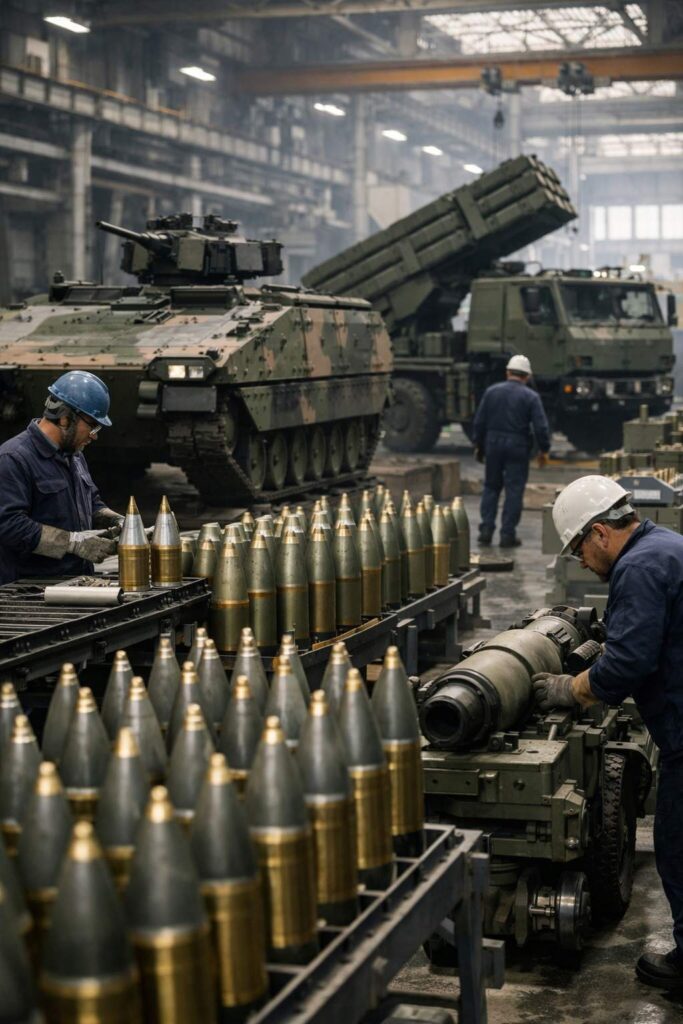
To meet rising demand, Rheinmetall has been expanding its manufacturing network across Europe. The company recently opened a major munitions facility in northern Germany that is expected to become the largest of its kind on the continent.
The plant will eventually be capable of producing up to 350,000 artillery shells per year by 2027, a significant increase in European ammunition capacity. The war in Ukraine has highlighted the importance of large-scale shell production, with Western stockpiles depleted by sustained military support.
Rheinmetall has also broadened its presence in naval defence by acquiring the German shipbuilder Naval Vessels Lürssen (NVL). The move allows the company to expand beyond land systems and ammunition into maritime defence projects.
Company shifts focus entirely to defence
Another strategic change announced by the company is its plan to sell its civilian automotive business. Germany’s car industry has been facing increasing challenges, and Rheinmetall said it intends to focus entirely on defence technologies instead.
The shift would transform Rheinmetall into a pure-play defence contractor specializing in military systems for land, air, space and sea. Investors can review additional details about the company’s defence divisions and product portfolio on the company’s official website.
Dividend increase signals confidence
Alongside its strong financial results, Rheinmetall announced plans to increase shareholder returns. The company said it will propose a dividend of €11.50 per share for the 2025 fiscal year at its annual general meeting in May, up from €8.10 the previous year.
The higher payout reflects management’s confidence in the company’s growth outlook and strong cash flow generation as defence orders continue to expand.
Why shares still fell
Despite the positive outlook, Rheinmetall shares declined after the announcement. The drop appears to reflect short-term profit taking following a significant rally in defence stocks over the past year.
Investors may also be adjusting expectations after the company’s updated forecasts, which came in above some earlier projections but may not have exceeded the most optimistic market assumptions.
For now, the bigger picture remains unchanged. Rheinmetall sits at the center of Europe’s rapidly expanding defence industry, supported by rising military budgets, geopolitical tensions and a continent-wide effort to rebuild armed forces capabilities.
While today’s share decline may reflect near-term market dynamics, the company’s record backlog, expanding production network and aggressive growth forecast suggest Rheinmetall could remain one of the most closely watched defence stocks in global markets over the coming years.

Make Swikblog your go-to source on Google for reliable updates, smart insights, and daily trends.