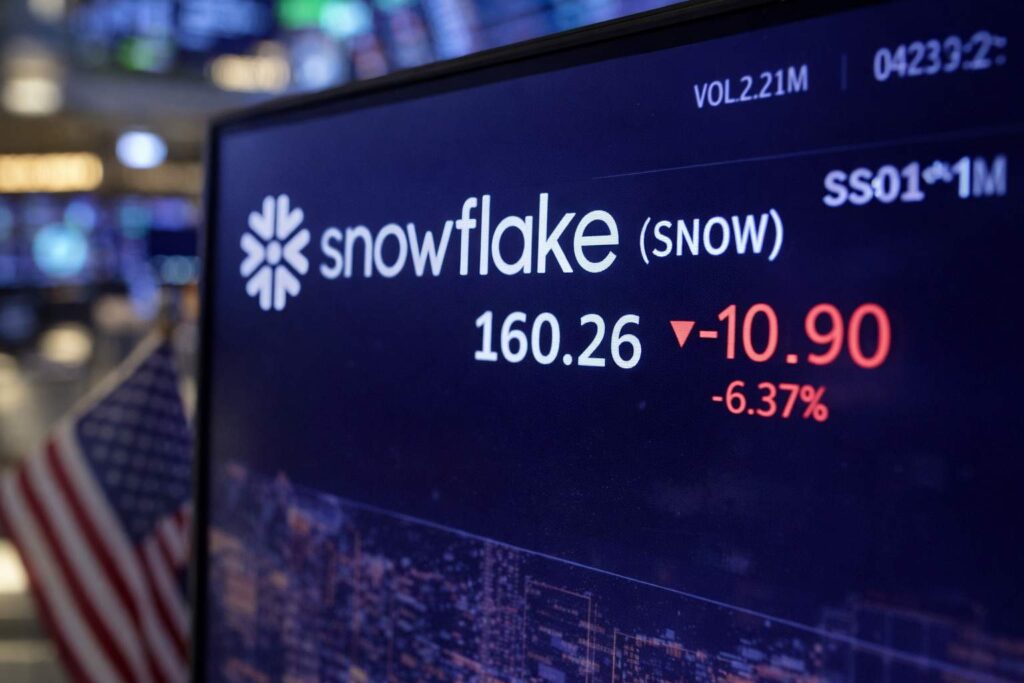

Snowflake (NASDAQ: SNOW) dropped nearly 6% today, sliding toward the $160 level as a broader selloff hit software and SaaS stocks. The move wasn’t isolated. Shares of Workday, Elastic, nCino, and Appian also fell between 4% and 6%, signaling a sector-wide reaction rather than company-specific weakness.
The trigger behind this sudden decline was a major shift in how investors are thinking about artificial intelligence and its impact on enterprise software. A new announcement around AI capabilities has raised serious questions about whether traditional software models could face disruption in the coming years.
AI shock triggers selloff across SaaS stocks
The immediate catalyst was Anthropic’s latest update to its Claude AI assistant, which can now control computers by mimicking human actions like typing and mouse movements. You can read more about this capability directly on Anthropic’s official update.
This development has intensified the idea of an “agentic AI” future, where autonomous AI systems can execute tasks across multiple applications without requiring users to interact directly with software interfaces. Investors quickly reacted to the possibility that value in enterprise technology could shift away from traditional software platforms toward AI-driven intelligence layers.
As a result, software companies that rely on subscription-based models and strong pricing power suddenly faced concerns about long-term disruption.
Software stocks hit across the board
The selloff was broad and aggressive, affecting multiple high-growth names:
- Snowflake (SNOW): -6.4%
- Workday (WDAY): -5.7%
- Elastic (ESTC): -4.8%
- nCino (NCNO): -5.4%
- Appian (APPN): -5.4%
This kind of synchronized drop highlights that the market is reacting to a macro-level narrative rather than any single company’s earnings or guidance.
Why investors are worried about the “agentic era”
Analysts are increasingly discussing the potential for an “agentic era,” where AI agents become the primary interface for completing business tasks. In such a scenario, users may no longer rely heavily on individual software applications.
This shift could have major implications:
- Reduced dependence on multiple SaaS tools
- Lower switching costs for customers
- Declining pricing power for software companies
- Potential margin compression across the sector
In simple terms, if AI can operate across platforms seamlessly, the value of standalone software products could diminish over time.
Snowflake stock: Volatility continues
Snowflake’s latest drop adds to an already volatile year for the stock. Shares are down approximately 25.5% since the beginning of 2026 and are trading about 42% below their 52-week high of $277 reached in November 2025.
The stock has also shown frequent large swings, with 19 moves greater than 5% over the past year. This suggests that while today’s decline is significant, it is not entirely unusual for a high-growth technology name like Snowflake.
Interestingly, just a day before this drop, Snowflake shares had gained over 4% as part of a broader market rally driven by geopolitical optimism following comments related to U.S.-Iran discussions.
That rally saw nearly 90% of S&P 500 stocks rise, highlighting how quickly sentiment can shift in the current market environment.
Is this a real threat or an overreaction?
The key debate now is whether today’s selloff reflects a genuine long-term risk or simply a short-term overreaction.
On one hand, the rise of AI agents does introduce uncertainty around the future of software business models. If enterprises begin relying more on AI to execute workflows, some traditional applications could face reduced demand.
On the other hand, companies like Snowflake operate at a deeper level of the technology stack. As a data infrastructure platform, Snowflake plays a critical role in storing, managing, and analyzing data—capabilities that are essential for AI systems to function effectively.
In fact, the growth of AI could increase demand for high-quality data platforms. Initiatives like the Open Semantic Interchange, led by Snowflake and industry partners, aim to create standardized, interoperable data ecosystems that support AI and analytics at scale.
What this means for investors
Today’s drop appears to be driven more by narrative and sentiment than by any immediate change in Snowflake’s business fundamentals. Markets often react quickly to emerging trends, especially when new technologies challenge existing frameworks.
For investors, this creates both risk and opportunity. Sharp declines can sometimes present entry points for high-quality companies, but they also reflect real uncertainty about future industry dynamics.
Those tracking Snowflake’s performance can follow real-time updates on Yahoo Finance, where price movements and analyst reactions continue to evolve.
The bigger picture
Snowflake’s decline is part of a broader shift in how markets are evaluating technology companies in the age of AI. The question is no longer just who can adopt AI, but who will capture the most value from it.
Whether AI becomes a complementary force that enhances software platforms or a disruptive layer that replaces them will determine the long-term trajectory of stocks like Snowflake.
For now, the market has chosen caution. But as the AI landscape continues to evolve, today’s selloff may ultimately be remembered as either an early warning—or a major overreaction.
You may also like: SanDisk Stock (SNDK) Drops 6% After Nanya Investment Update

Make Swikblog your go-to source on Google for reliable updates, smart insights, and daily trends.